Weekly Neuroscience Update

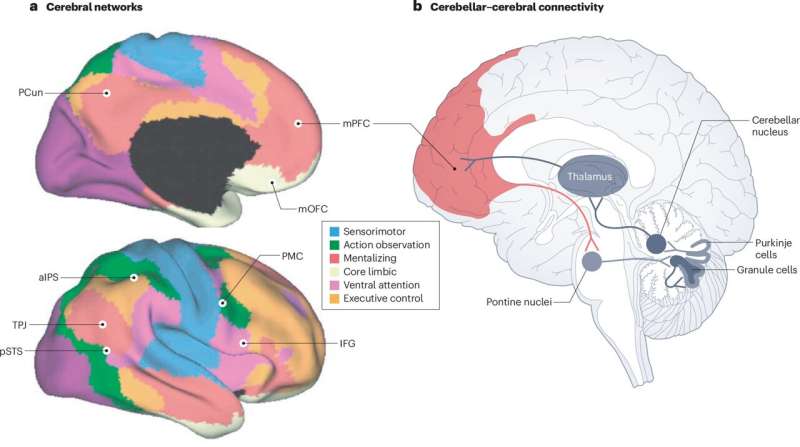
Cerebral networks and reciprocal connectivity between the cerebellum and cerebrum, supporting social and emotional learning. Credit: Nature Reviews Neuroscience (2024).

A recent publication in Nature Reviews Neuroscience sheds light on the often-overlooked role of the cerebellum in both motor and social-cognitive processes.

New research has shown that Alzheimer’s disease impacts the brain in two primary phases: an early, gradual phase that damages select cell types and a late phase marked by rapid, widespread damage as symptoms emerge.

Playing video games may boost your cognitive abilities and exercise can improve your mental health, but not the other way around, a large-scale study has found.

A large meta-analysis of over 600,000 people shows that experiencing loneliness significantly raises the risk of developing dementia by 31%. Researchers found that loneliness is a key factor in cognitive decline, contributing to conditions like Alzheimer’s disease, regardless of age or sex.

Researchers have found that senescent cells—non-dividing “zombie” cells—accumulate in the skin as people age and may influence aging in other parts of the body.

A new study reveals that visual clutter alters how information flows between neurons in the brain’s primary visual cortex, but not the order in which it’s processed. Researchers found that the efficiency of information transfer changes depending on the location of clutter in the visual field.

An innovative study, published in Nature Communications, reveals the mechanism behind two seemingly contradictory effects of fear memories: the inability to forget yet the difficulty to recall.

After only one to three days of a whiplash injury, scientists can predict which patients will develop chronic pain based on the extent of cross “talk” between two regions of the brain, and the person’s anxiety level after the injury, according to a new Northwestern Medicine study.

Women who began an aerobic exercise program during chemotherapy for breast cancer reported improved cognitive function and quality of life compared to those who received standard care. 

A new study reveals that setting reminders can eliminate some age-related declines in memory. The findings offer a significant breakthrough in addressing the cognitive challenges faced by older adults, particularly in the context of prospective memory, which is the ability to remember to perform an intended action at the right moment, like taking medication or attending appointments.

Concussion researchers have recognized a new concussion sign that could identify up to 33% of undiagnosed concussions. 

In a study published in the journal Bilingualism: Language and Cognition, Concordia researchers use neuroimaging methods to examine brain resilience in regions of the brain linked to language and aging. They found that the hippocampus in bilinguals with Alzheimer’s disease was noticeably larger than those who were monolingual when matched for age, education, cognitive function and memory.

People in early middle age who have poor sleep quality, including having difficulty falling or staying asleep, have more signs of poor brain health in late middle age, according to a recent study.

New research shows that prolonged mental exertion weakens connectivity between the brain’s frontal and parietal lobes, impacting cognitive efficiency. However, the brain has built-in compensatory mechanisms that adjust neural connections to preserve function under fatigue.

Finally this week, cannabis use may lead to thinning of the cerebral cortex in adolescents, according to a recent study published in The Journal of Neuroscience.


Your brain on cannabis

A recent article in the Irish Times exploring how a new, highly potent strain of cannabis now being grown in Ireland is more harmful than the drug’s benign image would suggest, prompted me to write about the topic this week.

Marijuana can hurt you

The marijuana problem is much bigger than previously recognized. It is the most widely used illicit drug in the world. Of the 5.6 million people suffering in the US, 62% are using marijuana and young people – some now as young as 12 years of age – represent 23% of the suffering population. The average age of initiation is decreasing while marijuana’s potency is increasing. With increasing potency and earlier use, marijuana poses a significant threat. It is no surprise then that of all teens in drug treatment, 62% have primary marijuana diagnosis. That number represents more young people in treatment than for alcohol and almost equal to the numbers from criminal justice and other sources

Route of administration

Marijuana (from the Mexican Spanish marihuana) also known as cannabis, is much more powerful today than it was 30 years ago. Marijuana is the herbal form of cannabis, and comprises the flowers, leaves and stalks of the mature female plant while hashish is the resinous, concentrated form of cannabis. Chemically, the major psychoactive compound in marijuana is Delta-9-tetrahydrocannabinol (Δ9-THC); it is one of 400 compounds in the plant The smoke also contains more than 150 other types of these cannabinoids such as cannabidiol (CBD), cannabinol (CBN), and tetrhydrocannabivarin (THCV), which can produce sensory effects unlike the psychoactive effects of THC. The pharmacology of marijuana is complex. The cannabinoids are vaporized (smoke) and then deeply inhaled. They are fatty compounds which rapidly cross from the lungs into the blood and tend to accumulate in specific regions of brain.

The psychological effects of marijuana – a Pandora’s Box

The immediate (acute) effects of marijuana include changes in time-sense, a loss of recent memory and impairment in attention. There is also a general difficulty expressing simple thoughts in words. Other effects include impaired motor skills, increase in hunger, nausea, dizziness, and  – depending on the personality of the person and the context in which it is taken – altered moods such as euphoria, a state of relaxation, panic, anxiety, tension, anger, confusion and – especially when eaten – an unpleasant sensation called depersonalization.

The effects on your body are not good either

Marijuana smoke contains more than 150 compounds many of which are cancer–causing so the respiratory system including the lungs suffer the most. Common symptoms include air obstruction, chronic cough, bronchitis, decreased tolerance to exercise and cancer. An increase in heart rate can aggravate existing cardiac conditions or high blood pressure (hypertension) – so don’t take this drug if you have a weak heart.

Definitely not good for your MOJO

Marijuana decreases blood testosterone levels, sperm count and motility. It also decreases sex-drive (libido) and impairs fertility as well as disrupting the female reproductive system which can impact pregnancy in adverse ways. The effect of the drug on the immune system is still unclear but recent studies in animals demonstrate that it impairs T helper cells – key cells in the immune system – which may increase the risk of cancer (by disrupting the cancer surveillance system).

In Part Two of Your Brain On Cannabis, we will take a closer look at the effects of marijuana on your brain, how the drug affects how you learn, how to counter the argument that it is a harmless drug, and if there is any scientific basis for using marijuana as medicine.

Weekly Round Up

Image Source: The Dana Foundation

Our senses of sight and hearing work closely together, perhaps more than people realize, a new UCLA psychology study shows.

A team of neurobiologists  has shown for the first time that cortex, the largest area of the brain that is typically associated with higher functions such as perception and cognition, is also a prominent site of emotional learning.

Tiny electric currents applied across regions of the brain can improve hand movements in recovering stroke patients for a short period, an Oxford University study has demonstrated.

For the first time, scientists have proven that cannabis harms the brain. But the same study challenges previously-held assumptions about use of the drug, showing that some brain irregularities predate drug use.

How might keeping patients awake during surgery lead to the more successful removal of brain tumours? James Keidel, in his shortlisted entry for the 2011 Wellcome Trust Science Writing Prize, explains.

Researchers from the University of Bristol have discovered that a chemical compound in the brain can weaken the synaptic connections between neurons in a region of the brain important for the formation of long-term memories. The findings, published in the Journal of Neuroscience, may also provide a potential explanation for the loss of memory associated with Alzheimer’s.