Is the mind modular?

Mind – n. the human consciousness that originates in the brain and is manifested especially in thought, perception, emotion, will, memory, and imagination. 

Architecture of the human mind

No robot can solve a crossword, or engage in a conversation, with anything like the facility the average human being can. Somehow or other we humans are capable of performing complex cognitive tasks with minimal effort. Trying to understand how this could be is the central explanatory problem of the discipline known as cognitive psychology. There is an old but ongoing debate among cognitive psychologists concerning the architecture of the human mind. 

The ‘general-purpose problem-solver’ mind

According to one view the human mind is a’ general-purpose problem-solver’. This means that the mind contains a general set of problem-solving skills or ‘general intelligence’ which it applies to an infinitely large number of different tasks. So the same set of cognitive capacities is employed, whether you are trying to count marbles, deciding what movie to see, or learning a foreign language – these tasks represent different applications of the human’s general intelligence.

The modular mind

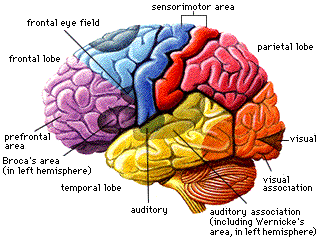
A rival view argues that the human mind contains a number of subsystems or modules – each of which is designed to perform a very limited number of tasks and cannot do anything else. This is known as the modularity of mind hypothesis. So for example it is widely believed that there is special module for learning a language – a view deriving from the linguist Noam Chomsky. Chomsky insisted that a child does not learn to speak by overhearing adult conversation and then using ‘general intelligence’ to figure out the rules of the language being spoken; rather there is a distinct neuronal circuit – a module – which specialises in language acquisition in every human child which operates automatically and whose sole function is to enable that child to learn a language, given appropriate prompting. The fact that even those with very low ‘general intelligence’ can often learn to speak perfectly well strengthens this view.

Clues from the broken brain

Some of the most compelling evidence for the modularity of mind hypothesis comes from studies of patients with brain damage. If the human mind were a general all-purpose problem-solver we would expect damage to the brain to affect all cognitive capacities more or less equally. But this is not what we find. On the contrary, brain damage often impairs some cognitive capacities but leaves other untouched. A good example of this is damage to a part of the brain known as Wernicke’s area – following injury or viral infection – which leaves a patient unable to understand speech although they are still able to produce fluent, grammatical sentences. This strongly suggests that there are separate modules for sentence production and comprehension. Other brain-damaged patients lose their long-term memory (amnesia) but their short-term memory and their ability to speak and understand are entirely unimpaired.

Modular or ‘general purpose problem-solver’ …or both?

The evidence for a modular mind is compelling and the philosopher Jerry Fodor published a book in 1983 titled The Modularity of Mind  which explained exactly what a module is. However the modular view is controversial and is not endorsed by all philosophers. Opponents argue that even in a general purpose problem-solver brain it is still possible that distinct cognitive capacities might be differently affected by brain damage. Fodor himself even admits that the answer may not be all that clear cut and suggests that while perception and language are modular, thinking and reasoning are almost certainly not – we solve some cognitive tasks using specialised modules and others using our ‘general intelligence’. However not all psychologists agree with this. 

Is the mind scientifically inexplicable?

Exactly how many modules there are and precisely what they do, are questions that cannot be answered given the current state of brain research. Most neuroscientists equate mind and brain as one and the same thing and predict that in the not-too-distant future neuroscience will deliver a radically different type of brain science, with radically different explanatory techniques what will explain the architecture of the human mind.


 

Weekly Round Up

Pathways within the brain can be strengthened by reading and language exposure

 Recent research shows that reading  boosts brain pathways and can actually affect understanding in nearly all school subjects – a great reason to encourage the reading habit in your children.

Scientists at the University of Michigan Health System have demonstrated how memory circuits in the brain refine themselves in a living organism through two distinct types of competition between cells. Their results, published  in Neuron, mark a step forward in the search for the causes of neurological disorders associated with abnormal brain circuits, such as Alzheimer’s disease, autism and schizophrenia.

The left and right halves of the brain have separate stores for working memory, the information we actively keep in mind, suggests a study published online yesterday by the Proceedings of the National Academy of Sciences.

Over time, and with enough Internet usage, the structure of our brains can actually physically change, according to a new study.

Bringing the real world into the brain scanner, researchers at The University of Western Ontario from The Centre for Brain and Mind can now determine the action a person was planning, mere moments before that action is actually executed.

And finally good news at last for coffee addicts.For years we’ve been told that caffeinated coffee was bad for us. It’s unhealthy and addictive, doctors warned. But as vindication for all who stuck by their energizing elixir, a new study published early online in the Journal of Alzheimer’s Disease,  shows that guzzling caffeinated coffee may actually be good for our brains. In fact, it may help keep Alzheimer’s at bay.  So enjoy that cuppa joe!

Weekly Round Up

Are teenage brains wired to predict the next big music hit?

The brain is constantly changing as it perceives the outside world, processing and learning about everything it encounters. In a new study, which will be published in an upcoming issue of Psychological Science, scientists find a surprising connection between two types of perception: If you’re looking at a group of objects and getting a general sense of them, it’s difficult for your brain to learn relationships between the objects.

Recent research published in the Journal of Consumer Psychology.suggests that the activity in teen brains may have some Nostradamus-like qualities when it comes to predicting the hits or misses of popular music.

Fear burns memories into our brain, and new research by University of California, Berkeley neuroscientists explains how in findings that have implications for the treatment of PTSD.

Ands speaking of memory…have you forgotten where you put your keys recently? Your brain might be in a better state to recall where you put them at some times than at others, according to new research from UC Davis.

The Empathic Brain

Empathy is a powerful interpersonal tool which is under-valued in our society.  Ineed it is a skill that is frequently underutilised. Perhaps this is in part due to the misconception that em-pathetic somehow implies pathetic? It is often confused with sympathetic, but while empathy denotes a deep emotional understanding of another’s feelings or problems, sympathy is more general and can apply to small annoyances or setbacks.

In Deep Brain Learning: Pathways to Potential with Challenging Youth, Brendtro, Mitchell, and McCall summarize empathy as follows:

Empathy is the foundation of moral development and pro-social behavior. The original word began in the German language as Einfuhlung which is literally translated as feeling into. Empathy taps the ability of mirror neurons to display in our own brain the emotions, thoughts, and motives of another. Empathy allows us to share anothers joy and pain and motivates care and concern.

Stephen Covey writes in his book, ‘The 7 Habits of Highly Effective People’

Empathetic listening is so powerful because it gives you accurate data to work with.  Instead of projecting your own autobiography and assuming thoughts, feelings, motives and interpretation, you are dealing with the reality inside the other person’s head.

Empathy allows us to not only  interact with each other effectively, but
also to predict the actions, intentions, and feelings of others. A useful trait indeed. But is empathy something that we can cultivate or is it more innate? Are we hard wired for empathy?

Despite the advances in our understanding of neuroplasticity, research on the empathic brain is still in its early stages. In recent years, the field of social neuroscience has begun to shed light on the neural underpinnings of empathy.

In an interesting review paper,”The Social Neuroscience of Empathy“, Tania Singer and Claus Lamm of the University of Zurich,  give an overview of this research, and provide recommendations for future research. If you are interested in learning more, you can download a pdf copy by clicking here.

You might also like:

The Neuroscience of Emotions

You mi

Treatment expectation will boost or reduce drug efficacy

If you read my post yesterday on the neuroscience of success, you will have read of the unbeatable combination of optimism tempered with reality. Having written that post, it was fascinating today to read a paper in the current edition of Science Translational Medicine, which shows that a patient’s belief that a drug will not work can indeed become a self-fulfilling prophecy.

Researchers from Oxford University identified the regions of the brain which are affected in an experiment where they applied heat to the legs of 22 patients, who were asked to report the level of pain on a scale of one to 100. The patients were also attached to an intravenous drip so drugs could be administered secretly.

The initial average pain rating was 66. Patients were then given a potent painkiller, remifentanil, without their knowledge and the pain score went down to 55.

They were then told they were being given a painkiller and the score went down to 39.

Then, without changing the dose, the patients were then told the painkiller had been withdrawn and to expect pain, and the score went up to 64.

So even though the patients were being given remifentanil, they were reporting the same level of pain as when they were getting no drugs at all.

Brain scans during the experiment also showed which regions of the brain were affected. The expectation of positive treatment was associated with activity in the cingulo-frontal and subcortical brain areas while the negative expectation led to increased activity in the hippocampus and the medial frontal cortex.

The limbic system comprises several cortical and subcortical brain areas that are interconnected. This system essentially controls emotions, and the autonomic and endocrine responses associated with emotions. The hippocampus also belongs to the limbic system and plays an important role in long-term memory. Activity in the medial frontal cortex predicts learning from errors.

This latest research could have important consequences for patient care and for testing new drugs. Negative expectations about a drug can reduce its efficacy quite significantly, as indeed positive expectation can boost its efficacy. So it seems, that once more, a positive attitude holds the key to another area of success!

Weekly Update

People’s brains are more responsive to friends than to strangers, even if the stranger has more in common, according to a study in the Oct. 13 issue of The Journal of Neuroscience.

In Time magazine’s What Your Brain Looks Like After 20 Years of Marriage, Belinda Luscomb has been taking a look at the neuroscience of love.

And speaking of love, new research has also found that falling in love only takes about a fifth of a second!

And what exactly is going on in your brain if you are looking back with nostalgia at past loves? I came across a fascinating article on the neuroscience of nostalgia and memories.

Now a question for you? How many of you feel you have lost the art of writing by hand, now that we are all so computer literate these days?  Associate professor Anne Mangen at the University of Stavanger’s Reading Centre asks if something is lost in switching from book to computer screen, and from pen to keyboard and discovers that writing by hand does indeed strengthen the learning process.

Exercise doesn’t just make you fitter – it makes you smarter too!

Exercise is important in keeping your heart and lungs healthy. We know for decades that the effort required in exercise allows life-giving oxygen to travel quicker and in greater amounts to all the tissues of the body – allowing the cells in them to grow and divide. A noticeable exception to this rule is the brain.

Neurons are different

Nerve cells or neurons are notoriously bad at dividing. Rather than divide, a neuron survives by making up to 10,000 connections to neighbouring neurons – and this is the key to how we learn and recall as memories are created and strengthened.  This compromise works well for the first four decades of life however by your 50’s a gradual loss of neurons and their connections starts to take it toll resulting in a noticeable reduction in cognition as we find it harder to remember, especially recent events. 

An unexpected finding

Recent scientific findings from Columbia University show that exercise is important in helping to reverse this age-related loss of neurons. In this study in a small group of middle-aged people, exercising just an hour a day, four times a week, for three months triggers the growth of new neurons – a feat which has previously proved almost impossible for neuroscientists to achieve using drugs. Neuroscientists are still working out the possible reasons why simple exercise is so powerful at triggering the birth of neurons but a clue may be that the brain is very well supplied by blood vessels needed to deliver the food and oxygen to help make and maintain the trillions of synapses in the brain. In fact the brain is one of the most oxygen-sensitive organs of the body. It receives 20% of the cardiac output and accounts for about 25% of overall resting oxygen consumption. In addition, the brain as a highly vascular organ is very sensitive to changes in blood perfusion. It seems the extra increase in blood perfusion and life-giving oxygen associated with exercise may invigorate the brain to such a degree that it starts to actually grow new neurons again.

Exercise is as important as drugs

The finding that exercise triggers the brain to grow new nerve cells is a truly stunning discovery that will have implications for public healthcare policies for an increasingly ageing population. In addition, new treatments for brain illness such as Alzheimer’s disease and head injury may involve a combination of different therapies such as medication, psychological therapies, social support, self-help techniques and now, most importantly exercise. This combined approach will treat the person as a whole, and marks the beginning of the journey back to wellness and a normal life.

So the message is simple –if you want to stay smart just get out there and exercise.

How to increase serotonin in the brain without drugs

Aerobic exercise has been shown to elevate mood

As a follow-on to my last post on depression, I would like to direct you to an article I have stumbled upon from the Journal of Psychiatry and Neuroscience (1) published in 2007.

Its primary focus is on individuals with a serotonin-related susceptibility to depression, and nonpharmacologic methods of increasing serotonin to prevent depression in those with such a susceptibility.

Nonpharmacologic methods of raising brain serotonin may not only improve mood and social functioning of healthy people — a worthwhile objective even without additional considerations — but would also make it possible to test the idea that increases in brain serotonin may help protect against the onset of various mental and physical disorders.

The article discusses four possible strategies that are worth further investigation:

1. Altering Thought Patterns

The idea that alterations in thought, either self-induced or due to psychotherapy, can alter brain metabolism is not new. Numerous studies have demonstrated changes in blood flow in such circumstances. However, reports related to specific transmitters are much less common. In one recent study, meditation was reported to increase release of dopamine.The study by Perreau-Linck and colleagues (2) is the first to report that self-induced changes in mood can influence serotonin synthesis.

2. Exposure to Bright Light

Bright light is, of course, a standard treatment for seasonal depression, but a few studies also suggest that it is an effective treatment for nonseasonal depression and also reduces depressed mood in women with premenstrual dysphoric disorder and in pregnant women suffering from depression.

3. Exercise

A third strategy that may raise brain serotonin is exercise. A comprehensive review of the relation between exercise and mood concluded that antidepressant and anxiolytic effects have been clearly demonstrated.

4. Diet

According to some evidence, tryptophan, which increases brain serotonin  is an effective antidepressant in mild-to-moderate depression. Further, in healthy people with high trait irritability, it increases agreeableness, decreases quarrelsomeness and improves mood. However, the idea, common in popular culture, that a high-protein food such as turkey will raise brain tryptophan and serotonin is, unfortunately, false. Another popular myth that is widespread on the Internet is that bananas improve mood because of their serotonin content. Although it is true that bananas contain serotonin, it does not cross the blood–brain barrier.

To read this article in full please click here.

1. J Psychiatry Neurosci. 2007 November; 32(6): 394–399.

2. Perreau-Linck E, Beauregard M, Gravel P, et al. In vivo measurements of brain trapping of α-[11C]methyl-L-tryptophan during acute changes in mood states. J Psychiatry Neurosci 2007;32:430-4.