Tag: brain
Digital Stress and Your Brain (Infographic)
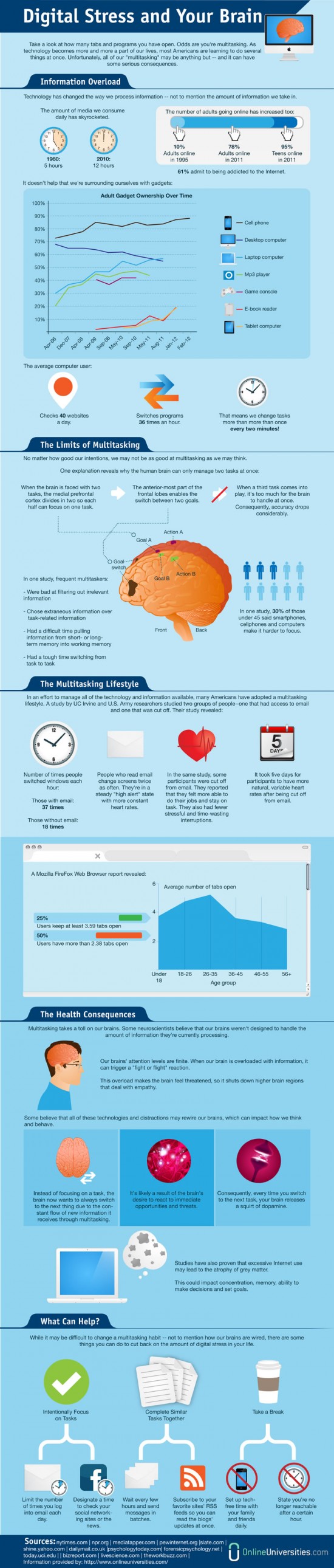
Source: wwww.onlineuniversities.com
Neuroscience and Cognitive Training
Know Your Neurons

Different Types of Neurons A. Purkinje cell B. Granule cell C. Motor neuron D. Tripolar neuron E. Pyramidal Cell F. Chandelier cell G. Spindle neuron H. Stellate cell (Credit: Ferris Jabr; based on reconstructions and drawings by Cajal)
The Know Your Neurons series on the Scientific American website features some great information on the discovery and naming of neurons, alongside some terrific historical images.

Human hippocampus stained with Golgi’s method (Credit: Wikimedia Commons)

Cajal’s drawing of Purkinje cells and granule cells in a pigeon’s brain (Credit: Wikimedia Commons)
This is your brain on Twitter
See what David J. Linden, Professor in the Department of Neuroscience at the Johns Hopkins University School of Medicine has to say about how digital media activates the pleasure circuits in our brain.
Inside the brain in your gut
Did you know you have functioning neurons in your intestines – about a hundred millions of them?
In this TED talk, food scientist Heribert Watzke tells us about the “hidden brain” in our gut and the surprising things it makes us feel.
Weekly Round Up

The secret world of dreams could soon be cracked open. Innovative neuroscientists have already begun to figure out the thoughts of awake people– now, a team reckon they can use similar methods to tap into dreams.
We already know that “mirror therapy” – visual feedback from mirrors – has been shown to reduce some kinds of chronic pain, notably the pain felt in “phantom limbs” of amputees. Preliminary results from a new study, described November 12 at the annual meeting of the Society for Neuroscience, suggests mirror therapy may offer a may offer a powerful and inexpensive way to fight persistent arthritis pain.
Brain scans have revealed the workings of the brain’s GPS that underpin our decisions as we navigate towards a destination.
A team of researchers co-led by the University of Pennsylvania has developed and tested a new high-resolution, ultra-thin device capable of recording brain activity from the cortical surface without having to use penetrating electrodes. The device could make possible a whole new generation of brain-computer interfaces for treating neurological and psychiatric illness and research.
How you think about pain can have a major impact on how it feels. That’s the intriguing conclusion neuroscientists are reaching as scanning technologies let them see how the brain processes pain.
Fourteen-year-olds who were frequent video gamers had more gray matter in the rewards center of the brain than peers who didn’t play video games as much – suggesting that gaming may be correlated to changes in the brain, much as addictions are.
Why do we have brains?
Neuroscientist Daniel Wolpert starts from a surprising premise: the brain evolved, not to think or feel, but to control movement. In this entertaining, data-rich talk he gives us a glimpse into how the brain creates the grace and agility of human motion.
What is dopamine?
Dopamine is a neurotransmitter that helps control the brain’s reward and pleasure centers. Dopamine also helps regulate movement and emotional responses, and it enables us not only to see rewards, but to take action to move toward them.
Dopamine deficiency results in Parkinson’s Disease, and people with low dopamine activity may be more prone to addiction. Most abused drugs cause the release of dopamine and this is thought to contribute to their addictive properties.
This video describes some of the cognitive functions of dopamine in your brain.
Opening a window into the movies in our minds
In research, that brings to mind the movie Minority Report, a group of neuroscientists have found a way to see through another person’s eyes.
By reconstructing YouTube videos from viewers’ brain activity, researchers from UC Berkeley, have, in the words of Professor Jack Gallant, opened ” a window into the movies in our minds.”
Gallant’s coauthors of the study, published in Current Biology, watched YouTube videos inside a magnetic resonance imaging machine for several hours at a time. The team then used the brain imaging data to develop a computer model that matched features of the videos — like colors, shapes and movements — with patterns of brain activity. Subtle changes in blood flow to visual areas of the brain, measured by functional MRI, predicted what was on the screen at the time.
Lead author, Shinji Nishimoto, said the results of the study shed light on how the brain understands and processes visual experiences. The next line of research is to investigate if the technology could one day allow people who are paralyzed to control their environment by imagining sequences of movements.
 inside-the-brain.com