Weekly Neuroscience Update

autism-men-neuroimaging

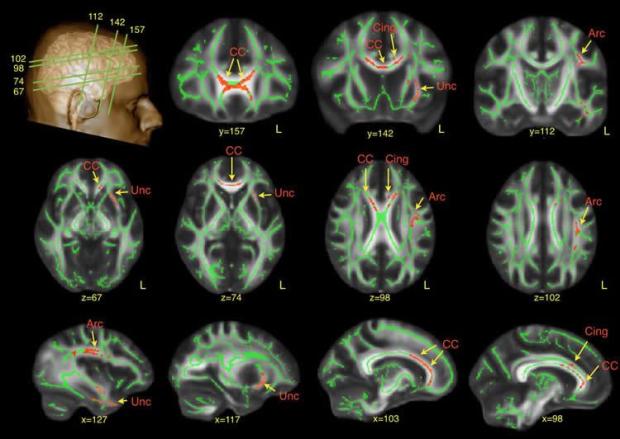
Red regions indicate reduced fractional anisotropy values in autism spectrum disorder (ASD). Credit: The researchers/King’s College London.

Research at King’s College London has revealed subtle brain differences in adult males with autism spectrum disorder (ASD), which may go some way towards explaining why symptoms persist into adulthood in some people with the disorder.

Women who take estrogen supplements from before or at the start of menopause and continue with them for a few years have better preserved brain structure, which may reduce the risk of dementia.

Scientists have taken a significant step toward understanding the cause of schizophrenia, in a landmark study that provides the first rigorously tested insight into the biology behind any common psychiatric disorder.

Stopping disruptions in cellular “trash removal” brought on by errors in molecular marks on DNA may guard against neurodegenerative diseases like Parkinson’s.

Roughly twenty years before the first symptoms of Alzheimer’s disease appear, inflammatory changes in the brain can be seen, according to a new study from Karolinska Institutet published in the medical scientific journal Brain.

In a new study, researchers reveal how brain scans could be used to identify children at high risk for later-life depression – information that could pave the way for early intervention and prevention.

Researchers have shown that graphene can be used to make electrodes that can be implanted in the brain, which could potentially be used to restore sensory functions for amputee or paralysed patients, or for individuals with motor disorders such as Parkinson’s disease.

A new study has linked stress and anxiety to the same neurocircuitry in the brain as depression and dementia.

Different regions of our brain need to work simultaneously in order for us to process emotion. But according to new research, such regions are disconnected among individuals who experience multiple episodes of major depression.

A team of international researchers have announced the discovery of a system in the brain that may underlie the development of involuntary vocalizations (commonly called vocal tics) that often occur in people with Tourette syndrome.

A new study sheds light on multiple sclerosis (MS), specifically damage in the brain caused by the disease that may explain the slow and continuous cognitive decline that many patients experience. The findings, which appear in the Journal of Neuroscience, show that the brain’s immune system is responsible for disrupting communication between nerve cells, even in parts of the brain that are not normally considered to be primary targets of the disease.

Cognitive function and health appear to be genetically linked, according to research published in Molecular Psychiatry. The study was carried out by an international team from the US, the UK and Germany.

Researchers have discovered the mechanics of how dopamine transports into and out of brain cells, a finding that could someday lead to more effective treatment of drug addictions and neurological disorders such as Parkinson’s disease.

The brains of children who are obese function differently from those of children of healthy weight, and exhibit an “imbalance” between food-seeking and food-avoiding behaviors, researchers at Vanderbilt University Medical Center have found.

Finally this week, neuroscientists have now shown that rhythmic brain waves, called theta oscillations, engage and synchronize the brain regions that support the integration of memories. The results were published in the journal Current Biology.

Weekly Neuroscience Update

Brain scans show a correlation between how well participants could make a connection between a new word and a sound, and the gray matter volume in the hippocampus and cerebellum. (Credit: Photo/Qinghua He)

A combination of brain scans and reading tests has revealed that several regions in the brain are responsible for allowing humans to read. The findings open up the possibility that individuals who have difficulty reading may only need additional training for specific parts of the brain — targeted therapies that could more directly address their individual weaknesses.

Children with Asperger’s syndrome show patterns of brain connectivity distinct from those of children with autism, according to a new study. 

Scientists have discovered that the brain circuits we engage when we think about social matters, such as considering other people’s views, or moral issues, inhibit the circuits that we use when we think about inanimate, analytical things, such as working on a physics problem or making sure the numbers add up when we balance our budget. And they say, the same happens the other way around: the analytic brain network inhibits the social network.

Using direct human brain recordings, a research team has identified a new type of cell in the brain that helps people to keep track of their relative location while navigating an unfamiliar environment.

A collaborative team of researchers has uncovered evidence that a specific genetic alteration appears to contribute to disorders of brain development, including schizophrenia. They also found that schizophrenia shares a common biological pathway with Fragile X mental syndrome, a disorder associated with both intellectual impairment and autism.
A team of researchers has identified 18 new genes responsible for driving glioblastoma multiforme, the most common—and most aggressive—form of brain cancer in adults. The study was published August 5, 2013, in Nature Genetics.

Johns Hopkins biophysicists have discovered that full activation of a protein ensemble essential for communication between nerve cells in the brain and spinal cord requires a lot of organized back-and-forth motion of some of the ensemble’s segments. Their research, they say, may reveal multiple sites within the protein ensemble that could be used as drug targets to normalize its activity in such neurological disorders as epilepsy, schizophrenia, Parkinson’s and Alzheimer’s disease.

A sleepless night makes us more likely to reach for doughnuts or pizza than for whole grains and leafy green vegetables, suggests a new study from UC Berkeley that examines the brain regions that control food choices. The findings shed new light on the link between poor sleep and obesity

Where Is Your Brain Taking You (Part II) ?

http://whyriskit.files.wordpress.com/2012/11/2012-10-23-karen-bee.jpgWhat is the point about living our lives?

Today  I want to expand on a previous post – Is there an end point to us becoming more human or the fulfilment of its potential? As a neuroscientist who has studied the origins of learning and memory it has become obvious to me that the more we learn and remember the better we can predict the future.

This question can be now be answered in the context that every single human being on
the planet is unique because they posses a uniquely complex brain. In fact, the brain is so
complex that in all of human history no two brains were the same. Furthermore, this unique
combination of about 100 trillion tiny connections grows and changes through life – a work in progress from conception to death. In this way we each evolve as we journey through life.

Neurodiversity is the key to our success

The term ‘neurodiversity’ has been coined to extend the finding that every single human being is neurologically different, to view those with attention deficit hyperactivity disorder, autism spectrum disorder, Asperger syndrome, dyscalculia, dyslexia, dyspraxia, Tourette syndrome, and others as just another variation of human brain wiring, rather than a disease – and that these differences in brain wiring are authentic forms of communication, self-
expression and being.

Vive la différence!

Rather than focus on the need for a ‘cure’ what we actually need to do is to promote support- systems that allow those who are neurologically different to live their lives as they are, rather than attempting to conform to some clinical ideal – because it is these very individuals that give the rest of us unique insights and solutions by viewing the world in a different way. Take for example Albert Einstein – considered by many to have had Asperger syndrome – who single-handedly worked out the relationship between space and time and went on to model the structure of the universe as a whole.

To bee or not to bee

The advantages of neurodiversity can be seen elsewhere in nature for instance in the thermoregulation in honey bee nests. The temperature in the nest ranges between 32 and 36 degrees. If it is getting warmer the bees ventilate with their wings until the set point is reached again. However in genetically uniform colonies the bees tend to start with ventilation about the same time – causing even greater instability by producing more temperature fluctuations, whereas the nest temperature in genetically diverse colonies is more stable.

Who is in the spotlight?

Despite what some like to think – humankind is not the centre of the world but rather a very actively growing branch of the evolutionary tree. We are not destined to ‘lift ourselves above nature’ – but rather to dramatically raise the intelligence and complexity of this thing we call ‘life’ through our intellectual and spiritual evolution.

So what’s the answer?

The evolution of the human race is not going to proceed by trying to transcend it – rather we will move forward as a race by making room for each and every individual to express their personalities to the full. In this way the evolution of the human race has everything to do with our own personal development.

In short, personality equals evolution.

Weekly Neuroscience Update

Have you ever wondered why some people find it so much easier to stop smoking than others? New research shows that vulnerability to smoking addiction is shaped by our genes. A study from the Montreal Neurological Institute and Hospital — The Neuro, McGill University shows that people with genetically fast nicotine metabolism have a significantly greater brain response to smoking cues than those with slow nicotine metabolism.

When children learn to play a musical instrument, they strengthen a range of auditory skills. Recent studies suggest that these benefits extend all through life, at least for those who continue to be engaged with music. But a study published last month is the first to show that music lessons in childhood may lead to changes in the brain that persist years after the lessons stop.

A team of Australian researchers, led by University of Melbourne has developed a genetic test that is able to predict the risk of developing autism spectrum disorder (ASD).

Recent findings by an international collaboration including IRCM researchers hold new implications for the pathogenesis of myotonic dystrophy.

Researchers at Newcastle University have revealed the mechanism by which neurons, the nerve cells in the brain and other parts of the body, age. The research opens up new avenues of understanding for conditions where the ageing of neurons are known to be responsible, such as dementia and Parkinson’s disease.
Finally, this week…a new study has shown that it’s possible to predict how well people will remember information by monitoring their brain activity while they study.