University of Chichester psychologists have studied prospective memory to accurately diagnose diseases of cognitive impairment. Image: University of Chichester.
Researchers say acting out scenarios may help to improve prospective memory. Poor prospective memory, researchers report, may be an early indicator of Alzheimer’s disease.
A new study using machine learning has identified brain-based dimensions of mental health disorders, an advance towards much-needed biomarkers to more accurately diagnose and treat patients.
A new report examines the effect stress can have on our bodies and general health.
Structural differences in the cerebellum may be linked to some aspects of autism spectrum disorder, according to a neuroimaging study from Columbia University Irving Medical Center (CUIMC).
A new study reports your body fat could be a predictor of cognitive decline.
Researchers reportblind people need additional timing cues to accurately judge relative locations of sounds, but those without visual impairments who were blindfolded could judge the relative location of sounds independently from timing cues.
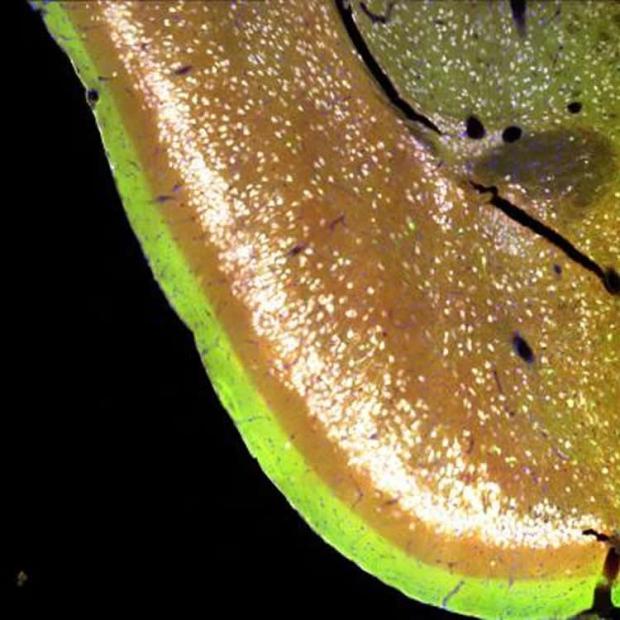
Staining one section of the brain, as shown, reveals layers of the piriform cortex–in green, brownish-red, and white–and other cells of the brain in blue. Image is credited to Salk Institute.
Researchers say the randomness of the piriform cortex plays a critical role when it comes to distinguishing between similar odors.
A new study sheds light into how we recognize facial expressions of emotion. Researchers report our interpretation of emotions expressed facially by others depends upon our pre-conceived understanding of emotion.
Scientists in Israel have developed a breath test that can detect people with early-stage Parkinson’s disease.
A new study, published in the journal PNAS, suggests that a diagnostic blood test for depression may soon be on the horizon. The new research shows that treatment-resistant depression is characterized by reduced blood levels of a specific molecule.
‘Inattentional smell blindness’, or inattentional anosmia, has been proven to exist in a new study.
Yale researchers have tested a new method for directly measuring synaptic loss in individuals with Alzheimer’s disease. The method, which uses PET imaging technology to scan for a specific protein in the brain linked to synapses, has the potential to accelerate research for new Alzheimer’s treatments.
A recent study finds that noninvasive brain stimulation, activated while asleep, improves memory performance the next day.
Finally this week, researchers have identified a neural linkbetween depression and sleep problems. The study reports brain regions associated with short-term memory, self and negative emotions are strongly connected in those with depression, and this may lead to bad sleep quality.
Researchers report the brain’s reward network could play an influential role in evaluating the opportunity to gain new information, just as it does to evaluate rewards such as food or financial gain.
Scientists are beginning to understand the neuroscience behind sensory processing disorder and are developing new therapies to help those with it.
A new study shows Alzheimer’s disease does not appear to affect the salience network. Researchers found, when listening to music, the salience network along with other networks, show higher functional connectivity in Alzheimer’s patients.
A new study reveals maternal diet during pregnancy can have implications for fetal brain development and can impact short-term memory in adults.
Scientists have uncovered dozens of genes that increase the risk of depression — a major finding that underscores the complexity of the disease and reveals why antidepressant therapies work well for some people but are utterly ineffective for others.
Researchers report the critical period of language learning may be longer than previously believed. A new study reveals children remain skilled at learning new languages until age 18.
Treatment for the most common mental health problems could be ineffective or even detrimental to about 50 percent of the population, according to a radical new model of emotion in the brain.
Finally this week, researchers report high sugar and fat based diets that lead to obesity, coupled with the normal aging process, may increase the risk of Alzheimer’s disease.
A new studyreports people who sit down too much during middle to older age show signs of thinning in the medial temporal cortex, an area of the brain associated with the formation of new memories.
Researchers explore the neuroscience behind binge eating and the triggers that might make us reach for comfort foods.
According to a new study, children with executive function deficits were more likely to show physical and reactive aggression later in life. Researchers suggest helping children to improve executive function could help to reduce aggression levels.
Olfactory system neurons appear to play a role in the connection between rhythmic breathing and emotional regulation, researchers report.
Researchers report newly identified risk factors differ from currently known genetic causes of autism. The variants identified do not alter the genes directly, but disrupt the neighboring DNA control elements that turn genes on or off. Additionally, the variants do not occur as new mutations in autistic children, but are inherited from parents.
A new study reveals we quickly process opinions we agree with as facts, even if the opinion is non-factual.
New research implicates the hippocampus in conceptual memory formation. The study reveals activity within the hippocampus and ventromedial prefrontal cortex is consistent with the retrieval of new concepts.
Researchers report the later a women enters into natural menopause, the better, on average, her verbal memory is later in life.
A new study adds to growing evidence that early exposure to pollution can increase both suicide risks in younger people and Alzheimer’s disease as people age.
Finally this week, new research reveals specific parts of the hippocampus may play a key role in emotional regulation.
An astrocyte (green) interacts with a synapse (red), producing an optical signal (yellow). NeuroscienceNews.com image is credited to UCLA/Khakh lab.
Researchers have developed a new method that allows them to see how astrocytes influence neural communication in real time.
The chronic neurodegenerative Parkinson’s disease affects an increasing number of people. However, scientists still do not know why some people develop Parkinson’s disease. Now researchers have taken an important steptowards a better understanding of the disease.
Researchers have published a new research framework that defines Alzheimer’s disease by brain changes, not symptoms.
The risk of dementia, including Alzheimer’s, was significantly higher in people who had experienced a traumatic brain injury (TBI) than with people who had no history of TBI, according to one of the largest studies to date on that association.
A new voice manipulation algorithm allows researchers to visualize the neural codes people use to judge others by the tone of their voices.
UCLA researchers have developed a way to use brain scans and machine learning — a form of artificial intelligence — to predict whether people with OCD will benefit from cognitive behavior therapy. The technique could help improve the overall success rate of cognitive behavioral therapy, and it could enable therapists to tailor treatment to each patient.
Researchers report synchrony of brain waves within three regions of the brain can ‘break down’ when visual working memory load becomes too extensive to handle.
A new study reveals our brains process weak visual stimuli better in the evenings and mornings than during daylight hours. Researchers say the transition from light to dark has greater influence on visual perception than previously believed.
A new neuroimaging study reveals babies with Fragile X syndrome have less developed white matter in the brain compared to children without the condition.
Finally this week, a new studybuilds on previous findings that demonstrate EEG recordings of the rostral anterior cingulate cortex can predict eventual response to treatments for depression.
A new guideline for medical practitioners says they should recommend twice-weekly exercise to people with mild cognitive impairment to improve memory and thinking.
Researchers reveal Parkinson’s patientshave more copies of mitochondrial DNA in the brain stem, leading to increased cell death within that area.
Musical training may enhance the ability to process speech in noisy settings, a new study shows.
A new study reveals the piriform cortex is able to archive long term memory, but requires instruction from the orbiotfrontal cortex to indicate the event is to be stored as a long-term memory.
Greater muscle strength is associated with better cognitive function in ageing men and women, according to a new Finnish study.
Researchers have discovered a new biomarker that can help diagnose Huntington’s disease. They note the findings could result in the development of treatments to postpone neuron death in those who carry the Huntington’s gene mutation, but who do not currently show symptoms of the disease.
A new study reveals the superior temporal gyrus appears to be critical for voice recognition.
Researchers have identified several new genes responsible for Alzheimer’s disease (AD) including those leading to functional and structural changes in the brain and elevated levels of AD proteins in cerebrospinal fluid (CSF).
Finally this week, a new study adds to evidence that current clinical tools can fail to capture autism presentations in females.
Contrary to a popular theory, researchers have discovered the brain remains connected during non-REM sleep. The study reports not all forms of communication within the cerebral cortex are disrupted during this sleep phase.
UCLA neuroscientists are the first to show that rhythmic waves in the brain called theta oscillations happen more often when someone is navigating an unfamiliar environment, and that the more quickly a person moves, the more theta oscillations take place — presumably to process incoming information faster.
Researchers have identified a brain network that allows the brain to record memories of new places.
A new study reveals deep brain stimulation not only improves motor function, but can also increase survival rates for those with Parkinson’s disease.
A build up of urea in the brain to toxic levels may cause brain damage, eventually leading to dementia, a new study reports.
A new method to measure brain connectivity has found that people with depression have changes in the brain systems involved in memory and reward.
Researchers have developed a single cell sequencing method that can map the cellular origin of a wide variety of neurological and psychiatric disorders.
Finally this week, a new study reveals why some people find it more difficult than others to meet switching demands and change focus as efficiently.
An experimental therapy which involves a face-to-face discussion between a person with schizophrenia and an avatar representing their auditory hallucination may help reduce symptoms, when provided alongside usual treatment, according to a study led by King’s College London and published in The Lancet Psychiatry journal.
Researchers have identified a number of variable locations in the genome that influence hippocampal gene activity and may contribute to brain disorders.
For the first time, scientists have found a connectionbetween abnormalities in how the brain breaks down glucose and the severity of the signature amyloid plaques and tangles in the brain, as well as the onset of eventual outward symptoms, of Alzheimer’s disease.
A new study reports the rhythm of your breathing can influence neural activity that enhances memory recall and emotional judgment.
The amount of close and comforting contact between infants and their caregivers can affect children at the molecular level, an effect detectable four years later, according to new research.
The brain’s auditory system can be shaped by exposure to different auditory environments, such as native language and musical training.
Contrary to a popular theory, a new study has discovered the brain remains connected during non-REM sleep. The study reports not all forms of communication within the cerebral cortex are disrupted during this sleep phase.
Cannabis use in youth is linked to bipolar symptoms in young adults, finds new research.
According to researchers, when shifting attention from one spot to another, the brain blinks. They report these blinks are momentary unconscious gaps in visual perception.
How well we are able to complete simple and complex tasks depends upon the organization of subnetworks in the brain, a new study reports.
Researchers are working to create a neurochip capable of transmitting a signal to healthy brain cells. The neurochip can be used in devices intended to replace damaged parts of the brain.
A new brain mapping study reveals smokers could be predisposed to their addiction due to the molecular make up of their brains.
In a new study, researchers describe a unique model for the biology of Alzheimer’s disease which may lead to an entirely novel approach for treating the disease. The findings appear in the journal Nature Neuroscience.
Scientists hope to have found a new neurobiological marker to help recognise patients with post-traumatic stress disorder (PTSD).
Researchers have identified a mechanism that drives hunger. A new study reports the sight or smell of food can temporarily turn of AgRP neurons, which drive the urge to eat. These neurons remain inactive until the brain receives a signal from the gut that calories have been consumed.
Finally this week, a new study reports that certain brain regions interact more closely, while others are less engaged, in people with higher intelligence.
Sleep-deprived brain cells react more slowly and fire more weakly, and their signals are more drawn out. NeuroscienceNews.com image is credited to UCLA.
A Japanese research group has revealed that elderly people with mild cognitive impairment (MCI) have a particularly weakened ability to memorize human faces in the short term when compared to healthy elderly people. MCI patients also had a different gaze behavior when trying to memorize a face. This research may lead to the early detection of dementia.
Researchers provide new insight into human consciousness, reporting we don’t consciously choose our feelings or thoughts; we simply become aware of them.
If a mother’s immune system is activated by infection during pregnancy, it could result in critical cognitive deficits linked to schizophrenia in her offspring, a new study has revealed.
People on the autism spectrum appear to have different reactions to subliminal social odors, researchers report.
Information from brain MRIs can help identify people with attention deficit hyperactivity disorder (ADHD) and distinguish among subtypes of the condition, according to a study appearing online in the journal Radiology.
Migraine triggers can increase oxidative stress, a new study reports. Targeting oxidative stress may help to prevent migraines.
A new studyreveals how the mechanism for storing olfactory memories differs slightly from erasing unnecessary memories. Understanding how the brain gets rid of unimportant memories could help unlock new avenues of research to better understand memory loss in aging, researchers say.
Finally this week, researchers report a developmental abnormality more prevalent in premature and male babies, may contribute to SIDS risk, in conjunction to the sleep position.
A new study provides the first direct evidence that within each person, smell sensitivity varies over the course of each day. The pattern, according to the data, tracks with the body’s internal day-night cycle, or circadian rhythm.
Researchers have revealed the neural signatures for explicit and implicit learning.
Neuroscientists have discovered precisely where and how to electrically stimulate the human brain to enhance people’s recollection of distinct memories. People with epilepsy who received low-current electrical pulses showed a significant improvement in their ability to recognize specific faces and ignore similar ones.
Adults likely do not develop ADHD, according to new research.
Researchers propose a new theory of memory formation, reporting memory storage does not rely on the strengthening of connection between memory cells, but on the pattern of connections that form within the first few minutes of an event.