Weekly Neuroscience Update

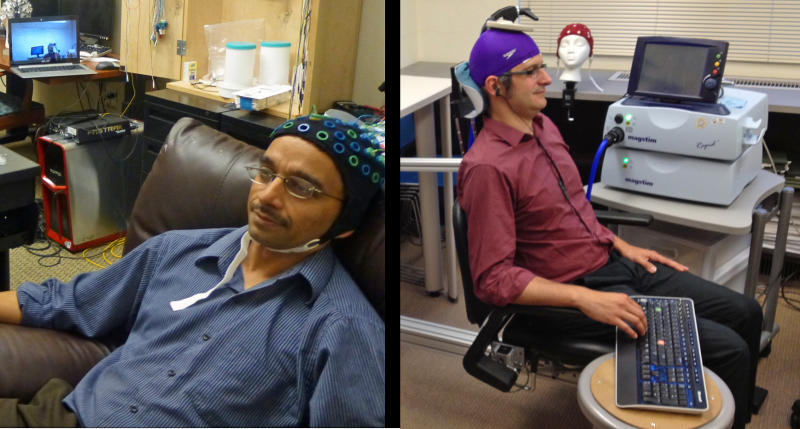
University of Washington University of Washington researcher Rajesh Rao, left, plays a computer game with his mind. Across campus, researcher Andrea Stocco, right, wears a magnetic stimulation coil over the left motor cortex region of his brain. Stocco’s right index finger moved involuntarily to hit the “fire” button as part of the first human brain-to-brain interface demonstration. (Credit: Image courtesy of University of Washington)

University of Washington University of Washington researcher Rajesh Rao, left, plays a computer game with his mind. Across campus, researcher Andrea Stocco, right, wears a magnetic stimulation coil over the left motor cortex region of his brain. Stocco’s right index finger moved involuntarily to hit the “fire” button as part of the first human brain-to-brain interface demonstration. (Credit: Image courtesy of University of Washington)

University of Washington researchers have performed what they believe is the first noninvasive human-to-human brain interface, with one researcher able to send a brain signal via the Internet to control the hand motions of a fellow researcher.

A new study strengthens the link between amyotrophic lateral sclerosis (ALS) and problems in protein production machinery of cells and identifies a possible treatment strategy.

A team of neuroscientists has found a key to the reduction of forgetting. Their findings, which appear in the journal Neuron, show that the better the coordination between two regions of the brain, the less likely we are to forget newly obtained information.

Sleep is well-known to help us better understand what we have learned. But now, researchers believe they have discovered exactly how sleep helps our brains to better learn specific motor tasks, such as typing or playing the piano.

With Magnetic Resonance Imaging (MRI), researchers have identified specific markers in the brain which could help predict whether people with psychosis will respond to antipsychotic medications.

New findings published in the journal Nature show how one component of the brain’s circuitry – inhibitory neurons – behave during critical periods of learning.

Researchers report the first biomarker results reported from the Parkinson’s Progression Markers Initiative (PPMI), showing that a comprehensive test of protein biomarkers in spinal fluid have prognostic and diagnostic value in early stages of Parkinson’s disease. The study is reported in JAMA Neurology.

Death Of Broadcasting Legend Colm Murray

Colm Murray

Colm Murray

I am saddened to hear of the death last night of  the hugely popular RTÉ Sport broadcaster Colm Murray,  who was diagnosed with motor neurone disease three years ago.

In a moving documentary MND – The Inside Track, aired last year on RTE television, the broadcaster said that he wanted to do something “positive”, despite his personal struggle. His doctor, Trinity and Beaumont Professor Orla Hardiman, hailed him for his willingness “to be of service”, and to help find a future cure by partaking in medical trials. “Colm could easily have laid down to the disease and become a victim but he instead became a champion,” she said.

While he admitted at the time that he did not expect to be cured, Colm Murray said that it was his most “fervent wish that the coming years will see giant steps forward in the battle to find a cure”.

“It gives me something to hope for. It’s a faint glimmer of light at the end of a very dark tunnel.”

What is Motor Neurone Disease?

One in 50,000 people will develop the terminal disease, which attacks the central nervous system, and ultimately destroys all muscular function, but what exactly is this disease?

Amyotrophic Lateral Sclerosis (ALS)*,  also known as Motor Neuron Disease,  targets the nerves controlling the muscles of movement including postural muscles eventually disabling those nerves controlling chest breathing. Interestingly nerves regulating the senses, seeing, hearing, touching, tasting and smelling are not affected. Cognition is not affected – dementia is rare.

Incidence

ALS occurs in 2-5 people per 100,000 with slightly more males affected than females. The origin is still a mystery however elite sportsmen and women are disproportionally affected.

The podcast below gives an excellent in-dept explanation of ALS.

http://neuroscene.com/?p=204

*Amyotrophic Lateral Sclerosis 

= lack of:   Myo = muscle; Trophic = nourishment;

Lateral = location in the spinal cord;   Sclerosis = scarring.

Weekly Neuroscience Update

medium_3312316471

Scientists have shown that working as a piano tuner may lead to changes in the structure of the memory and navigation areas of the brain. The study, published in the Journal of Neuroscience, shows that these structural differences correlate with the number of years of experience a piano tuner has accumulated.

An unusual kind of circuit fine-tunes the brain’s control over movement and incoming sensory information, and without relying on conventional nerve pathways, according to a study published in the journal Neuron.

The reason we struggle to recall memories from our early childhood is down to high levels of neuron production during the first years of life, say Canadian researchers.

Researchers have identified mutations in several new genes that might be associated with the development of spontaneously occurring cases of the neurodegenerative disease known as amyotrophic lateral sclerosis, or ALS. Also known as Lou Gehrig’s disease, the progressive, fatal condition, in which the motor neurons that control movement and breathing gradually cease to function, has no cure.

The brains of people with depression show a reduced ability to adapt to their environment, a unique study shows.

Researchers at the Stanford University School of Medicine have found that a naturally occurring protein secreted only in discrete areas of the mammalian brain may act as a Valium-like brake on certain types of epileptic seizures.

photo credit: Chandra Marsono via photopin cc