Weekly Neuroscience Update

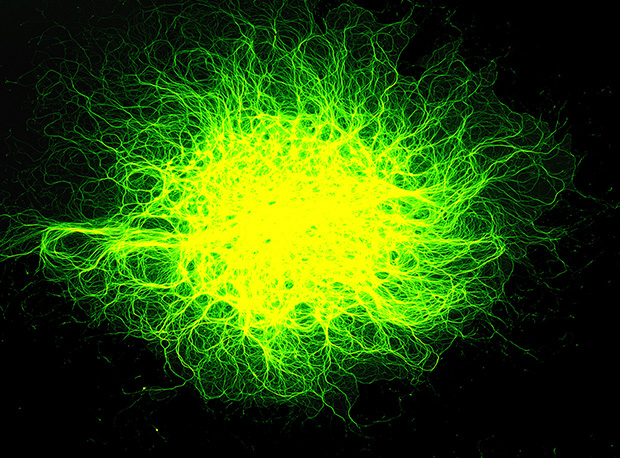
To study how nerve cells respond to injuries in their branches, Washington University researcher Valeria Cavalli grows them in “spots” like the one shown above. Cavalli recently identified a chain reaction that enables repair of these branches when they are cut. Credit Yongcheol Cho/Washington University at St. Louis.

To study how nerve cells respond to injuries in their branches, Washington University researcher Valeria Cavalli grows them in “spots” like the one shown above. Cavalli recently identified a chain reaction that enables repair of these branches when they are cut. Credit Yongcheol Cho/Washington University at St. Louis.

Researchers have identified a chain reaction that triggers the regrowth of some damaged nerve cell branches, a discovery that one day may help improve treatments for nerve injuries that can cause loss of sensation or paralysis.

Groundbreaking research nearly two decades ago linking a mother’s educational background to her children’s literacy and cognitive abilities stands out among decades of social science studies demonstrating the adverse effects of poverty. Now new research has taken that finding in a neuroscientific direction: linking poor processing of auditory information in the adolescent brain to a lower maternal educational background.

A review of new research says there is growing evidence to support the idea that the brain plays a key role in normal glucose regulation and the development of type 2 diabetes.

University of Queensland (UQ) scientists have made a fundamental breakthrough into how the brain decodes the visual world.

Cocaine addicts may become trapped in drug binges not because they are always seeking euphoric highs but rather to avoid emotional lows, says a study in Psychopharmacology.

Researchers have developed a therapeutic at-home gaming program for stroke patients who experience motor weakness affecting 80 percent of survivors.

Learning a musical instrument as a child gives the brain a boost that lasts long into adult life, say scientists.

The birth of new neurons depend upon activation of an important molecular pathway in stem cells, a new Yale School of Medicine study shows.

Researchers have taken a major step towards understanding the causes of Alzheimer’s disease with the largest study yet into the genetics of the disorder.

Light enhances brain activity during a cognitive task even in some people who are totally blind, according to a new study.

Scientists have discovered biological mechanisms that may link Parkinson’s disease to Alzheimer’s disease, according to a study published in the journal Acta Neuropathologica.


How Did Tolerance Kill Cory Monteith?

Corey M

I was saddened this week to read of the coroner’s verdict on the death of Cory Monteith.  The 31-year-old talented actor and performer had been plagued by substance abuse problems long before his Hollywood days and had voluntarily checked himself into rehab in March where he completed a 30-day program.

Heroin and alcohol – a potentially lethal mix

Over the past two decades I have visited high schools and colleges to talk on how addictive drugs including heroin and alcohol affect the brain and it still amazes me how little the general public understand how these potentially lethal drugs work.

The post mortem showed the Cory’s death was due to a combination of heroin and alcohol intake. Both heroin and alcohol have similar effects on the brain. They both elevate mood, lower heart rate and put your brain into a sleepy inattentive state.  Heroin and alcohol are what’s called narcotics (i.e. sleep inducers) and sometimes called nervous system depressants – not to be confused with a depressed mood but relating as to how these drugs act to silence (i.e. depress) activity in the nervous system.  It is no coincidence then that a street name for heroin is dope. Once in the brain, heroin is converted to morphine by enzymes and the morphine binds to opiate receptors in certain areas of the brain. Alcohol in contrast, acts in a less specific way by making neurons ‘leaky’.  Both drugs are highly addictive and to make matters worse, at high enough doses they  both can act as anaesthetics – drugs that switch off important nervous functions in the brain stem – like for instance, respiration (breathing) and it was the combined effect of both of these drugs  in slowing and eventually stopping breathing which was why Cory died.

Many addiction experts were not surprised

It is clear from reading newspaper reports that although Cory Monteith’s friends and loved ones are deeply shocked by the revelations of the inquest many addiction experts were not surprised.  Corey struggled with drugs since he was 13 – so long in fact that his chronic addiction was hardwired into his brain. Thus, 30 days in rehab was not enough time to get to the root cause of the addiction especially if there were any underlying psychiatric issues. Brain rewiring for chronic addiction usually takes between 90 and 120 days to be effective.  Alarm bells should also have rung after he was released from rehab when he went on vacation to Mexico.  A vacation was a huge post-rehab mistake as a structured, supportive environment is so important to grow, maintain and strengthen the new brain connections.

What is tolerance and how did it kill Cory?

Not everyone who takes heroin and alcohol together dies; so what is so special about Cory’s situation? Cory died because of a brain phenomenon called tolerance. When drugs such as heroin are used repeatedly over time, tolerance may develop.  Tolerance occurs when the person no longer responds to the drug in the way that person initially responded.  Stated another way, it takes a higher dose of the drug to achieve the same level of response achieved initially.  So for example, in the case of heroin, morphine and alcohol tolerance develops rapidly to the effects of the drug.  The development of tolerance is not addiction, although many drugs that produce tolerance also have addictive potential.  Tolerance to drugs can be produced by several different mechanisms, but in the case of heroin, morphine and alcohol tolerance develops at the level of biochemical reactions mainly within the liver whereby  enzymes adapt so that the drug can no longer cause changes in brain cell firing. Thus, the effect of a given dose of heroin, morphine and/or alcohol is diminished.

A decrease in tolerance after rehab put Cory’s brain at risk

During the 30 days in rehab Cory’s body gradually rid itself of drugs and tolerance also gradually faded. The reasons why Cory’s death occurred shortly after his release from rehab was because of a large decrease in tolerance that his body experienced after that period of abstinence. Thus, when Cory returned to using, he ran the risk of experiencing a far more extreme reaction to the same drug doses that he was once accustomed to using.

It is particularly sad that our memories of this genuinely loved and popular person may be tarnished by the revelation. I would urge people not to let this be the case, and to remember Corey for his talent and not the sordid nature of his death.

Drug taking as a way of coping

I do think however that Cory’s death might not be in vain if it opens up a debate on how we as a society deal with stress. We have heard that Cory had a history of chronic addiction and we are led to surmise that alcohol and drug taking was his way of coping. In this he is not alone. As the world economy continues on its downward slide, and unemployment and financial worries beset us, are we going to turn more and more to these quick fixes to handle our dis-stress?

Probably the most important lesson to be taken from Cory’s death is the realization that the stresses of life and how we manage them IS the difference between life and death. I look forward to developing this theme in greater detail including drug-free tips on how the avoid worry and stress in future posts, but in the meantime, my deepest sympathy goes to Cory’s loved ones at this difficult time.
Weekly Neuroscience Update

Getting a grip—literally— by clenching your right fist before remembering information and your left when you want to remember it can boost your recall, according to the latest study. This strange trick may work because clenching your hands activates the side of the brain that handles the function— in right-handed people, for instance, the left side of the brain is primarily responsible for encoding information and the right for recalling memory. (If you are left-handed, the opposite applies).

Mathematicians from Queen Mary, University of London will bring researchers one-step closer to understanding how the structure of the brain relates to its function in two recently published studies.

Greater adherence to a Mediterranean diet (MeD) is associated with a lower likelihood of incident cognitive impairment (ICI), especially among those without diabetes, according to a study published in the April 30 issue of Neurology.

The widespread belief that dopamine regulates pleasure could go down in history with the latest research results on the role of this neurotransmitter. Researchers have proved that it regulates motivation, causing individuals to initiate and persevere to obtain something either positive or negative.

Supposedly ‘primitive’ reflexes may involve more sophisticated brain function than previously thought, according to researchers at Imperial College London.

The production of a certain kind of brain cell that had been considered an impediment to healing may actually be needed to staunch bleeding and promote repair after a stroke or head trauma, researchers at Duke Medicine report.

For any addiction, external  cues and stress can trigger  cravings that are hard to resist, and the latest research points to an area of  the brain that might be responsible  for sabotaging recovery.

Weekly Neuroscience Update

Have you ever wondered why some people find it so much easier to stop smoking than others? New research shows that vulnerability to smoking addiction is shaped by our genes. A study from the Montreal Neurological Institute and Hospital — The Neuro, McGill University shows that people with genetically fast nicotine metabolism have a significantly greater brain response to smoking cues than those with slow nicotine metabolism.

When children learn to play a musical instrument, they strengthen a range of auditory skills. Recent studies suggest that these benefits extend all through life, at least for those who continue to be engaged with music. But a study published last month is the first to show that music lessons in childhood may lead to changes in the brain that persist years after the lessons stop.

A team of Australian researchers, led by University of Melbourne has developed a genetic test that is able to predict the risk of developing autism spectrum disorder (ASD).

Recent findings by an international collaboration including IRCM researchers hold new implications for the pathogenesis of myotonic dystrophy.

Researchers at Newcastle University have revealed the mechanism by which neurons, the nerve cells in the brain and other parts of the body, age. The research opens up new avenues of understanding for conditions where the ageing of neurons are known to be responsible, such as dementia and Parkinson’s disease.
Finally, this week…a new study has shown that it’s possible to predict how well people will remember information by monitoring their brain activity while they study.

Neuroscience News

Is Angry Birds keeping your brain healthy?

A new study from the Archives of Neurology says playing brain stimulating games can improve your memory and delay or prevent the onset of Alzheimer’s disease.

A new study suggests hearing metaphors can activate brain regions involved in sensory experience.

Whether you are an athlete, a musician or a stroke patient learning to walk again, practice can make perfect, but more practice may make you more efficient, according to a surprising new University of Colorado Boulder study.

Researchers have found a way to study how our brains assess the behavior – and likely future actions – of others during competitive social interactions. Their study, described in a paper in the Proceedings of the National Academy of Sciences, is the first to use a computational approach to tease out differing patterns of brain activity during these interactions, the researchers report.

A molecular path from our body’s internal clock to cells controlling rest and activity have been revealed.

A new study looks at how our brain processes visual information to prevent collisions.

Can Brain Scans of Young Children Predict Reading Problems?  Brain scientists are studying whether they can predict which young children may struggle with reading, in order to provide early help.

Virtual therapists being developed to treat depression. Scientists at a U.S. university are developing new technologies to treat depression and other disorders — including a mood-detecting smart phone that will call to check up on you.

A new study shows how to boost the power of pain relief without drugs.

Neuroscience could change the face of warfare. Soldiers could have their minds plugged directly into weapons systems, undergo brain scans during recruitment and take courses of neural stimulation to boost their learning, if the armed forces embrace the latest developments in neuroscience to hone the performance of their troops

Brain activity differs when one plays against others. Researchers have found a way to study how our brains assess the behavior – and likely future actions – of others during competitive social interactions. Their study, described in a paper in the Proceedings of the National Academy of Sciences, is the first to use a computational approach to tease out differing patterns of brain activity during these interactions, the researchers report.

Reporting in PLoS Biology, researchers write that they were able to correlate words a person was hearing to specific electrical activity in the brain. Neuroscientist Robert Knight, a co-author of the study, discusses future applications of this research and concerns that it amounts to mental wiretapping.

Brains may be wired for addiction.  Abnormalities in the brain may make some people more likely to become drug addicts, according to scientists at the University of Cambridge.

Patients’ Brains May Adapt to ADHD Medication. New research reveals how the brain appears to adapt to compensate for the effects of long-term ADHD medication, suggesting why ADHD medication is more effective short-term than it is long-term.

A two-year study of high school football players suggests that concussions are likely caused by many hits over time and not from a single blow to the head, as commonly believed.

Weekly Update: Brain Research

Using a sling or cast after injuring an arm may cause your brain to shift quickly to adjust, according to a study published in the January 17, 2012, print issue of Neurology®. The study found increases in the size of brain areas that were compensating for the injured side, and decreases in areas that were not being used due to the cast or sling.

A  new UC Davis study shows how the brain reconfigures its connections to minimize distractions and take best advantage of our knowledge of situations.

Neuroscientists at Kessler Foundation have documented increased cerebral activation in patients with multiple sclerosis (MS) following memory retraining using the modified Story Memory Technique (mSMT).  This is the first study to demonstrate that behavioral interventions can have a positive effect on brain function in people with cognitive disability caused by MS, an important step in validating the clinical utility of cognitive rehabilitation.

A program designed to boost cognition in older adults also increased their openness to new experiences, researchers report, demonstrating for the first time that a non-drug intervention in older adults can change a personality trait once thought to be fixed throughout the lifespan.

Researchers from the Institute of Psychiatry (IoP) at King’s College London have, for the first time, identified the facial expression of anxiety. The facial expression for the emotion of anxiety comprises an environmental scanning look that appears to aid risk assessment. The research was published this week in the Journal of Personality and Social Psychology.

New research from Uppsala University, Sweden, shows that a specific brain region that contributes to a person’s appetite sensation is more activated in response to food images after one night of sleep loss than after one night of normal sleep. Poor sleep habits can therefore affect people’s risk of becoming overweight in the long run. The findings are published in the Journal of Clinical Endocrinology & Metabolism.

Teenagers are more susceptible to developing disorders like addiction and depression, according to a paper published by Pitt researchers Jan. 16 in the Proceedings of the National Academy of Sciences.

Harvard scientists have developed the fullest picture yet of how neurons in the brain interact to reinforce behaviors ranging from learning to drug use, a finding that might open the door to possible breakthroughs in the treatment of addiction.

Virtual reality-enhanced exercise, or “exergames,” combining physical exercise with computer-simulated environments and interactive videogame features, can yield a greater cognitive benefit for older adults than traditional exercise alone, according to a new study published in the February issue of the American Journal of Preventive Medicine.

Sleeping after a traumatic event might lock in bad memories and emotions, a new study has found.

A team of researchers at the MedUni Vienna’s Department of Neurophysiology (Centre for Brain Research) has discovered a previously unknown effect of opioids – that opioids not only temporarily relieve pain, but at the right dose can also erase memory traces of pain in the spinal cord and therefore eliminate a key cause of chronic pain.


What is dopamine?

Dopamine is a neurotransmitter that helps control the brain’s reward and pleasure centers. Dopamine also helps regulate movement and emotional responses, and it enables us not only to see rewards, but to take action to move toward them.

Dopamine deficiency results in Parkinson’s Disease, and people with low dopamine activity may be more prone to addiction. Most abused drugs cause the release of dopamine and this is thought to contribute to their addictive properties.

This video describes some of the cognitive functions of dopamine in your brain.

Weekly Round Up

What can neuroscience teach us about making predictions?

Every day we make thousands of tiny predictions — when the bus will arrive, who is knocking on the door, whether the dropped glass will break. Now, in one of the first studies of its kind, researchers at Washington University in St. Louis are beginning to unravel the process by which the brain makes these everyday prognostications.

Imitation may be the sincerest form of flattery but how do our brains decide when and who we should copy? Researchers from The University of Nottingham have found that the key may lie in an unspoken invitation communicated through eye contact.

Cognitive training can enhance working memory and the release of the neurotransmitter dopamine, according to a study published recently in the journal Science.

The American Society of Addiction Medicine (ASAM) just released this new definition of addiction after a four-year process involving more than 80 experts: “Addiction is a chronic brain disorder and not simply a behavior problem involving alcohol, drugs, gambling or sex, experts contend in a new definition of addiction, one that is not solely related to problematic substance abuse.”

Finally, IBM has been shipping computers for more than 65 years, and it is finally on the verge of creating a true electronic brain. It has just announced that along with four universities and the Defense Advanced Research Projects Agency (DARPA), it has created the basic design of an experimental computer chip that emulates the way the brain processes information.