Can neuroscience explain consciousness?

Consciousness – n. the quality or state of being aware especially of something within oneself. 

Some philosophers are convinced that there are phenomena that science can never explain. One example of this is consciousness – a distinguishing feature of thinking, feeling creatures such as ourselves and other higher mammals. Much research into the nature of consciousness has been done by neuroscientists, psychologists and others. But despite all the new scientific findings, a number of recent philosophers claim that there is something intrinsically mysterious about the phenomena of consciousness that no amount of scientific investigation can eliminate.

Is consciousness scientifically inexplicable? 

What are the grounds for this view? Their basic argument is that conscious experiences are fundamentally unlike anything else in the world in that they have a ‘subjective’ aspect.  Consider for example the experience of watching a sad movie. This is an experience that will have a distinctive ‘feel’ to it and while neuroscience may one day explain the complex goings-on in the brain that produce our feeling of sadness – it cannot explain why watching a sad move feels the way it does. These philosophers argue that the scientific study of the brain can at most tell us which brain processes are correlated with which consciousness experiences and while scientific information is interesting and valuable it does not tell us why experience with a distinctive subjective feel (such as sadness) should result from the purely physical going on in the brain.  Many people believe this to be the case also.

Science – the art of the possible 

This argument is compelling but it is controversial and is not endorsed by all philosophers, let alone neuroscientists. Indeed, in response to this argument the philosopher Daniel Dennett published a book in 1991 defiantly titled Consciousness Explained. Most neuroscientists would sometimes accuse those philosophers who argue that consciousness must always elude scientific explanation of being dogmatic and having a lack of imagination and predict that in the not-too-distant future neuroscience will deliver a radically different type of brain science, with radically different explanatory techniques what will explain why our experiences feel the way they do.

Science is a tribute to what we can know although we are fallible

Unfortunately there is a 2000-year-long tradition of philosophers trying to tell scientists what is and is not possible and later scientific development have often proved the philosophers wrong. Only time will tell whether the same fate awaits those who argue that consciousness must always elude scientific explanation.

My money is on the neuroscientists with this one!

Weekly Round Up

What can neuroscience teach us about making predictions?

Every day we make thousands of tiny predictions — when the bus will arrive, who is knocking on the door, whether the dropped glass will break. Now, in one of the first studies of its kind, researchers at Washington University in St. Louis are beginning to unravel the process by which the brain makes these everyday prognostications.

Imitation may be the sincerest form of flattery but how do our brains decide when and who we should copy? Researchers from The University of Nottingham have found that the key may lie in an unspoken invitation communicated through eye contact.

Cognitive training can enhance working memory and the release of the neurotransmitter dopamine, according to a study published recently in the journal Science.

The American Society of Addiction Medicine (ASAM) just released this new definition of addiction after a four-year process involving more than 80 experts: “Addiction is a chronic brain disorder and not simply a behavior problem involving alcohol, drugs, gambling or sex, experts contend in a new definition of addiction, one that is not solely related to problematic substance abuse.”

Finally, IBM has been shipping computers for more than 65 years, and it is finally on the verge of creating a true electronic brain. It has just announced that along with four universities and the Defense Advanced Research Projects Agency (DARPA), it has created the basic design of an experimental computer chip that emulates the way the brain processes information.

When love is the drug

Photos: James Duncan Davidson / TED. Photo editor: Mike Femia

Dr Paul Zak, a neuroeconomist, investigates the neurophysiology of economic decisions. His research at the Center for Neuroeconomics Studies  draws on economic theory, experimental economics, neuroscience, endocrinology, and psychology to develop a comprehensive understanding of human decisions.

Dr Zak also studies why we humans like and trust each other. And the answer, he’s found, is the compound oxytocin. In this photo above, Zak has brought a syringe loaded with oxytocin onstage, to create a striking visual aid by atomizing it into the air (now that’s what I call a prop!)

Oxytocin – the cuddle chemical – is a hormone made in the hypothalamus – a structure at the base of the brain involved in regulating strong emotions. Research has shown that behaviours necessary for developing long-term relationships such as hugging, kissing and skin-to-skin contact – trigger the release of this hormone into the blood and as the romantic attachment increases so does the amount of oxytocin circulating in the body.  In fact, it is suggested that this hormone ‘primes’ the brain to fall in love by acting on the brain to increase trust and reduce fear, increase empathy and generosity and increase attachment and bonding. For this reason oxytocin is sometimes called the cuddle chemical.  Some drug companies have considered putting oxytocin into perfumes and sprays  – to help attract a mate.

Yes folks …it’s official… love is a drug!

Weekly Round Up

Latest study shows buddhist meditation promotes rational thinking

Studies looking at the brains of people playing a fairness game found very different responses between Buddhist meditators and other participants.

It’s possible that depression could be cured by reducing mild swelling in your brain.

New York University neuroscientists have identified the parts of the brain we use to remember the timing of events within an episode. The study, which appears in the latest issue of the journal Science, enhances our understanding of how memories are processed and provides a potential roadmap for addressing memory-related afflictions.

A leading University of Chicago researcher on empathy is launching a project to understand psychopathy by studying criminals in prisons.

A new study at the University of California at Davis has made progress in determining the factors that affect brain degeneration and why our brains shrink with age and a new drug to prevent the development of Alzheimer’s disease could be tested on patients within six years according to researchers at Lancaster University.

Weekly Round Up

Researchers Aim for Direct Brain Control of Prosthetic Arms Credit J. Contreras-Vidal/University of Maryland.

Engineering researchers at four U.S. universities are embarking on a four-year project to design a prosthetic arm that amputees can control directly with their brains and that will allow them to feel what they touch. The researchers have developed a prototype of a device that provides feedback to the wearer’s arm while objects are moved with a prosthetic ‘hand,’ a gripper. The prototype, which incorporates noninvasive monitoring of electrical activity and blood-oxygen levels in the brain, may be incorporated into next-generation prosthetic arms.

Millions of people with severe, treatment-resistant depression could improve their condition by adding an anti-inflammatory drug to their antidepressant medication, a leading consortium of UK researchers in biological psychiatry has reported.

A new study of the brain’s master circadian clock — known as the suprachiasmatic nucleus, or SCN — reveals that a key pattern of rhythmic neural activity begins to decline by middle age.

Vanderbilt University psychologists have found that our visual perception can be contaminated by memories of what we have recently seen, impairing our ability to properly understand and act on what we are currently seeing.

And finally, a new study provides clues about the cellular mechanisms of traumatic brain injury, a signature injury of the wars in Iraq and Afghanistan.

What fuelled the rage in Anders Baring Brevik’s brain?

Friends and loved ones gather at the Oslo cathedral to mourn (Photo by Paula Bronstein/Getty Images)

Along with so many of you, I was horrified this week to hear of the despicable attack of Anders Behring Brevik on the people of Norway. In his rambling 1500-page manifesto and instruction manual for would-be “crusaders” against Islam and liberal European politicians, Brevik describes how he will be on a “steroid rush” in the midst of the attack. In fact, the manifesto describes the extensive use of steroids and protein drinks to provide him with more energy and one point he writes that he wishes he could obtain “aggressiveness pills.”  I believe that Brevik’s abuse of steroids provides a hint to understanding his behaviour.

Playing with fire

Steroids are dangerous drugs, and when used inappropriately, they can cause serious behavioural and psychiatric problems – possibly by interfering with the brain’s ability to regulate a hormone called vasopressin – which is linked to aggression1.  Research has shown that the inappropriate use of anabolic steroids – man-made versions of the male sex hormone testosterone – can have catastrophic behavioural consequences including aggression (also known as roid rage or the “steroid rush” mentioned in Brevik’s manifesto) such as fighting, physical and sexual assault, armed robbery and property crimes such as burglary and vandalism.  The full-blown aggression can last for up to two weeks after withdrawal. As if this is not bad enough, the psychiatric consequences of inappropriate use of anabolic steroids include jealousy, irritability, deluded thinking, mood swings and bad judgement due to a feeling of invincibility.  Why would anyone even dream of taking such a drug – I hear you ask?

The upside of anabolic steroids

Anabolic steroids are powerful body-building drugs. They promote rapid growth of muscle bone, the larynx (voice box) and a decrease in body fat leading to increased strength and endurance. For this reason anabolic steroid abuse is widespread among athletes, bodybuilders, weightlifters and football players at all levels. However, in this case anabolic steroids are taken to simply replace the discipline required for the long hours of training needed to build up more muscle – as nature intended – and are thus a “shortcut” to an athletic body. These bulking-up effects of steroids on muscle can boost confidence and strength leading the abuser to overlook the potential serious long-term damage that these substances can cause. These drugs are also abused by people who believe that they look underweight, are the wrong shape, to stop being bullied, beaten up or sexually attacked.

Anabolic steroids are very effective in treating conditions such as delayed puberty, some types of impotence, body wasting in patients with AIDS, and other diseases that occur when the body produces abnormally low amounts of testosterone. However, the doses prescribed to treat these medical conditions are 10 to 100 times lower than the doses that are abused for performance enhancement usually by some athletes, nightclub bouncers and others interested in beefing-up their muscles.

Why are anabolic steroids addictive?

By enhancing certain types of performance or appearance anabolic steroid abuse is increasing in adolescents and most rapidly among females. Abuse of anabolic steroids differs from the abuse of other illegal drugs because the initial use of anabolic steroids is not driven by the immediate euphoria that accompanies most drugs of abuse, such as cocaine, heroin, alcohol and marijuana, but by the desire of the abuser to change their appearance and performance, characteristics of great importance to adolescents and young adults.

Route of administration

They can be taken orally (by mouth) as tablets or capsules (Anadrol® [oxymetholone], Oxandrin® [oxandrolone], Dianabol® [methandrostenolone], Winstrol® [stanozolol], and others), by injection into muscles (Deca-Durabolin® [nandrolone decanoate], Durabolin® [nandrolone phenpropionate], Depo-Testosterone® [testosterone cypionate], Equipoise® [boldenone undecylenate], and others) or by ointment preparations rubbed into the skin and are often taken together with drinks rich in protein – the building blocks of muscle.  Health food supplements such as dehydroepiandrosterone (DHEA) and androsterone (street name Andro) are not anabolic steroids.

Enough is never enough

Anabolic steroids are legally available only on prescription and for the illegal market are manufactured in illegal laboratories (poor quality), smuggled in from other countries or stolen from hospitals and pharmacies. One of the hallmarks of addiction is an inability to control drug intake and anabolic steroid abuse is no exception to this. Abusers use two ways of maximizing the effect of the drug on muscle growth – stacking and pyramiding. Both can cause very high levels of steroids to accumulate quickly in the body resulting in acute behavioural and psychiatric problems such as the controlled rage or “steroid rush” described by Brevik.

Stack ‘em high

Stacking is the term used when abusers take two or more anabolic steroids together, mixing oral and/or injectable types, sometimes adding drugs such as stimulants (caffeine, nicotine) or painkillers (codeine, morphine, heroin, diazepam).  Stacking is thought to produce a greater effect on muscle size than could be obtained by simply increasing the dose of a single drug.

The ultimate pyramid scheme

In a separate procedure called pyramiding at the beginning of a cycle, the abuser starts with low doses of the stacked substances – gradually increasing the doses for 6 to 12 weeks.  In the second half of the cycle, the doses are slowly decreased to zero.  This is followed by a second cycle during which the person continues to train, but without drugs. Abusers believe that pyramiding allows the body time to adjust to the high doses, and the drug-free cycle allows time for the body’s natural hormonal system to recover.

Inside the enraged brain of Anders Baring Brevik

Brevik carefully planned his terrible crime suggesting that while he took care of his physical body and noticed the interest females took in his appearance he abused anabolic steroids probably for the psychological effects – to fuel his jealousy and irritability with Islam and liberal European politicians, and for the controlled rage or “steroid rush” required in the midst of his attack. Individuals who abuse steroids can experience prolonged withdrawal symptoms (up to one year), the most dangerous of which is depression, because it sometimes leads to suicide attempts. So it’s no surprise that Brevik has been put on suicide watch and will be for some time to come.

Life is not just about winning

A key lesson to be taken from this appalling tragedy is the importance of encouraging youths to avoid anabolic steroid abuse. However, most adolescents already know that anabolic steroids build muscles and can increase athletic prowess and a failure to acknowledge these potential benefits creates a credibility problem and can actually make youths more likely to try the drugs.  Young people need to see the benefits of working with what nature has provided – such as the importance of proper nutrition and exercise and other techniques for improving performance – and not “cheat” by using steroids and thereby exposing themselves to the negative side-effects associated with these drugs.  Participating in sports offers many benefits, but young people and adults shouldn’t take unnecessary health risks in an effort to win.  By giving a balanced picture of what these drugs can do for you and to you I hope that this blog post will help in those prevention and education efforts by reaching young people, their parents, and others who may think that anabolic steroids are a harmless way to ‘bulk up’ or achieve athletic goals.

What can we learn from the actions of Anders Baring Brevik?

Probably the most important lesson to be taken from this appalling tragedy is the realization that the stresses of life and how we manage them IS the difference between life and death. We also need to support research that increases our understanding of the impact of steroid abuse and improve our ability to prevent abuse of these drugs, but also promote other healthy behaviours and attitudes. I look forward to developing this theme in greater detail including drug-free tips on how to manage anger and stress in future posts, but in the meantime, my deepest sympathy goes to the victims’ loved ones and to all the people of Norway at this difficult time.

  1. Plasticity in anterior hypothalamic vasopressin correlates with aggression during anabolic-androgenic steroid withdrawal in hamsters.  Grimes, Jill M.; Ricci, Lesley A.; Melloni, Richard H., Jr.  Behavioral Neuroscience, Vol 120(1), Feb 2006, 115-124. doi: 10.1037/0735-7044.120.1.115

For those interested in the topic of steroid abuse more information can be found at:

www.steroidabuse.gov

http://www.nida.nih.gov/Drugpages/PSAhome.html

How to make good decisions

The cognitive subconscious, otherwise known as the “felt sense” or gut feeling, is activated when strategizing decisions. Watch as Daniel Goleman talks about brain activity and good decision-making in this short video.

Weekly Round-Up

Transcranial magnetic stimulation can minimize forgetfulness

Memory failure is a common occurrence yet scientists have not reached a consensus as to how it happens. However, according to a new study at Beth Israel Deaconess Medical Center, Transcranial magnetic stimulation (TMS) is able to minimize forgetfulness by disrupting targeted brain regions as they compete between memories.

A new study which will be published in an upcoming issue of Psychological Science, finds changes in brain activity after only five weeks of meditation training.

In an ongoing quest to map the brain, scientists have determined how the brain works to understand others. According to a new study, the brain generates empathy in one manner for those who differ physically and in another method for those who are similar. In a paper published online by Cerebral Cortex, researcher Dr Lisa Aziz-Zadeh, suggests empathy for someone to whom you can directly relate — (for example, because they are experiencing pain in a limb that you possess) — is mostly generated by the intuitive, sensory-motor parts of the brain. However, empathy for someone to whom you cannot directly relate relies more on the rationalizing part of the brain.

The brain holds on to false facts, even after they have been retracted according to a report in Scientific American.

Psychologists have found that thought patterns used to recall the past and imagine the future are strikingly similar. Using functional magnetic resonance imaging to show the brain at work, they have observed the same regions activated in a similar pattern whenever a person remembers an event from the past or imagines himself in a future situation. This challenges long-standing beliefs that thoughts about the future develop exclusively in the frontal lobe.

Many dementia patients being prescribed antipsychotic drugs could be better treated with simple painkillers, say researchers from Kings College, London, and Norway.

Brain damage can cause significant changes in behaviour, such as loss of cognitive skills, but also reveals much about how the nervous system deals with consciousness. New findings reported in the July 2011 issue of Cortex demonstrate how the unconscious brain continues to process information even when the conscious brain is incapacitated.

Years after a single traumatic brain injury (TBI), survivors still show changes in their brains. In a new study, researchers from the Perelman School of Medicine at the University of Pennsylvania suggest that Alzheimer’s disease-like neurodegeneration may be initiated or accelerated following a single traumatic brain injury, even in young adults.

This is your brain on art

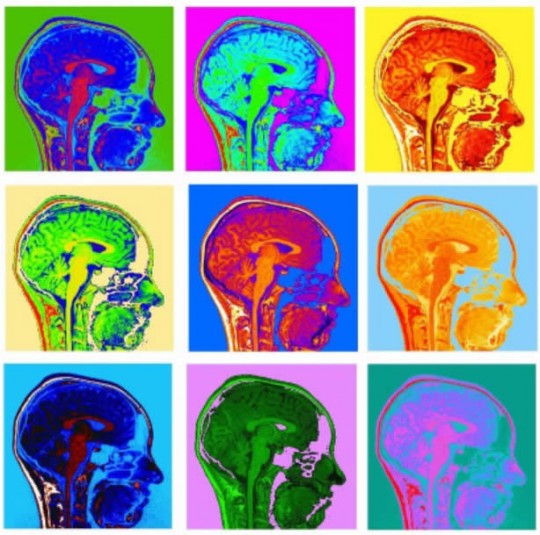
Andy Warhol for Neuroscientists. Image by Valerie van Mulukom

This morning I spent some time looking through the winners of the first annual Brain-Art Competition, a competition designed to “recognize the beauty and creativity of artistic renderings emerging from the neuroimaging community”. This competition aims to recognize the artistic creativity of our community that often goes unappreciated in the publication process.

There are some incredibly visually striking images and you can view an online gallery of these here.