Fascinating video from the Mayo Clinic on research into communicating via brain waves.
Weekly Round-Up

Blogging may have psychological benefits for teens suffering from social anxiety, improving their self-esteem and helping them relate better to their friends, according to new research published by the American Psychological Association.
Scientists at The Scripps Research Institute have discovered that DNA stays too tightly wound in certain brain cells of schizophrenic subjects. The findings suggest that drugs already in development for other diseases might eventually offer hope as a treatment for schizophrenia and related conditions in the elderly.
Deep depression that fails to respond to any other form of therapy can be moderated or reversed by stimulation of areas deep inside the brain.
Radiology researchers at The University of Texas Health Science Center at Houston (UTHealth) have found evidence that multiple sclerosis affects an area of the brain that controls cognitive, sensory and motor functioning apart from the disabling damage caused by the disease’s visible lesions.
People with diets high in several vitamins or in omega 3 fatty acids are less likely to have the brain shrinkage associated with Alzheimer’s disease than people whose diets are not high in those nutrients, according to a new study published in the December 28, 2011, online issue of Neurology®, the medical journal of the American Academy of Neurology.
When you experience a new event, your brain encodes a memory of it by altering the connections between neurons. This requires turning on many genes in those neurons. Now, MIT neuroscientists have identified what may be a master gene that controls this complex process. The findings, described in the Dec. 23 issue of Science, not only reveal some of the molecular underpinnings of memory formation — they may also help neuroscientists pinpoint the exact locations of memories in the brain.
HealthTech Ideas That Will Change Medicine In 2012

Following on from yesterday’s video presentation from Daniel Kraft on the future of innovations in medicine, here is a link to a recent interview in which he discusses the biggest emerging trends in HealthTech.
The TechCrunch interview examines how A.I, big data, 3D printing, social health networks and other new technologies will help you get better medical care. Kraft believes that by analyzing where the field is going, we have the ability to reinvent medicine and build important new business models.
6 Big HealthTech Ideas That Will Change Medicine in 2012
Image Credit: TechCrunch
Medicine’s future? There’s an app for that
In this video recorded at TEDxMaastricht, Daniel Kraft offers a fast-paced look at the next few years of innovations in medicine, powered by new tools, tests and apps that bring diagnostic information right to the patient’s bedside.
Blogging Year in Review
The WordPress.com stats helper monkeys prepared a 2011 annual report for this blog.

Here’s an excerpt:
The concert hall at the Syndey Opera House holds 2,700 people. This blog was viewed about 22,000 times in 2011. If it were a concert at Sydney Opera House, it would take about 8 sold-out performances for that many people to see it.
Weekly Round Up
 Welcome to the last weekly round-up of 2011. I have enjoyed putting this together each week and look forward to updating you with lots more new and exciting research in the field of neuroscience in the coming year.
New research has shown, for the first time, that the cortex, which is the largest zone of the brain and which is generally associated with high cognitive functions, is also a key zone for emotional learning.
When you experience a new event, your brain encodes a memory of it by altering the connections between neurons. This requires turning on many genes in those neurons. Now, MIT neuroscientists have identified what may be a master gene that controls this complex process.
A new technique for color-coding nerves involved in touch gives neuroscientists a much-needed tool for studying that mysterious sense.
When accidents that involve traumatic brain injuries occur, a speedy diagnosis followed by the proper treatment can mean the difference between life and death. A research team, led by Jason D. Riley in the Section on Analytical and Functional Biophotonics at the U.S. National Institutes of Health, has created a handheld device capable of quickly detecting brain injuries such as hematomas, which occur when blood vessels become damaged and blood seeps out into surrounding tissues where it can cause significant and dangerous swelling.
Shrinkage in certain parts of the brain may herald Alzheimer’s disease long before symptoms arise, according to new research.
At UCLA’s Laboratory of Integrative Neuroimaging Technology, researchers use functional MRI brain scans to observe brain signal changes that take place during mental activity. They then employ computerized machine learning (ML) methods to study these patterns and identify the cognitive state — or sometimes the thought process — of human subjects. The technique is called “brain reading” or “brain decoding.”
Compared to our other senses, scientists don’t know much about how our skin is wired for the sensation of touch. Now, research reported in the December 23rd issue of the journal Cell, a Cell Press publication, provides the first picture of how specialized neurons feel light touches.
Both children and the elderly have slower response times when they have to make quick decisions in some settings. But recent research suggests that much of that slower response is a conscious choice to emphasize accuracy over speed. In fact, healthy older people can be trained to respond faster in some decision-making tasks without hurting their accuracy – meaning their cognitive skills in this area aren’t so different from younger adults.
Scientists at the University of Cambridge have made a significant step in the development of a novel therapy that could one day help to slow down, or even halt, the damage caused by Parkinson’s disease, one of the most common neurodegenerative disorders.
Neuroplasticity
For decades, scientists thought that the adult human brain was static and unchanging. But in the last few decades, we have learned that the adult brain is more dynamic than we ever imagined!
This short film was created for the Society for Neuroscience 2011 Brain Awareness Video Contest.
Christmas Brain Teasers
Weekly Round-Up

Researchers believe they found a link between the volume of one’s cerebellum and general intelligence. The cerebellum is involved in the coordination of voluntary motor movement, balance and equilibrium and muscle tone. It is located just above the brain stem and toward the back of the brain.
A small but promising study suggests that magnetic stimulation of the brain could aid the recovery of some stroke patients.
Treatment that increases brain levels of an important regulatory enzyme may slow the loss of brain cells that characterizes Huntington’s disease (HD) and other neurodegenerative disorders.
How much do babies remember about the world around them? New research reveals that even though infants can’t remember the details of an object that has been hidden from view, their brains have built-in “pointers” that help them retain the idea that the object still exists even though they can’t see it anymore.
Neuroscience research involving epileptic patients with brain electrodes surgically implanted in their medial temporal lobes shows that patients learned to consciously control individual neurons deep in the brain with thoughts.
Loyola University Medical Center researchers are reporting what could become the first reliable method to predict whether an antidepressant will work on a depressed patient.
How we perceive motion is a significantly more complex process than previously thought, researchers at New York University’s Center for Neural Science, Stanford University and the University of Washington have found. Their results, which appear in the journalCurrent Biology, show that the relationship between the brain and visual perception varies, depending on the type of motion we are viewing.
After birth, the developing brain is largely shaped by experiences in the environment. However, neurobiologists at Yale and elsewhere have also shown that for many functions the successful wiring of neural circuits depends upon spontaneous activity in the brain that arises before birth independent of external influences.
Revolutionary technique investigates the cause of psoriasis
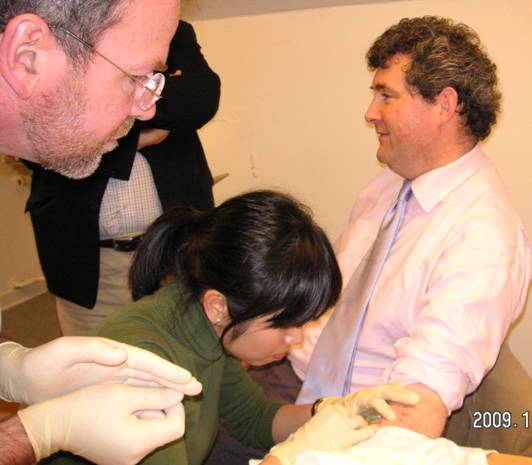
Dr. Wen Lynn Ho inserts a microdialysis catheter into the skin on my left forearm under the watchful eye of Professor Bart Ramsey. I do not suffer from psoriasis myself but I acted as a control in this study – for comparison.
Psoriasis is a chronic skin disease resulting from abnormal immune function and is characterized by the presence of scaly psoriatic plaques which are areas of inflammation and excessive skin production. The exact cause remains unknown but the brain may be involved given that stress can trigger psoriatic flares.
In my latest research at the University of Limerick (UL) Medical School, I have been leading a team who have successfully applied a new method of monitoring chemicals in the body – a method known as microdialysis – which has the potential to revolutionise the diagnosis and treatment of this disease
Microdialysis involves the temporary insertion of microscopic hollow tubes or artificial blood vessels through the skin. Artificial blood (or Ringer) solution is then passed through the tubes at a very slow rate allowing any chemicals or biological markers to be trapped and carried away by microdialysis catheters and collected.
What is revolutionary about this technique is that it can go into the living skin. We can measure skin chemistry in real-time without any drugs. This is the first time inIreland that skin chemistry has been measured by microdialysis. Currently the only way to monitor skin chemistry is by biopsy. However, as biopsy involves punching a hole in the skin causing damage and wound formation, it does not provide a real-time physiological picture as the skin tested is dead.
By putting these tiny artificial blood vessels into the skin and fooling the skin into thinking that these are real blood vessels, we can extract chemicals without doing any damage.
Read more:
Rapid quantification of histamine in human psoriatic plaques using microdialysis (article in press, Journal of Chromatography)
(article in press, Journal of Chromatography)
Related Article:

