
The History of Neuroscience
Society for Neuroscience archival interview with Johns Hopkins University Professor Emeritus of Neuroscience Vernon B. Mountcastle.
Weekly Neuroscience Update

Research from the University of Southampton, which examines how dolphins might process their sonar signals, could provide a new system for man-made sonar to detect targets, such as sea mines, in bubbly water.
Evidence is mounting that exercise provides some protection from memory loss and Alzheimer’s disease, with three new studies showing that a variety of physical activities are associated with healthier brains in older adults.
Researchers have discovered an important clue to how the human brain —important clue to how the human brain — which is constantly bombarded with millions of pieces of visual information, can filter out what’s unimportant and focus on what’s most useful.
Scientists at the California Institute of Technology (Caltech) pioneered the study of the link between irregularities in the immune system and neurodevelopmental disorders such as autism a decade ago. Since then, studies of postmortem brains and of individuals with autism, as well as epidemiological studies, have supported the correlation between alterations in the immune system and autism spectrum disorder.
Researchers at Aalto University in Finland have developed the world’s first device designed for mapping the human brain that combines whole-head magnetoencephalography (MEG) and magnetic resonance imaging (MRI) technology. MEG measures the electrical function and MRI visualizes the structure of the brain. The merging of these two technologies will produce unprecedented accuracy in locating brain electrical activity non-invasively.
Cognition psychologists have discovered why stressed persons are more likely to lapse back into habits than to behave goal-directed. The researchers have now reported in the Journal of Neuroscience that the interaction of the stress hormones hydrocortisone and noradrenaline shut down the activity of brain regions for goal-directed behaviour. The brain regions responsible for habitual behaviour remained unaffected.
Raising levels of the neurotransmitter dopamine in the frontal cortex of the brain significantly decreased impulsivity in healthy adults, in a study conducted by researchers at the Ernest Gallo Clinic and Research Center at the University of California, San Francisco
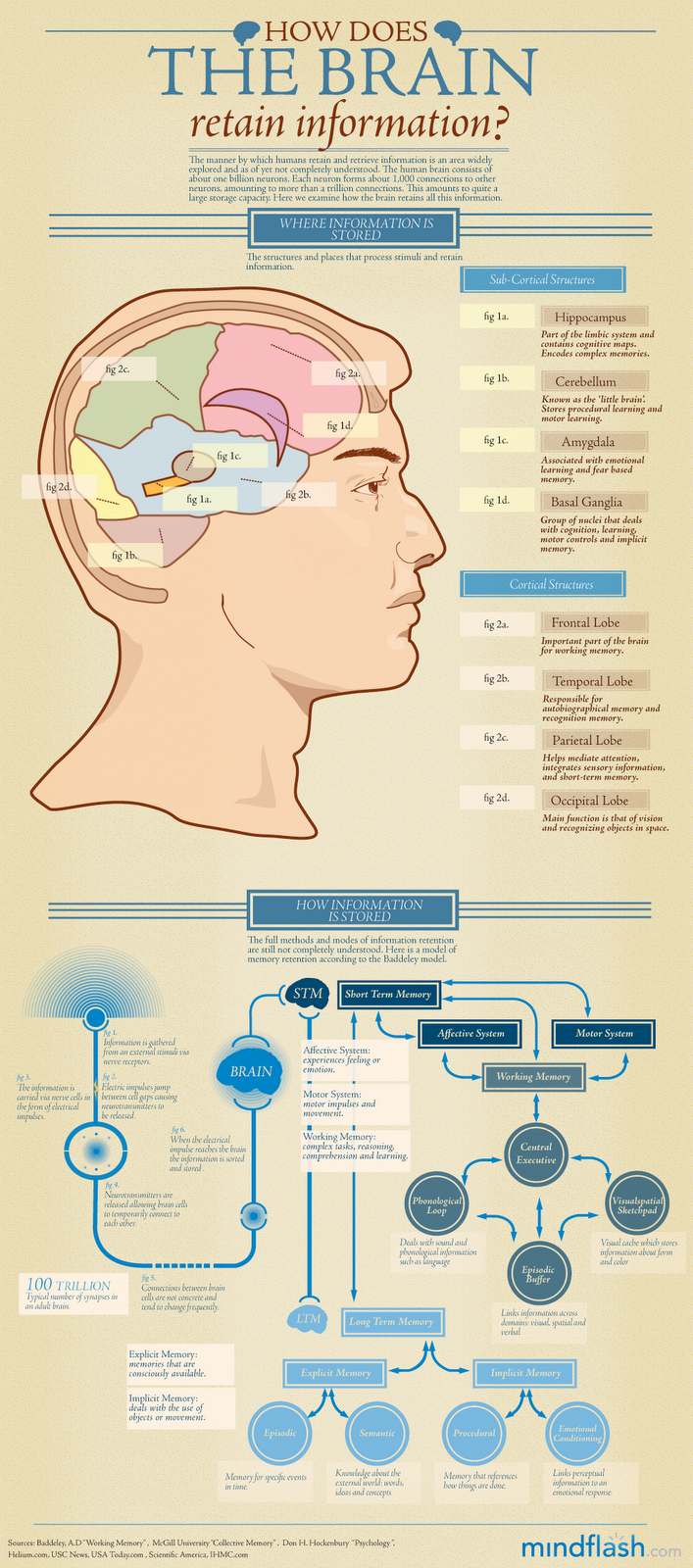
How the brain retains information (infographic)
What Stephen Covey taught us about the neuroscience of focus

I was saddened to hear of the death of Stephen Covey yesterday. He was a truly inspirational figure who studied human behaviour and drew up a set of simple instructions for human happiness – The 7 Habits of Highly Effective People.
One of these habits was –‘The main thing is to keep the main thing the main thing.’
Covey proposed that happiness in life depends not only in having a focus or goal (i.e. the main thing) but in having the discipline to stay focused on that goal (i.e. keeping the main thing the main thing). He contended that one reason why people fail to achieve their full potential was in not staying focused on that goal.
Where in the brain do we create focus and how can we strengthen it?
There are two types of focused attention in two separate regions of the brain. The prefrontal lobes are in charge of goal setting and willful concentration; if you are studying for a test or writing a novel, the impetus and the orders come from there. But if there is a sudden, riveting event – the attack of a tiger or the scream of a child – it is the parietal lobes behind each ear that are activated. Neuroscientists have learned that these two brain regions sustain concentration when neurons emit pulses of electricity at specific rates – faster frequencies for the automatic processing of the parietal cortex, slower frequencies for the deliberate, intentional work of the prefrontal.
Furthermore, studies of seasoned meditators – Tibetan Buddhist monks show that regular meditation – i.e. paying attention on purpose – generates brain wave patterns which synchronise neuronal firing in both the frontal and parietal lobes – a phenomenon which is thought to underlie the sustained concentration involved in focused attention i.e. in keeping the main thing the main thing. In fact, the ability of mediation to strengthen the connection between these two key brain regions involved in sustained concentration explains the ability of seasoned meditators to stay calm and focused.
These finding on attention in the brain may also radically alter our understanding of attention disorders and provide new opportunities to learn how brains pay attention in real world settings and acquire healthy habits to stay focused and prevent distraction.
Computer simulation of pyramidal neurons in the cerebral cortex

ESOF 2012

I spent the last few days at The Euroscience Open Forum (ESOF), Europe’s largest, general science meeting, which this year was held in Dublin.
ESOF is an interdisciplinary, pan-European meeting, held under the auspices of Euroscience, which aims to showcase the latest advances in science and technology; promote a dialogue on the role of science and technology in society and public policy; stimulate and provoke public interest, excitement and debate about science and technology. I would say it certainly lived up to its mission this past week.
To find out more visit http://esof2012.org/
Weekly Neuroscience Update

UC Santa Barbara scientists turned to the simple sponge to find clues about the evolution of the complex nervous system and found that, but for a mechanism that coordinates the expression of genes that lead to the formation of neural synapses, sponges and the rest of the animal world may not be so distant after all.
Scientists have discovered a mechanism which stops the process of forgetting anxiety after a stress event. In experiments they showed that feelings of anxiety don’t subside if too little dynorphin is released into the brain. The results can help open up new paths in the treatment of trauma patients. The study has been published in the current edition of the Journal of Neuroscience.
The biological role of a gene variant implicated in multiple sclerosis (MS) has been determined by researchers at Oxford University. The finding explains why MS patients do badly on a set of drugs used successfully in other autoimmune diseases, such as rheumatoid arthritis and inflammatory bowel disease – something that has been a puzzle for over 10 years.
A clinical trial of an Alzheimer’s disease treatment developed at MIT has found that the nutrient cocktail can improve memory in patients with early Alzheimer’s. The results confirm and expand the findings of an earlier trial of the nutritional supplement, which is designed to promote new connections between brain cells.
An international consortium, has taken cells from Huntington’s Disease patients and generated human brain cells that develop aspects of the disease in the laboratory. The cells and the new technology will speed up research into understanding the disease and also accelerate drug discovery programs aimed at treating this terminal, genetic disorder.
Stem cells that come from a specific part of the developing brain help fuel the growth of brain tumors caused by an inherited condition, researchers at Washington University School of Medicine in St. Louis report.
Findings from the first study directly examining gamma-aminobutyric acid (GABA) concentrations in the brains of children with ADHD were published last week in the Archives of General Psychiatry. In this new article researchers report finding significantly lower concentrations of GABA in the cerebral cortexes of children diagnosed with ADHD, compared with typically developing children. GABA is the brain’s main inhibitory neurotransmitter. The differences were detected in the region of the brain that controls voluntary movement.
People who are born deaf process the sense of touch differently than people who are born with normal hearing, according to research funded by the National Institutes of Health. The finding reveals how the early loss of a sense— in this case hearing—affects brain development. It adds to a growing list of discoveries that confirm the impact of experiences and outside influences in molding the developing brain. The study is published in the July 11 online issue of The Journal of Neuroscience.
Neuronal abnormalities in the brains of children with obstructive sleep apnea are reversible with treatment, a prospective study has shown.
Although many areas of the human brain are devoted to social tasks like detecting another person nearby, a new study has found that one small region carries information only for decisions during social interactions. Specifically, the area is active when we encounter a worthy opponent and decide whether to deceive them. A brain imaging study conducted by researchers at the Duke Center for Interdisciplinary Decision Science (D-CIDES) put human subjects through a functional MRI brain scan while playing a simplified game of poker against a computer and human opponents. Using computer algorithms to sort out what amount of information each area of the brain was processing, the team found only one brain region — the temporal-parietal junction, or TPJ — carried information that was unique to decisions against the human opponent.
How to look inside the brain
Inside the Brains of Bieber Fans
![[image]](https://i0.wp.com/si.wsj.net/public/resources/images/OB-TN162_HEALTH_G_20120625193406.jpg)
The symptoms include uncontrollable screaming, swooning and spending hours on Twitter and Facebook . It primarily affects preteen and teen girls, yet it is highly contagious and can infect mothers, too.
These are the opening lines of a recent Wall Street Journal article investigating the neuroscience of “fan mania” – in this case ” “Bieber Fever”, which according to the article is approaching a global pandemic with the release of the 18-year-old pop star, Justin Bieber’s latest album, “Believe”.
Compared with past outbreaks of fan mania, scientists now have a better understanding of why teens—girls in particular—become so passionate about some musicians, and what looks like mass hysteria is a harmless stage in adolescent development.
Hearing familiar, favorite music stimulates the release of dopamine, the neurotransmitter involved in pleasure and addiction, providing the same rush as eating chocolate or that winning does for a compulsive gambler, says neuroscientist Daniel Levitin, author of This Is Your Brain on Music, who was a record producer before turning to neuroscience.
Dr. Levitin’s research also showed that musical tastes formed in the teen years become part of the brain’s internal wiring, as that is the time when some neural pathways are solidifying and others are being pruned away. That’s why the music adults tend to be nostalgic for is the music from their teenage years.

