 Researchers report new insights into how the brain responds to extreme stress, whether from combat, natural disasters, or repeated violent competition. The insights offer hope for detecting and treating several widespread and debilitating neuropsychiatric disorders, and were presented at Neuroscience 2012, the annual meeting of the Society for Neuroscience and the world’s largest source of emerging news about brain science and health.
Researchers reveal first brain study of Temple Grandin
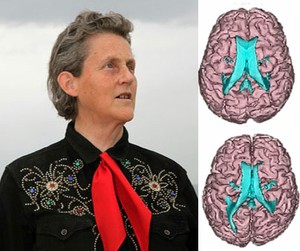
Left-leaning: Unlike controls (top), Temple Grandin has lateral ventricles (bottom) that are significantly larger on the left side of her brain than on the right.
This time of year usually sees me travelling to the US for the Society for Neuroscience annual meeting. This year for the first time in many years I am missing it, but thanks to the wonders of the internet, I am keeping abreast of the proceedings.
A presentation at the meeting in New Orleans this past weekend revealed the first study to take a close look at Temple Grandin, perhaps the world’s most famous person with autism, and one of the first to look at the brains of savants. Grandin, professor of animal sciences at Colorado State University, is an outspoken advocate for autism research and awareness. She is known as a ‘savant,’ or a person who shows characteristic social deficits of autism and yet also has some exceptional abilities.
Click here to read Virginia Hughes report for Simons Foundation Autism Research Initiative
Weekly Neuroscience Update

Neuroscientists have announced a longitudinal research collaboration to investigate the emotional, social and cognitive effects of musical training on childhood brain development. The five-year research project, Effects of Early Childhood Musical Training on Brain and Cognitive Development, will offer USC researchers an important opportunity to provide new insights and add rigorous data to an emerging discussion about the role of early music engagement in learning and brain function.
UCLA researchers have for the first time measured the activity of a brain region known to be involved in learning, memory and Alzheimer’s disease during sleep. They discovered that this part of the brain behaves as if it’s remembering something, even under anesthesia, a finding that counters conventional theories about memory consolidation during sleep.
New research reveals that stroke may be affecting people at a younger age. The study is published in the October 10, 2012, online issue of Neurology, the medical journal of the American Academy of Neurology.
Scientists studying a rare genetic disorder have identified a molecular pathway that may play a role in schizophrenia, according to new research in the October 10 issue of The Journal of Neuroscience. The findings may one day guide researchers to new treatment options for people with schizophrenia — a devastating disease that affects approximately 1 percent of the world’s population.
Researchers from the University of Exeter Medical School have for the first time identified the mechanism that protects us from developing uncontrollable fear.
Small amounts of the drug ketamine can immediately relieve the symptoms of chronic depression, as well as those of treatment-resistant patients within a few hours, say Yale scientists.
Scientists find that competition between two brain regions influences the ability to make healthy choices.
A compassion-based meditation program can significantly improve a person’s ability to read the facial expressions of others, finds a study published by Social Cognitive and Affective Neuroscience. This boost in empathic accuracy was detected through both behavioral testing of the study participants and through functional magnetic resonance imaging (fMRI) scans of their brain activity.
A study in PLOS ONE shows that whether or not you like the person you’re watching can actually have an effect on brain activity related to motor actions and lead to “differential processing” – for example, thinking the person you dislike is moving more slowly than they actually are.
Which sound does our brain most hate to hear?

Picture: shelbyasteward, flickr.com
Scientists from Newcastle University have drawn up a league table of the least pleasant sounds we may encounter as part of everyday life – albeit a slightly old-fashioned life as the top five include the rasp of chalk on a blackboard.
Working with 13 volunteers, they tested reactions to 74 different noises both in outward response and more closely via small changes in the brain.
The results are published in the latest issue of the Journal of Neuroscience and show, among other things, that acoustically anything in the frequency range of around 2,000 to 5,000 Hz was found to be unpleasant.
Making sense of maps
Map designer Aris Venetikidis is fascinated by the maps we draw in our minds as we move around a city — less like street maps, more like schematics or wiring diagrams, abstract images of relationships between places. How can we learn from these mental maps to make better real ones? As a test case, he remakes the notorious Dublin bus map.
(Filmed at TEDxDublin)
Weekly Neuroscience Update
 An aspirin a day may slow brain decline in elderly women at high risk of cardiovascular disease, research finds.
The hippocampus represents an important brain structure for learning. Scientists at the Max Planck Institute of Psychiatry in Munich discovered how it filters electrical neuronal signals through an input and output control, thus regulating learning and memory processes.
Scientists performing experimental brain surgery on a man aged 50 have stumbled across a mechanism that could unlock how memory works. The accidental breakthrough came during an experiment originally intended to suppress the obese man’s appetite, using the increasingly successful technique of deep-brain stimulation. Electrodes were pushed into the man’s brain and stimulated with an electric current. Instead of losing appetite, the patient instead had an intense experience of déjà vu. He recalled, in intricate detail, a scene from 30 years earlier. More tests showed his ability to learn was dramatically improved when the current was switched on and his brain stimulated.
Brain metastases are common secondary complications of other types of cancer, particularly lung, breast and skin cancer. The body’s own immune response in the brain is rendered powerless in the fight against these metastases by inflammatory reactions. Researchers in Vienna have now, for the first time, precisely characterised the brain’s immune response to infiltrating metastases. This could pave the way to the development of new, less aggressive treatment options.
Inside the teenage brain
Why do teenagers seem so much more impulsive, so much less self-aware than grown-ups? In this video, cognitive neuroscientist, Sarah-Jayne Blakemore, compares the prefrontal cortex in adolescents to that of adults, to show us how typically “teenage” behavior is caused by the growing and developing brain.
Weekly Neuroscience Update
 Newly formed emotional memories can be erased from the human brain. This is shown by researchers from Uppsala University in a new study now being published by the academic journal Science. The findings may represent a breakthrough in research on memory and fear.
A growing body of research shows that children who suffer severe neglect and social isolation have cognitive and social impairments as adults. A study from Boston Children’s Hospital shows, for the first time, how these functional impairments arise: Social isolation during early life prevents the cells that make up the brain’s white matter from maturing and producing the right amount of myelin, the fatty “insulation” on nerve fibers that helps them transmit long-distance messages within the brain.
People with psychopathic tendencies have an impaired sense of smell, which points to inefficient processing in the front part of the brain [orbitofrontal cortex]. These findings by Mehmet Mahmut and Richard Stevenson, from Macquarie University in Australia, are published online in Springer’s journal Chemosensory Perception.
According to new research of MRI scans of children’s appetite and pleasure centers in their brains, the logos of such fast-food giants as McDonald’s, Pizza Hut, and Burger King causes those areas to “light up”.
New signs of future Alzheimer’s disease have been identified by researchers at Lund University and Skane University in Sweden. Dr. Peder Buchhave and his team explain that disease-modifying treatments are more beneficial if started early, so it is essential identify Alzheimer’s disease patients as quickly as possible.
A new study from MIT neuroscientists sheds light on a neural circuit that makes us likelier to remember what we’re seeing when our brains are in a more attentive state.
What we’re learning from 5,000 brains
Read Montague is interested in the human dopamine system — or, as he puts it in this illuminating talk from TEDGlobal 2012, that which makes us “chase sex, food and salt” and therefore survive.
Specifically, Montague and his team at the Roanoke Brain Study are interested in how dopamine and valuation systems work when two human beings interact with each other.
“We have a behavioral superpower in our brain and it at least in part involves dopamine,” says Montague in this talk. “We can deny any instinct we have for survival for an idea. No other species can do that.”
So how do we assign value to ideas, process the gestures of those around us, make complicated decisions, and create informed judgments about each other? Montague’s lab hopes to discover much more about how these processes work by “eavesdropping” on the brains of 5,000 to 6,000 participants all over the world as they play negotiation games. It’s fascinating research that could tell us more about our social nature. Because as Montague says, “You often don’t know who you are until you see yourself in interaction with people who are close to you, people who are enemies to you, and people who are agnostic to you.”
Source: TED blog
What stress does to your brain

By watching individual neurons at work, a group of psychologists at the University of Wisconsin-Madison has revealed just how stress can addle the mind, as well as how neurons in the brain’s prefrontal cortex help “remember” information in the first place.
Read this story in full here
 inside-the-brain.com