Inside The See-Through Brain


Scientists have come up with a way to make whole brains transparent, so they can be labelled with molecular markers and imaged using a light microscope. The technique, called CLARITY, enabled its creators to produce the detailed 3D visualisations you see in this video which takes a look into the brain of a 7-year-old boy who had autism.

How playing an instrument benefits your brain

When you listen to music, multiple areas of your brain become engaged and active. But when you actually play an instrument, that activity becomes more like a full-body brain workout. What’s going on? In this video, Anita Collins explains the fireworks that go off in musicians’ brains when they play, and examines some of the long-term positive effects of this mental workout.


Weekly Neuroscience Update

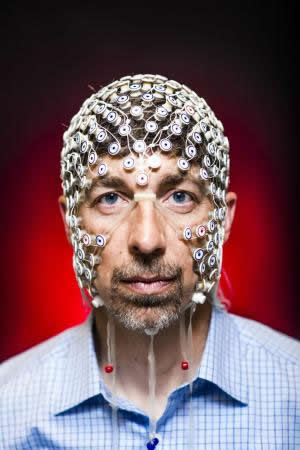
Electrical and computer engineering professor Barry Van Veen wears an electrode net used to monitor brain activity via EEG signals. His research with psychiatry professor and neuroscientist Giulio Tononi could help untangle what happens in the brain during sleep and dreaming. Credit Nick Berard.

Electrical and computer engineering professor Barry Van Veen wears an electrode net used to monitor brain activity via EEG signals. His research with psychiatry professor and neuroscientist Giulio Tononi could help untangle what happens in the brain during sleep and dreaming. Credit Nick Berard.

As real as that daydream may seem, its path through your brain runs opposite reality. Aiming to discern discrete neural circuits, researchers at the University of Wisconsin-Madison have tracked electrical activity in the brains of people who alternately imagined scenes or watched videos.

People with mentally taxing jobs, including lawyers and graphic designers, may end up having better memory in old age, research suggests.

Researchers at the RIKEN Brain Science Institute in Japan have identified a key neuronal pathway that makes learning to avoid unpleasant situations possible. Published online in the November 20 issue of Neuron, the work shows that avoidance learning requires neural activity in the habenula representing changes in future expectations.

Combining behavioral and physiologic measures depicts gradual process, may help diagnose sleep disorders. 

Neurophysicists have found that space-mapping neurons in the brain react differently to virtual reality than they do to real-world environments. Their findings could be significant for people who use virtual reality for gaming, military, commercial, scientific or other purposes.

New brain imaging technology is helping researchers to bridge the gap between art and science by mapping the different ways in which the brain responds to poetry and prose.

As methods of imaging the brain improve, neuroscientists and educators can now identify changes in children’s brains as they learn, and start to develop ways of personalizing instruction for kids who are falling behind.

Scientists have identified a weak spot in the human brain for Alzheimer’s disease and schizophrenia, revealing a connection between the two diseases.

A team of scientists has found a simple method to convert human skin cells into the specialized neurons that detect pain, itch, touch and other bodily sensations. These neurons are also affected by spinal cord injury and involved in Friedreich’s ataxia, a devastating and currently incurable neurodegenerative disease that largely strikes children.

Berkeley lab reports proper copper levels are essential to spontaneous neural activity.

Researchers are using an enhanced MRI approach to visualize brain injury in the blood brain barrier in order to identify significant changes to the blood-brain barrier in professional football players following a concussion.

A new study reports that older learners retained the mental flexibility needed to learn a visual perception task but were not as good as younger people at filtering out irrelevant information.

Finally this week, in the largest study of the genetics of memory ever undertaken, an international researcher team have discovered two common genetic variants that are believed to be associated with memory performance. The findings, which appear in the journal Biological Psychiatry, are a significant step towards better understanding how memory loss is inherited.

 

Death Of Cricketer Phillip Hughes: Why Are Some Brain Injuries Worse Than Others?

Australian cricketer, Phillip Hughes.

Australian cricketer, Phillip Hughes.

Australian cricketer Phillip Hughes has died two days after being struck in the head by a bouncer while batting for South Australia at the The Sydney Cricket Ground. Hughes, 25, had been in an induced coma since the accident on Tuesday afternoon.

Two of the most tragic events within Australian cricket in just over the past decade have involved catastrophic head injuries: firstly to David Hookes in a hotel altercation, secondly to Phillip Hughes while batting. According to research published in The Lancet, approximately a fifth of adults with a severe traumatic brain injury make a good recovery. But many more die or are left with enduring disability.  

So why are some brain injuries worse than others?

The effects of brain injury fall into three main categories:

  • Cognitive – problems with memory, concentration, information processing
  • Emotional and behavioural problems – anxiety, explosive anger and irritability, lack of awareness or empathy
  • Physical – problems with movement, balance and co-ordination, fatigue, epilepsy

Sometimes a head injury which seems severe is followed by a good recovery while a seemingly small head injury can have very serious, long-lasting consequences.  Why is this?

Location, location, location.

The reason is that brain injury operates a bit like the property market in that the three most important things to consider are location, location and location. When nerve pathways are damaged, those brain areas served by those pathways may wither or have their functions taken over by other brain regions. Nerve pathways are also called ‘white’ pathways or ‘white matter’ because they are covered by an insulating sheath of myelin and appear white to the naked eye.

The challenge is to determine the location of key ‘scaffold’ pathways and to understand what makes them so vulnerable and important. This is not an easy task given the total length of nerve pathways in the average 20-year old human brain is 160,000 km. A recent study provides new findings on the brain’s network scaffold that will help inform clinicians about the neurological impacts of brain diseases such as multiple sclerosis, Alzheimer’s disease and brain injury.


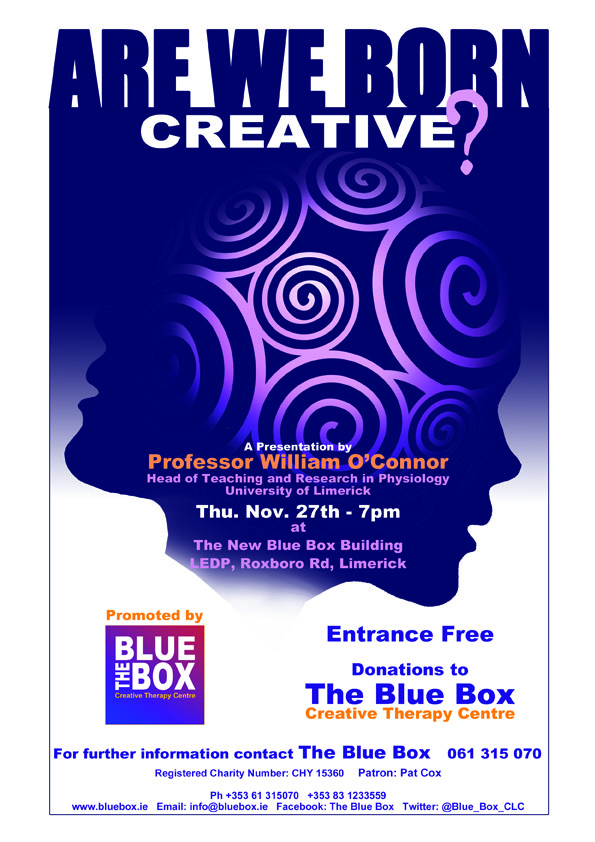
Are We Born Creative?

blue box

Since the dawn of human evolution, our world has been driven by creative flashes of inspiration.  Creativity often appear as a spontaneous burst of new ideas but it is really the ability to derive new ideas from old ones – the reassembly of information that we already possess.  While everyone can learn to be creative to some degree, new research is revealing that the extent to which we inherit our creativity may be greater that previously thought.

This Thursday, November 27, I will be giving a public talk on creativity and how we can foster it. The talk will take place at The Blue Box Creative Therapy Centre in Limerick city centre.  Entrance is free; donations to this worthy cause are welcome.

Book your ticket


Weekly Neuroscience Update

Nerve cells communicate with each other via intricate projections. In brain diseases such as Alzheimer’s and Parkinson’s these extensions atrophy, thereby causing connectivity problems. Credit DZNE/Detlef Friedrichs.

Nerve cells communicate with each other via intricate projections. In brain diseases such as Alzheimer’s and Parkinson’s these extensions atrophy, thereby causing connectivity problems. Credit DZNE/Detlef Friedrichs.

A new study shows the interdependency between the structure and function of neurons.

Neuroscientists have discovered an unexpected benefit of getting older – a more nuanced understanding of social signals, such as the age of others.

Children with autism show different patterns of brain activity during everyday gestures and movements than controls do, suggest unpublished results presented at the 2014 Society for Neuroscience annual meeting.

Researchers have gained fresh insights into how ‘local’ body clocks control waking and sleeping.

People with bipolar disorder who are being treated with the drug lithium are at risk of acute kidney damage and need careful monitoring, according to new research.

Age-related Macular Degeneration (AMD) is the major cause of blindness in the western world, affecting around 50 million people. Now scientists at The University of Manchester have identified an important new factor behind its causes, which they hope could lead to new treatments.

A team of researchers has identified an enzyme key to the survival and spread of glioblastoma cancer cells that is not present in healthy brain cells, making the enzyme a promising therapeutic target.

It is claimed one in five students have taken the ‘smart’ drug Modafinil to boost their ability to study and improve their chances of exam success. But new research into the effects of Modafinil has shown that healthy students could find their performance impaired by the drug.

Researchers have developed new insight into a rare but deadly brain infection, called progressive multifocal leukoencephalopathy (PML). This disease – which is caused by the JC virus – is most frequently found in people with suppressed immune systems and, until now, scientists have had no effective way to study it or test new treatments.

New research offers insight into short-term effects of maternal caregiving on a developing brain.

A team of researchers  has now been able to demonstrate in a study that the bonding hormone oxytocin inhibits the fear center in the brain and allows fear stimuli to subside more easily. This basic research could also usher in a new era in the treatment of anxiety disorders.

Blocking a key receptor in brain cells that is used by oxygen free radicals could play a major role in neutralizing the biological consequences of Alzheimer’s disease, according to new research.

Finally this week, brain scientists have long believed that older people have less of the neural flexibility (plasticity) required to learn new things. A new study shows that older people learned a visual task just as well as younger ones, but the seniors who showed a strong degree of learning exhibited plasticity in a different part of the brain than younger learners did.


#SfN14 highlights: DREADD-nought, or the role of the posterior parietal cortex in decision making

Enjoying more blogs from Society For Neuroscience Annual Meeting

neuroscience and medicine

I’m sure that you would like to improve on this terrible pun–feel free to chime in in the comments! And now let’s move beyond the acronym: this post is about a poster that was shown at #SfN14 on Monday morning, November 17, during the session on Executive function: Decision making.

358.21/SS34. Disrupting inhibition in posterior parietal cortex reduces decision accuracy. K. ODOEMENE, A. M. BROWN, M. T. KAUFMAN, A. K. CHURCHLAND

The authors, from Cold Spring Harbor Laboratory, NY, are interested in understanding how sensory information is used by the brain to inform decision making. They trained mice on a visual discrimination task in which the animals had to learn to recognize that a slowly flashing light was associated with a water reward in one location and a faster flash with a reward at another place. They then injected a viral vector encoding a protein known as a DREADD: a designer receptor exclusively activated by a designer drug…

View original post 243 more words