Weekly Neuroscience Update

consciousness-time-slices

Consciousness seems to work as continuous stream: one image or sound or smell or touch smoothly follows the other, providing us with a continuous image of the world around us. Image adapted from the EPFL press release.


Scientists propose a new way of understanding of how the brain processes unconscious information into our consciousness. According to the model, consciousness arises only in time intervals of up to 400 milliseconds, with gaps of unconsciousness in between.

A new study finds bursts of neural activity as the brain holds information in mind, overturns a long-held model.

Why do we sometimes decide to take risks and other times choose to play it safe? In a new study, researchers explored the neural mechanisms of one possible explanation: a contagion effect.

Using imagery is an effective way to improve memory and decrease certain types of false memories.

Scientists have developed an imaging process that for the first time, they say, can identify and track the progression of Alzheimer’s disease in people’s brains, even when there are no symptoms — a development that could lead to earlier diagnosis and treatment.

People prone to seeking stimulation and acting impulsively may have differences in the structure of their brains according to a study published in the Journal of Neuroscience. What’s more, those differences may predispose them to substance abuse.

In a recent study, researchers found evidence of a compromised dopamine system in heavy users of marijuana. Lower dopamine release was found in the striatum – a region of the brain that is involved in working memory, impulsive behavior, and attention. Previous studies have shown that addiction to other drugs of abuse, such as cocaine and heroin, have similar effects on dopamine release, but such evidence for cannabis was missing until now.

Finally this week an innovative collaboration between neuroscientists and developmental psychologists that investigated how infants’ brains process other people’s action provides the first evidence that directly links neural responses from the motor system to overt social behaviour in infants.
 

Weekly Neuroscience Update

alzheimers-synapse-loss

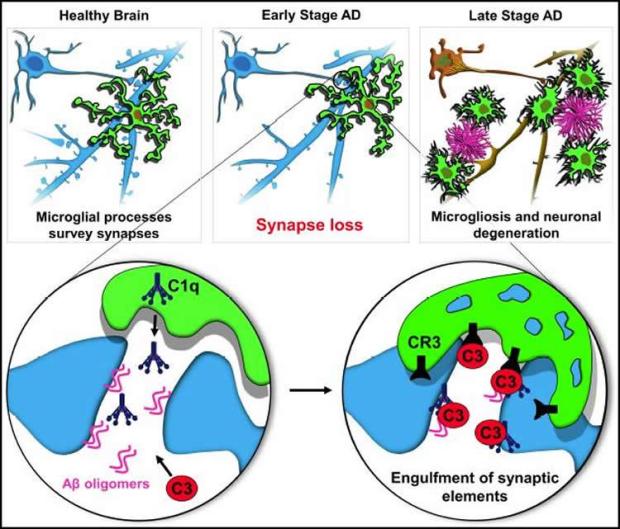
Researchers show how brain connections, or synapses, are lost early in Alzheimer’s disease and demonstrate that the process starts, and could potentially be halted, before telltale plaques accumulate in the brain.

Older adults who exercise regularly could buy an extra decade of good brain functioning, a new study suggests.

Researchers have identified an area of the brain that helps us to perceive boundaries.

Using a sophisticated MRI technique, researchers have found abnormalities in the brain’s white matter tracts in patients with insomnia. Results of the study were published online in the journal Radiology.

A pioneering new study has revealed how an individual’s movement can give a unique insight into their inherent personality traits.

The fluctuations of your heartbeat may affect your wisdom, according to new research.

Researchers have found that the emotional impact experienced by music listeners depends on the concert hall’s acoustics.

Lysergic acid diethylamide (LSD) use causes changes in the way that people think about time that may help develop drug therapies for people suffering from depression, according to a study published in the Journal of Psychopharmacology.

Repeated minor trauma to the head and other body parts can lead to early dementia, according to a new study.

The risk of schizophrenia in children associated with younger and older maternal age appears to be partly explained by the genetic association between schizophrenia and age at first birth, according to an article published online by JAMA Psychiatry.

A new imaging study shows that intense exercise boosts two critical neurotransmitters — glutamate and gamma-aminobutyric acid (GABA) — resulting in better mental fitness.

Religion and science activate different networks in the brain and each suppresses the other, new research finds.

Sensory neurons in human muscles provide important information used for the perception and control of movement. Learning to move in a novel context also relies on the brain’s independent control of these sensors, not just of muscles, according to a new study published in the journal Current Biology.

Finally this week, women with Alzheimer’s have poorer cognitive abilities than men at the same stage of the disease, according to a new paper published in World Journal of Psychiatry.


Weekly Neuroscience Update

Early-diagnosis-staging-of-Alzheimers-disease-seen-in-PET-scans

Dr. William Jagust explains how tau and beta amyloid, two proteins associated with Alzheimer’s disease, develop in the aging brain, which his research team has visualized using positron emission tomography, or PET, scans. Photo by Stephen McNally/University of California Berkeley

Researchers have visualized the development of Alzheimer’s disease in the brain in living people using positron emission tomography, or PET scans, which they say will aid with its diagnosis and treatment. 

Researchers have  also identified a drug that targets the first step in the toxic chain reaction leading to the death of brain cells, suggesting that treatments could be developed to protect against Alzheimer’s disease, in a similar way to how statins are able to reduce the risk of developing heart disease.

new study shows that a variety of physical activities from walking to gardening and dancing can improve brain volume and cut the risk of Alzheimer’s disease by 50%.

In another study jointly led by King’s College London and the University of Southampton has found a link between gum disease and greater rates of cognitive decline in people with early stages of Alzheimer’s Disease.

Women may have a better memory for words than men despite evidence of similar levels of shrinkage in areas of the brain that show the earliest signs of Alzheimer’s disease, according to a study published in Neurology.

Refugees face a substantially higher risk of psychotic disorders, including schizophrenia, compared to non-refugee migrants from the same regions of origin, finds a study published in The BMJ

Research on decision-making bias found that interactive training exercises using video games improved participants’ general decision-making abilities when used alongside other traditional training methods.

Reducing a person’s calorie intake can protect against the development of neurodegenerative diseases such as Parkinson’s Disease.  Meanwhile, researchers may be closer to unraveling the underlying causes of Parkinson’s disease, after identifying the point at which alpha-synuclein – a protein believed to play a key role in the condition – becomes toxic to the brain.

Scientists have developed a 3D micro-scaffold technology that promotes reprogramming of stem cells into neurons, and supports growth of neuronal connections capable of transmitting electrical signals.

Finally this week, researchers in Japan have found that repetitive movements in slow-learning stages can alter an area of the brain responsible for movement, and help individuals retain these motor skills.

Weekly Neuroscience Update

short-term-memory-visual-distractions

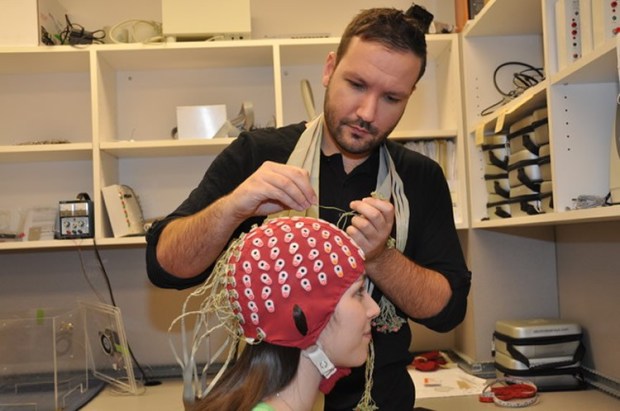
John Gaspar, an SFU psychology doctoral student, places 128 electrodes into a cap. The electrodes will pick up tiny changes in the wearer’s brain activity. Image is adapted from the SFU press release.

A new study has found that differences in an individual’s working memory capacity correlate with the brain’s ability to actively ignore distraction.

A research team has connected neurons using ultrashort laser pulses. With their study, which was published in Scientific Reports, the team became the first ever to find a way to bond neurons.

Physicians and biomedical engineers from Johns Hopkins report what they believe is the first successful effort to wiggle fingers individually and independently of each other using a mind-controlled artificial “arm” to control the movement.

Researchers have identified a gene which can be used to predict how susceptible a young person is to the mind-altering effects of smoking cannabis.

Young adults with hostile attitudes or those who don’t cope well with stress may be at increased risk for experiencing memory and thinking problems decades later, according to a study published in the March 2, 2016, online issue of Neurology.

Researchers have found how lactate, a waste product of glucose metabolism can protect neurons from damage following acute trauma such as stroke or spinal cord injury.

Neuroscientists have discovered a specific enzyme that plays a critical role in spinal muscular atrophy, and that suppressing this enzyme’s activity, could markedly reduce the disease’s severity and improve patients’ lifestyles.

Birds that migrate the greatest distances have more new neurons in the regions of the brain responsible for navigation and spatial orientation, suggests a new paper published in Scientific Reports.

Scientists have now described the engineering of a bright red fluorescent protein-based voltage indicator, providing pathways to understanding complex neurological disorders.

Children with autism and other similar conditions often have difficulties in several areas of communication. A new doctoral thesis in linguistics from the University of Gothenburg shows that these children can develop speech, gestures and a sense of rhythm and melody by listening to various speech sounds.

Finally this week,  new research suggests that small numbers are processed in the right side of the brain, while large numbers are processed in the left side of the brain.

Weekly Neuroscience Update

virtual-relaity-depression

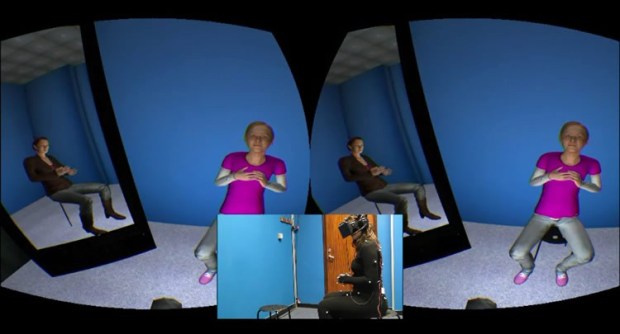
Participant playing the role of an adult comforting a crying child. Credit: UCL.

An immersive virtual reality therapy could help people with depression to be less critical and more compassionate towards themselves, reducing depressive symptoms, finds a new study from UCL and ICREA-University of Barcelona.

After just nine weeks of internet-delivered cognitive behavioral therapy, the brain of patients suffering from social anxiety disorder changes in volume. Anxiety is reduced, and parts of the patients’ brains decrease in both volume and activity. This study could help us develop more effective therapies for one of the most common problems in mental health.

New research shows brain function associated with attention peaks during the summer and dips in winter.

Pain can sear memories into the brain, a new study finds. A full year after viewing a picture of a random, neutral object, people could remember it better if they had been feeling painful heat when they first saw it.

New research reveals the cellular mechanisms by which memory-encoding neuronal networks emerge.

Why do we remember some events, places and things, but not others? Our brains prioritize rewarding memories over others, and reinforce them by replaying them when we are at rest, according to new research.

Researchers have found evidence to suggest a significant relationship between cannabis use and the onset and exacerbation of mania symptoms.

A study provides new insight into how the brains of drug addicts may be wired differently. The findings, which appear in the journal Psychopharmacology, show that while drug users have very strong motivation to seek out “rewards,” they exhibit an impaired ability to adjust their behavior and are less fulfilled once they have achieved what they desire. Addressing this disconnect between the craving for a drug and the ability to regulate behavior may be one of the keys to breaking the cycle of addiction.

Reading and listening to music at the same time affects how you hear the music. Language scientists and neuroscientists published this finding in an article in Royal Society Open Science.

Cognitive scientists have found more evidence that aging brains work differently than younger brains when performing the same memory task, pointing to a potentially new direction for age-related cognitive care and exploration.

Scientists have demonstrated for the first time that it is possible to specifically modify gene expression in diseased upper motor neurons, brain cells that break down in ALS.

Finally this week, researchers have discovered how cells in the human body build their own ‘railway networks’, throwing light on how diseases such as bowel cancer work. The results have just been published in Nature Scientific Reports.


Could this tactic help you give up smoking and other addictions?

Over the past three decades I have visited high schools and colleges to talk on how addictive drugs affect the brain and to explain the many theories about why certain people become addicted. There are as many reasons why someone becomes addicted as there are addicts. This situation is not helped by the fact that we cannot yet predict who will become addicted, or how to cure it.

Psychiatrist Judson Brewer studies the relationship between mindfulness and addiction — from smoking to overeating to all those other things we do even though we know they’re bad for us. In this short video, you will learn more about the mechanism of habit development and discover a simple but profound tactic that might help you beat your next urge to smoke, snack or check a text while driving.

Weekly Neuroscience Update

hypothalamus-genetics-obesity

Credit: BruceBlaus

Scientists have discovered a new genetic syndrome of obesity, over-eating, mental and behavioural problems in six families, from across the world. The study represents an important step in our understanding of how the hypothalamus and oxytocin control appetite and behaviour. 

A new study published in Biological Psychiatry suggests that a brain reward centre, the striatum, may be directly affected by inflammation and that striatal change is related to the emergence of illness behaviors.

By studying stroke patients who have lost the ability to spell, researchers have pinpointed the parts of the brain that control how we write words.

A study has shown for the first time that the structure of the brain circuitry known as the corticolimbic system is more likely to be passed down from mothers to daughters than from mothers to sons or from fathers to children of either gender. The corticolimbic system governs emotional regulation and processing and plays a role in mood disorders, including depression.

New research proves that suffering repeated traumatic experiences throughout infancy and adolescence multiplies by 7 the risk of suffering psychosis during adulthood.

Researchers are using a mathematical tool to help determine which concussion patients will go on to suffer migraine headaches, according to a new study published online in the journal Radiology.

Some of the earliest nerve cells to develop in the womb shape brain circuits that process sights and sounds, but then give way to mature networks that convert this sensory information into thoughts. This is the finding of a study led by researchers at NYU Langone Medical Center and published in the February 3 edition of Neuron.

Scientists have demonstrated for the first time that it is possible to specifically modify gene expression in diseased upper motor neurons, brain cells that break down in ALS.

New research indicates that the location of receptors that transmit pain signals IS important in how big or small a pain signal will be and how effectively drugs can block those signals.

A new way of using MRI scanners to look for evidence of multiple sclerosis in the brain has been successfully tested by researchers.

A team of European researchers has found evidence that suggests that human consciousness is a state where the neural network that makes up the brain operates at an optimal degree of connectedness. In their paper published in Journal of the Royal Society Interface, the team describes their study of the human brain using volunteers undergoing fMRI scans while succumbing to the effects of an anesthetic that caused them to lose consciousness, and what was revealed in reviewing the scan data.

Researchers have determined that testing a portion of a person’s submandibular gland may be a way to diagnose early Parkinson’s disease.

Finally this week, researchers of a new study published in the current issue of Biological Psychiatry report successful reduction of depressive symptoms in patients using a novel non-invasive method of vagus nerve stimulation, or VNS.

Weekly Neuroscience Update

autism-men-neuroimaging

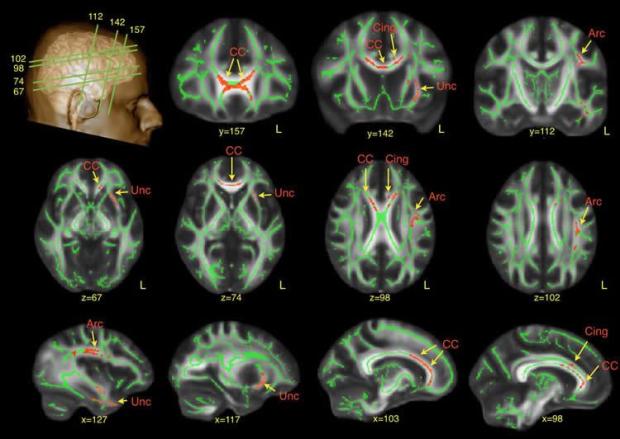
Red regions indicate reduced fractional anisotropy values in autism spectrum disorder (ASD). Credit: The researchers/King’s College London.

Research at King’s College London has revealed subtle brain differences in adult males with autism spectrum disorder (ASD), which may go some way towards explaining why symptoms persist into adulthood in some people with the disorder.

Women who take estrogen supplements from before or at the start of menopause and continue with them for a few years have better preserved brain structure, which may reduce the risk of dementia.

Scientists have taken a significant step toward understanding the cause of schizophrenia, in a landmark study that provides the first rigorously tested insight into the biology behind any common psychiatric disorder.

Stopping disruptions in cellular “trash removal” brought on by errors in molecular marks on DNA may guard against neurodegenerative diseases like Parkinson’s.

Roughly twenty years before the first symptoms of Alzheimer’s disease appear, inflammatory changes in the brain can be seen, according to a new study from Karolinska Institutet published in the medical scientific journal Brain.

In a new study, researchers reveal how brain scans could be used to identify children at high risk for later-life depression – information that could pave the way for early intervention and prevention.

Researchers have shown that graphene can be used to make electrodes that can be implanted in the brain, which could potentially be used to restore sensory functions for amputee or paralysed patients, or for individuals with motor disorders such as Parkinson’s disease.

A new study has linked stress and anxiety to the same neurocircuitry in the brain as depression and dementia.

Different regions of our brain need to work simultaneously in order for us to process emotion. But according to new research, such regions are disconnected among individuals who experience multiple episodes of major depression.

A team of international researchers have announced the discovery of a system in the brain that may underlie the development of involuntary vocalizations (commonly called vocal tics) that often occur in people with Tourette syndrome.

A new study sheds light on multiple sclerosis (MS), specifically damage in the brain caused by the disease that may explain the slow and continuous cognitive decline that many patients experience. The findings, which appear in the Journal of Neuroscience, show that the brain’s immune system is responsible for disrupting communication between nerve cells, even in parts of the brain that are not normally considered to be primary targets of the disease.

Cognitive function and health appear to be genetically linked, according to research published in Molecular Psychiatry. The study was carried out by an international team from the US, the UK and Germany.

Researchers have discovered the mechanics of how dopamine transports into and out of brain cells, a finding that could someday lead to more effective treatment of drug addictions and neurological disorders such as Parkinson’s disease.

The brains of children who are obese function differently from those of children of healthy weight, and exhibit an “imbalance” between food-seeking and food-avoiding behaviors, researchers at Vanderbilt University Medical Center have found.

Finally this week, neuroscientists have now shown that rhythmic brain waves, called theta oscillations, engage and synchronize the brain regions that support the integration of memories. The results were published in the journal Current Biology.