Weekly Neuroscience Update

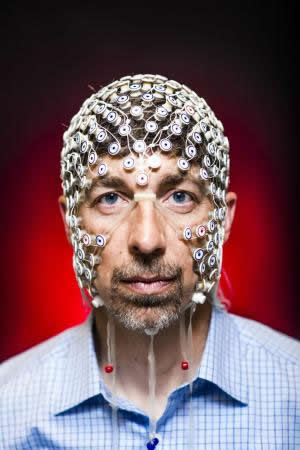
Electrical and computer engineering professor Barry Van Veen wears an electrode net used to monitor brain activity via EEG signals. His research with psychiatry professor and neuroscientist Giulio Tononi could help untangle what happens in the brain during sleep and dreaming. Credit Nick Berard.

Electrical and computer engineering professor Barry Van Veen wears an electrode net used to monitor brain activity via EEG signals. His research with psychiatry professor and neuroscientist Giulio Tononi could help untangle what happens in the brain during sleep and dreaming. Credit Nick Berard.

As real as that daydream may seem, its path through your brain runs opposite reality. Aiming to discern discrete neural circuits, researchers at the University of Wisconsin-Madison have tracked electrical activity in the brains of people who alternately imagined scenes or watched videos.

People with mentally taxing jobs, including lawyers and graphic designers, may end up having better memory in old age, research suggests.

Researchers at the RIKEN Brain Science Institute in Japan have identified a key neuronal pathway that makes learning to avoid unpleasant situations possible. Published online in the November 20 issue of Neuron, the work shows that avoidance learning requires neural activity in the habenula representing changes in future expectations.

Combining behavioral and physiologic measures depicts gradual process, may help diagnose sleep disorders. 

Neurophysicists have found that space-mapping neurons in the brain react differently to virtual reality than they do to real-world environments. Their findings could be significant for people who use virtual reality for gaming, military, commercial, scientific or other purposes.

New brain imaging technology is helping researchers to bridge the gap between art and science by mapping the different ways in which the brain responds to poetry and prose.

As methods of imaging the brain improve, neuroscientists and educators can now identify changes in children’s brains as they learn, and start to develop ways of personalizing instruction for kids who are falling behind.

Scientists have identified a weak spot in the human brain for Alzheimer’s disease and schizophrenia, revealing a connection between the two diseases.

A team of scientists has found a simple method to convert human skin cells into the specialized neurons that detect pain, itch, touch and other bodily sensations. These neurons are also affected by spinal cord injury and involved in Friedreich’s ataxia, a devastating and currently incurable neurodegenerative disease that largely strikes children.

Berkeley lab reports proper copper levels are essential to spontaneous neural activity.

Researchers are using an enhanced MRI approach to visualize brain injury in the blood brain barrier in order to identify significant changes to the blood-brain barrier in professional football players following a concussion.

A new study reports that older learners retained the mental flexibility needed to learn a visual perception task but were not as good as younger people at filtering out irrelevant information.

Finally this week, in the largest study of the genetics of memory ever undertaken, an international researcher team have discovered two common genetic variants that are believed to be associated with memory performance. The findings, which appear in the journal Biological Psychiatry, are a significant step towards better understanding how memory loss is inherited.


Weekly Neuroscience Update

Nerve cells communicate with each other via intricate projections. In brain diseases such as Alzheimer’s and Parkinson’s these extensions atrophy, thereby causing connectivity problems. Credit DZNE/Detlef Friedrichs.

Nerve cells communicate with each other via intricate projections. In brain diseases such as Alzheimer’s and Parkinson’s these extensions atrophy, thereby causing connectivity problems. Credit DZNE/Detlef Friedrichs.

A new study shows the interdependency between the structure and function of neurons.

Neuroscientists have discovered an unexpected benefit of getting older – a more nuanced understanding of social signals, such as the age of others.

Children with autism show different patterns of brain activity during everyday gestures and movements than controls do, suggest unpublished results presented at the 2014 Society for Neuroscience annual meeting.

Researchers have gained fresh insights into how ‘local’ body clocks control waking and sleeping.

People with bipolar disorder who are being treated with the drug lithium are at risk of acute kidney damage and need careful monitoring, according to new research.

Age-related Macular Degeneration (AMD) is the major cause of blindness in the western world, affecting around 50 million people. Now scientists at The University of Manchester have identified an important new factor behind its causes, which they hope could lead to new treatments.

A team of researchers has identified an enzyme key to the survival and spread of glioblastoma cancer cells that is not present in healthy brain cells, making the enzyme a promising therapeutic target.

It is claimed one in five students have taken the ‘smart’ drug Modafinil to boost their ability to study and improve their chances of exam success. But new research into the effects of Modafinil has shown that healthy students could find their performance impaired by the drug.

Researchers have developed new insight into a rare but deadly brain infection, called progressive multifocal leukoencephalopathy (PML). This disease – which is caused by the JC virus – is most frequently found in people with suppressed immune systems and, until now, scientists have had no effective way to study it or test new treatments.

New research offers insight into short-term effects of maternal caregiving on a developing brain.

A team of researchers  has now been able to demonstrate in a study that the bonding hormone oxytocin inhibits the fear center in the brain and allows fear stimuli to subside more easily. This basic research could also usher in a new era in the treatment of anxiety disorders.

Blocking a key receptor in brain cells that is used by oxygen free radicals could play a major role in neutralizing the biological consequences of Alzheimer’s disease, according to new research.

Finally this week, brain scientists have long believed that older people have less of the neural flexibility (plasticity) required to learn new things. A new study shows that older people learned a visual task just as well as younger ones, but the seniors who showed a strong degree of learning exhibited plasticity in a different part of the brain than younger learners did.


Weekly Neuroscience Update

The patterns of brain activity recorded in this fMRI scanner revealed how mental rest and reflection on past learning activities can boost future learning. Credit Jeff Luci.

The patterns of brain activity recorded in this fMRI scanner revealed how mental rest and reflection on past learning activities can boost future learning. Credit Jeff Luci.

A new study, which may have implications for approaches to education, finds that brain mechanisms engaged when people allow their minds to rest and reflect on things they’ve learned before may boost later learning.

Sixty-nine scientists at Stanford University and other institutions issued a statement that the scientific track record does not support the claims that so-called “brain games” actually help older adults boost their mental powers.

A new study examines link between brain cortex and food buying habits.

New research shows for the first time that engaging brain areas linked to so-called “off-task” mental activities (such as mind-wandering and reminiscing) can actually boost performance on some challenging mental tasks. The results advance our understanding of how externally and internally focused neural networks interact to facilitate complex thought.

We are more likely to be receptive to good news than bad, and researchers have gone some way to explaining why we prefer to look on the bright side.

Researchers have found a definitive link between gait – the way someone walks – and early changes in cognitive function in people with Parkinson’s diseaseAnd the findings, published in the journal Frontiers in Aging Neuroscience could mean that gait may be used as an early warning sign to help predict the development of cognitive impairment and dementia in Parkinson’s.

Exercise is one of the best ways to protect against dementia in later life and the earlier you start, the greater the effect, research suggests.

Finally this week, a previously unknown mechanism through which the brain produces new nerve cells after a stroke has been discovered at Lund University and Karolinska Institutet in Sweden. The findings have been published in the journal Science.

Weekly Neuroscience Update

EvC dwarfism results from genetic mutations that disrupt the signaling pathway known as sonic hedgehog (Shh). Statistical analyses confirmed the significant negative association between EvC and bipolar disorder. This further suggested that the Shh pathway plays a role in bipolar disorder. This image is for illustrative purposes only and shows the 3D structure of the Sonic Hedgehog protein. Credit Peter Znamenskiy/ Hall et al.

EvC dwarfism results from genetic mutations that disrupt the signaling pathway known as sonic hedgehog (Shh). Statistical analyses confirmed the significant negative association between EvC and bipolar disorder. This further suggested that the Shh pathway plays a role in bipolar disorder. This image is for illustrative purposes only and shows the 3D structure of the Sonic Hedgehog protein. Credit Peter Znamenskiy/ Hall et al.

Researchers have identified what is likely a key genetic pathway underlying bipolar disorder, a breakthrough that could lead to better drugs for treating bipolar affective disorder, as well as depression and other related mood disorders.

Hubs are locations in the brain where different networks come together to help us think and complete mental tasks. Now, a new study offers a fresh view of how injury affects the brain. It finds damage to brain hubs disrupts our capacity to think and adapt to everyday challenges more severely than damage to locations distant from hubs.

Neuroscientists have found that a gene mutation that arose more than half a million years ago may be key to humans’ unique ability to produce and understand speech.

A paper published this month in Biological Psychiatry shows that children who spent their early years in these institutions have thinner brain tissue in cortical areas that correspond to impulse control and attention.

Researchers have found vital new evidence on how to target and reverse the effects caused by one of the most common genetic causes of Parkinson’s.

Neuroscientists and engineers at North Carolina’s Duke University have pioneered a method with which the effects of transcranial magnetic stimulation (TMS) on the brain can be measured. The Duke team has made it possible to measure the response of a single neuron to an electromagnetic charge–something that has not before been possible. The work offers the potential to improve and initiate novel TMS therapy approaches.

Weekly Neuroscience Update

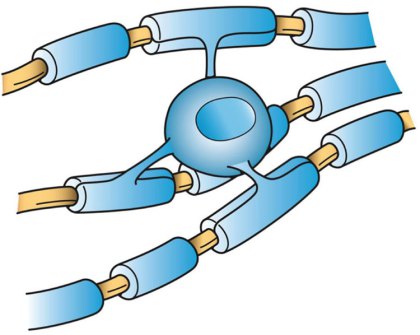
Oligodendrocytes are formed by a type of stem cell in the brain called oligodendrocyte progenitor cells (OPCs), and are responsible for re-wrapping, or remyelinating, the bare axons with myelin in response to injuries or diseases. This image is for illustrative purposes only and shows and artist’s representation of an oligodendrocyte. Credit Holly Fischer.

Oligodendrocytes are formed by a type of stem cell in the brain called oligodendrocyte progenitor cells (OPCs), and are responsible for re-wrapping, or remyelinating, the bare axons with myelin in response to injuries or diseases. This image is for illustrative purposes only and shows and artist’s representation of an oligodendrocyte. Credit Holly Fischer.

Like conducting an errant orchestra to play together, researchers are guiding processes that go awry in multiple sclerosis to repair themselves.

For the first time, scientists have discovered the exact mechanism rabies uses to efficiently enter the central nervous system, where it erupts in a toxic explosion of symptoms.

Neurons in human skin perform advanced calculations, previously believed that only the brain could perform.

Brain scans of college students have shed light on why people learn more effectively when their curiosity is piqued than when they are bored stiff. Researchers in the US found evidence that curiosity ramped up the activity of a brain chemical called dopamine, which in turn seemed to strengthen people’s memories.Students who took part in the study were better at remembering answers to trivia questions when they were curious, but their memories also improved for unrelated information they were shown at the same time.The findings suggest that while grades may have their place in motivating students, stimulating their natural curiosity could help them even more.

Researchers have discovered that T-cells – a type of white blood cell that learns to recognize and attack microbial pathogens – are activated by a pain receptor.

Quantitative tools dissect how two genes mutated in early-onset Parkinson’s disease collaborate in flagging damaged mitochondria.

A new study suggests a neural link between curiosity, motivation, and memory.

In a recent study published in the journal PLOS One, scientists uncovered a new pathway by which the brain uses an unusual steroid to control blood pressure. The study also suggests new approaches for treating high blood pressure and heart failure

Research using state-of-the-art eye-tracking technology has found that people suffering from chronic pain pay more frequent and longer attention to pain-related words than individuals who are pain-free.

The traditional view is that learning is based on the strengthening or weakening of the contacts between the nerve cells in the brain. However, this has been challenged by new research findings from Lund University in Sweden. These indicate that there is also a third mechanism – a kind of clock function that gives individual nerve cells the ability to time their reactions.

And finally this week, how your brain decides who to make friends with when you start university.

Weekly Neuroscience Update

Earlier research showed that progranulin levels were elevated near plaques in the brains of patients with Alzheimer’s disease, but it was unknown whether this effect counteracted or exacerbated neurodegeneration. This image is for illustrative purposes only. Credit NIH.

Earlier research showed that progranulin levels were elevated near plaques in the brains of patients with Alzheimer’s disease, but it was unknown whether this effect counteracted or exacerbated neurodegeneration. This image is for illustrative purposes only. Credit NIH.

Low levels of the naturally occurring protein progranulin exacerbate cellular and cognitive dysfunction, while raising levels can prevent abnormalities in an Alzheimer model.

Teenagers who said they had a traumatic brain injury in their lifetime, especially girls, also reported significantly higher rates of harmful behavior, according to new research.

A new University of Iowa study further supports an inescapable message: caregivers have a profound influence – good or bad – on the emotional state of individuals with Alzheimer’s disease. Patients may not remember a recent visit by a loved one or having been neglected by staff at a nursing home, but those actions can have a lasting impact on how they feel. The findings of this study are published in the September 2014 issue of the journal Cognitive and Behavioral Neurology.

A new study reveals individual neurons in the human brain are triggered by the subject’s conscious perception, rather than by the visual stimulus.

A chemical in the brain plays a vital role in controlling the involuntary movements and vocal tics associated with Tourette Syndrome (TS), a new study has shown.

Researchers discover how the brain works during meditation.

Finally, this week, teenagers who regularly do not get enough sleep are more likely to struggle academically, the results of a new study show. Swedish researchers looked at over 20,000 teenagers aged between 12 and 19 and found that those who regularly slept for less than seven hours per night were more likely to fail in school. Details of these findings are published in the journal, Sleep Medicine.

.


Weekly Neuroscience Update

The study by Kep Kee Loh and Dr Ryota Kanai found that grey-matter density in the highlighted region of the brain (anterior cingulate cortex) was negatively associated with the amount of media multitasking activity. Credit Kep Kee Loh & Ryota Kanai.

The study by Kep Kee Loh and Dr Ryota Kanai found that grey-matter density in the highlighted region of the brain (anterior cingulate cortex) was negatively associated with the amount of media multitasking activity. Credit Kep Kee Loh & Ryota Kanai.

Simultaneously using mobile phones, laptops and other media devices could be changing the structure of our brains, according to new University of Sussex research.

Breathing meditation is a powerful ally for military veterans recovering from post-traumatic stress disorder (PTSD), according to research recently published in the Journal of Traumatic Stress.

Areas of the brain that respond to reward and pleasure are linked to the ability of a drug known as butorphanol to relieve itch, according to new research.

An international research team has identified gene mutations causing severe, difficult-to-treat forms of childhood epilepsy.

A chemical in the brain plays a vital role in controlling the involuntary movements and vocal tics associated with Tourette Syndrome (TS), a new study has shown.

Finally this week, the traditional understanding in neuroscience is that tactile sensations from the skin are only assembled to form a complete experience in the cerebral cortex, the most advanced part of the brain. However, this is challenged by new research findings from Lund University in Sweden that suggest both that other levels in the brain play a greater role than previously thought, and that a larger proportion of the brain’s different structures are involved in the perception of touch.


Weekly Neuroscience Update

The study revealed that EGFR signaling is suppressed in a subset of glioblastomas. This image is for illustrative purposes only and shows an MRI brain scan of a person with glioblastoma brain cancer. Credit The Armed Forces Institute of Pathology.

The study revealed that EGFR signaling is suppressed in a subset of glioblastomas. This image is for illustrative purposes only and shows an MRI brain scan of a person with glioblastoma brain cancer. Credit The Armed Forces Institute of Pathology.

Researchers have found one of the keys to why certain glioblastomas – the primary form of a deadly brain cancer – are resistant to drug therapy. The answer lies not in the DNA sequence of the tumor, but in its epigenetic signature. These findings have been published online as a priority report in the journal Oncotarget.

It has been proposed that green tea extract may have a beneficial impact on cognitive functioning, suggesting promising clinical implications. However, the neural mechanisms underlying this putative cognitive enhancing effect of green tea extract still remain unknown.

According to researchers at the University of Montreal, the regions of the brain below the cortex play an important role as we train our bodies’ movements and, critically, they interact more effectively after a night of sleep.

Researchers find that the risk of future stroke is 39% higher among patients with cognitive impairment than those with normal cognitive function, according to a new study published in the Canadian Medical Association Journal (CMAJ).

A study is shining new light on a sleep disorder called “sleep drunkenness.” The disorder may be as prevalent as affecting one in every seven people. The research is published in Neurology.

A mindfulness-based therapy for depression has the added benefit of reducing health-care visits among patients who often see their family doctors, according to a new study.

In what may be the largest study of sleep problems among individuals with multiple sclerosis (MS), researchers at UC Davis have found that widely undiagnosed sleep disorders may be at the root of the most common and disabling symptom of the disease: fatigue.

Scientists have provided the first evidence that the lack of a naturally occurring protein is linked to early signs of dementia.

Weekly Neuroscience Update

Scientists used gene chips to help discover new genes that may be involved with Parkinson’s disease. Credit National Human Genome Research Institute.

cientists used gene chips to help discover new genes that may be involved with Parkinson’s disease. Credit National Human Genome Research Institute.

Using data from over 18,000 patients, scientists have identified more than two dozen genetic risk factors involved in Parkinson’s disease, including six that had not been previously reported.

Latest research says depression is a risk factor for dementia.

The happiness of over 18,000 people worldwide has been predicted by a mathematical equation, with results showing that moment-to-moment happiness reflects not just how well things are going, but whether things are going better than expected. And in another study, research suggests the right kind of happiness can change the code that defines our very being: our genes.

New research has mapped out the complex set of genes which interact with the environment to crystalise  reading and math abilities.

Children who have been abused or neglected early in life are at risk for developing both emotional and physical health problems. In a new study, scientists have found that maltreatment affects the way genes are activated, which has implications for children’s long-term development.

Scientists have discovered which brain networks are responsible when frustration leads to rage.

Adolescents who behave aggressively are more likely to drink alcohol and in larger quantities than their peers, according to a recent study completed in Finland. Depression and anxiety, on the other hand, were not linked to increased alcohol use. The study investigated the association between psychosocial problems and alcohol use among 4074 Finnish 13- to 18-year-old adolescents. The results were published in Journal of Adolescence.

New findings suggests that mild concussion may cause cognitive and memory problems.

Finally this week research conducted at the University of Adelaide, suggests that at least one part of the human brain may be able to process information the same way in older age as it does in the prime of life.


Weekly Neuroscience Update

Granule cells connect with other cells via long projections (dendrites). The actual junctions (synapses) are located on thorn-like protuberances called “spines”. Spines are shown in green in the computer reconstruction Credit DZNE/Michaela Müller.

Granule cells connect with other cells via long projections (dendrites). The actual junctions (synapses) are located on thorn-like protuberances called “spines”. Spines are shown in green in the computer reconstruction Credit DZNE/Michaela Müller.

New findings on the link between nerve cells at the interface to the hippocampus may have an influence on learning and memory.

People choosing between two or more equally positive outcomes experience paradoxical feelings of pleasure and anxiety, feelings associated with activity in different regions of the brain, according to research at the Princeton Neuroscience Institute at Princeton University.

Latest findings on how stress hormones promote the brain’s building of negative memories.

Researchers have studied the changes in the brain that are associated with impulsiveness, a personality trait that causes difficulties in inhibiting a response in the face of a stimulus and leads to unplanned actions without considering the negative consequences. These patterns can serve as an indicator for predicting the risk of behavioural problems.

People taking dopamine for Parkinson’s disease sometimes begin to generate a lot of artwork. New research differentiates their expressiveness from obsessive or impulsive tendencies.

Researchers have uncovered more than 100 genetic markers linked to developing schizophrenia.

A type of immune cell widely believed to exacerbate chronic adult brain diseases, such as Alzheimer’s disease and multiple sclerosis (MS), can actually protect the brain from traumatic brain injury (TBI) and may slow the progression of neurodegenerative diseases, according to research published in the online journal Nature Communications.