Weekly Neuroscience Update

Current treatment methods used are transcranial direct current simulation (tDCS) – which is application of a low intensity direct (constant) current between two electrodes on the head, and transcranial alternating current simulation (tACS) – which sees a constant electrical current flow back and forth. Image credit: Monash University.

Current treatment methods used are transcranial direct current simulation (tDCS) – which is application of a low intensity direct (constant) current between two electrodes on the head, and transcranial alternating current simulation (tACS) – which sees a constant electrical current flow back and forth. Image credit: Monash University.

Researchers have discovered a new technique to enhance brain excitability that could improve physical performance in healthy individuals such as athletes and musicians.

The constant movement of children with attention-deficit/hyperactivity disorder (ADHD) may be distracting — but the fidgeting also may improve their cognitive performance, a study has found.

It is known that sleep facilitates the formation of long-term memory in humans. In a new study, researchers show that sleep does not only help form long-term memory but also ensures access to it during times of cognitive stress.

An international team of neuroscientists has proved the uniqueness of screams for the first time. In a study, they discovered that screams possess very special acoustic properties: This makes them a specific type of vocal expression which is only used in stressful and dangerous situations.

A new study published in the journal Cerebral Cortex suggests people who speak two languages have more gray matter in the executive control region of the brain.

Structural brain abnormalities in patients with schizophrenia, providing insight into how the condition may develop and respond to treatment, have been identified in an internationally collaborative study

Memories that have been “lost” as a result of amnesia can be recalled by activating brain cells with light.

High blood levels of a growth factor known to enable new blood vessel development and brain cell protection correlate with a smaller size of brain areas key to complex thought, emotion and behavior in patients with schizophrenia, researchers report in the journal Molecular Psychiatry.

Scientists have discovered a link between autism and genetic changes in some segments of DNA that are responsible for switching on genes in the brain.

Finally this week, new research has found that types of empathy can be predicted by looking at physical differences in the brain. This raises the fascinating possibility that some kinds of empathy might be able to be increased by training or that it might be possible for people to lose their empathy over time.

Weekly Neuroscience Update

Findings suggest that physiological reactivity to sad stimuli, assessed using pupillometry, serves as one potential biomarker of depression risk among children of depressed mothers. Image credit: Jonathan Cohen, Binghamton University Photographer.

Findings suggest that physiological reactivity to sad stimuli, assessed using pupillometry, serves as one potential biomarker of depression risk among children of depressed mothers. Image credit: Jonathan Cohen, Binghamton University Photographer.

How much a child’s pupil dilates in response to seeing an emotional image can predict his or her risk of depression over the next two years, according to new research from Binghamton University.

Unwanted, intrusive visual memories are a core feature of stress- and trauma-related clinical disorders such as posttraumatic stress disorder (PTSD), but they can also crop up in everyday life. New research shows that even once intrusive memories have been laid down, playing a visually-demanding computer game after reactivating the memories may reduce their occurrence over time.

Rapid eye movement or REM sleep actively converts waking experiences into lasting memories and abilities in young brains reports a new study.

People who have diabetes and experience high rates of complications are more likely to develop dementia as they age than people who have fewer diabetic complications, according to a new study published in the Endocrine Society’s Journal of Clinical Endocrinology & Metabolism.

New research suggests that when deciding which of several possible actions to perform, the human brain plans multiple actions simultaneously prior to selecting one of them to execute.

In the first study of its kind researchers found that neurons in a specific brain region play a key role in rapidly forming memories about every day events, a finding that may result in a better understanding of memory loss and new methods to fight it in Alzheimer’s and other neurological diseases.

A major epidemiological registry-based study indicates that Parkinson’s disease begins in the gastrointestinal tract; the study is the largest in the field so far.

The activity of the emotion centres in the brain, the amygdala, is influenced by motivation rather than by the emotions themselves. This can be concluded from research carried out at Radboud University into the hormone testosterone. Testosterone increases amygdala activity in a person who is approaching a socially threatening situation and decreases the activity when such a situation is avoided.

An imaging study by Stanford University School of Medicine investigators has found distinct differences between the brains of patients with chronic fatigue syndrome and those of healthy people.

According to a new study, women experiencing difficulty with time management, attention, organization, memory, and problem solving – often referred to as executive functions – related to menopause may find improvement with a drug already being used to treat attention deficit hyperactivity disorder (ADHD

A new staining method could help map the entire brain.

Finally this week, Yale researchers have determined how a key component of the nervous system develops at the embryonic stage. Their work may ultimately offer new approaches to combat major diseases such as diabetes and peripheral artery disease.


Weekly Neuroscience Update

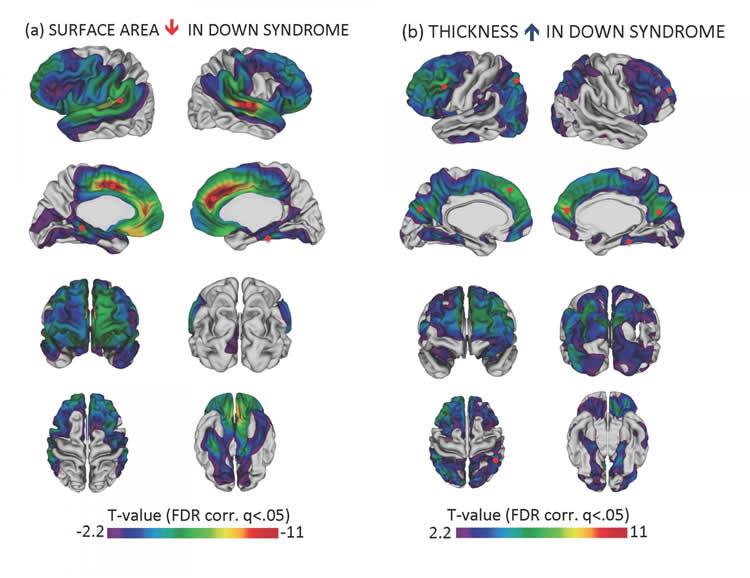
Reductions in cortical surface area and increases in cortical thickness in Down syndrome relative to typical controls. Panel A shows that the cortex surface area is lower in Down syndrome; panel B shows that the cortex is thicker in Down syndrome brains. Small red circles indicate the approximate locations where cortical surface area and thickness were most different between brains of participants with Down syndrome and brains of typically developing participants. Image credit: Lee et al., National Institute of Mental Health

Reductions in cortical surface area and increases in cortical thickness in Down syndrome relative to typical controls. Panel A shows that the cortex surface area is lower in Down syndrome; panel B shows that the cortex is thicker in Down syndrome brains. Small red circles indicate the approximate locations where cortical surface area and thickness were most different between brains of participants with Down syndrome and brains of typically developing participants. Image credit: Lee et al., National Institute of Mental Health

The thickness of the brain’s cerebral cortex could be a key to unlocking answers about intellectual development in youth with Down Syndrome. It could also provide new insights to why individuals with this genetic neurodevelopmental disorder are highly susceptible to early onset Alzheimer’s Disease later in life.

In a study published in The Journal of Experimental Medicine, researchers report a surprising finding that challenges current anatomy and histology textbook knowledge: Lymphatic vessels are found in the central nervous system where they were not known to exist.

Changes in the vaginal microbiome are associated with effects on offspring gut microbiota and on the developing brain, according to a new study published in Endocrinology, a journal of the Endocrine Society.

Researchers discover that a protein called Taranis could hold the key to a good night’s sleep.

A team of researchers has now been able to demonstrate in a study that the bonding hormone oxytocin inhibits the fear center in the brain and allows fear stimuli to subside more easily. This basic research could also usher in a new era in the treatment of anxiety disorders.

Early life stress affects cognitive functioning in low-income children.

Researchers at Monash University have found physical differences in the brains of people who respond emotionally to others’ feelings, compared to those who respond more rationally, in a study published in the journal NeuroImage.

Having a stroke ages a person’s brain function by almost eight years, new research finds — robbing them of memory and thinking speed as measured on cognitive tests. In another pilot study, women who experience more hot flashes, particularly while sleeping, during the menopause transition are more likely to have brain changes reflecting a higher risk for cerebrovascular disease, such as stroke and other brain blood flow problems.

Researchers discover the anatomic reasons for the persistence of musical memory in Alzheimer patients.

A new study on successful ageing has linked better memory performance in older age with patterns of neural compensation. The research sheds light on how memory can remain efficient in spite of common age-related neural decline.

There are more boys than girls diagnosed with autism spectrum disorder (ASD). Now, a study shows that behaviors relevant to autism are more frequently observed in boys than in girls, whether they’re at risk of autism or not. Meanwhile an early intervention program for toddlers with autism spectrum disorder improves their intellectual abilities and reduces autism symptoms – and those results persist years after the children originally received treatment, according to a recent study. And in another study, using functional magnetic resonance imaging, a team of  researchers has shown for the first time that children with autism spectrum disorder who are overly sensitive to sensory stimuli have brains that react differently than those with the disorder who don’t respond so severely to noises, visual stimulation and physical contact.

The stress hormone cortisol strengthens memories of scary experiences. 

Finally, this week, researchers have found that people who speak more than one language have twice as much brain damage as unilingual people before they exhibit symptoms of Alzheimer’s disease. It’s the first physical evidence that bilingualism delays the onset of the disease.


Weekly Neuroscience Update

Brain cell density remains constant with age among cognitively normal adults. (Courtesy of Dr. Keith Thulborn)

Brain cell density remains constant with age among cognitively normal adults. (Courtesy of Dr. Keith Thulborn)

New, ultra-high-field magnetic resonance images (MRI) of the brain provide the most detailed images to date to show that while the brain shrinks with age, brain cell density remains constant.

In a stunning discovery that overturns decades of textbook teaching, researchers have determined that the brain is directly connected to the immune system by vessels previously thought not to exist. That such vessels could have escaped detection when the lymphatic system has been so thoroughly mapped throughout the body is surprising on its own, but the true significance of the discovery lies in the effects it could have on the study and treatment of neurological diseases ranging from autism to Alzheimer’s disease to multiple sclerosis.

A new MRI study has found distinct injury patterns in the brains of people with concussion-related depression and anxiety, according to a new study published online in the journal Radiology.

Children and adolescents who received deep brain stimulation for generalized dystonia maintained significant symptom relief for up to eight years, according to a study presented at the 12th World Congress of the International Neuromodulation Society.

An international team of researchers is using data mapping methods created to track the spread of information on social networks to trace its dissemination across a surprisingly different system: the human brain.

A previously unknown link between the immune system and the death of motor neurons in Amyotrophic lateral sclerosis (ALS), also known as Lou Gehrig’s disease, has been discovered. The finding paves the way to a whole new approach for finding a drug that can cure or at least slow the progression of such neurodegenerative diseases as ALS, Alzheimer’s, Parkinson’s and Huntington’s diseases.

Spoken sentences can be reconstructed from activity patterns of human brain surface. “Brain to Text” combines knowledge from neuroscience, medicine and informatics.

Finally this week, scientists have figured out how newly learned concepts form in the human brain by visualizing how new information gets filed. They say this is the first time science visually witnessed how and where specific objects are coded in the brain.


Weekly Neuroscience Update

A new study has found that while stereotypic shapes exist for this structure, individuals with a broader hippocampus tend to perform better on various tests that assess memory. The image is for illustrative purposes only. Image credit: Camillo Golgi.

A new study has found that while stereotypic shapes exist for this structure, individuals with a broader hippocampus tend to perform better on various tests that assess memory. The image is for illustrative purposes only. Image credit: Camillo Golgi.

New research challenges the long-held belief that a larger hippocampus is directly linked to improved memory function.

Premature birth can alter the connectivity between key areas of the brain, according to a new study led by King’s College London. The findings should help researchers to better understand why premature birth is linked to a greater risk of neurodevelopmental problems, including autistic spectrum disorders and attention deficit disorders.

Scientists have uncovered mathematical equations behind the way the brain forms – and even loses – memories.

New scanning methods which map the wiring of the brain could provide a valuable new tool to predict people at risk of schizophrenia, according to a new study.

People with depression may be more likely to develop Parkinson’s disease, according to a large study published in Neurology.

Medical researchers have known for several years that there is some sort of link between long-term depression and an increased risk of stroke. But now scientists are finding that even after such depression eases, the risk of stroke can remain high.

A new study from the University of Cambridge has identified one of the oldest fossil brains ever discovered – more than 500 million years old – and used it to help determine how heads first evolved in early animals.

Researchers have succeeded in reconstructing the neuronal networks that interconnect the elementary units of sensory cortex — cortical columns. The scientists say that this study marks a major step forward to advance the understanding of the organizational principles of the neocortex and sets the stage for future studies that will provide extraordinary insight into how sensory information is represented, processed and encoded within the cortical circuitry.

Smokers who are able to quit might actually be hard-wired for success, according to a study from Duke Medicine.

Scientists are attempting to mimic the memory and learning functions of neurons found in the human brain. To do so, they investigated the electronic equivalent of the synapse, the bridge, making it possible for neurons to communicate with each other.

Finally this week, in a study using functional magnetic resonance imaging, scientists found that our inherent risk-taking preferences affect how we view and act on information from other people.

Weekly Neuroscience Update

brain-scan-reveals-out-of-body-illusion-neuroinnovations

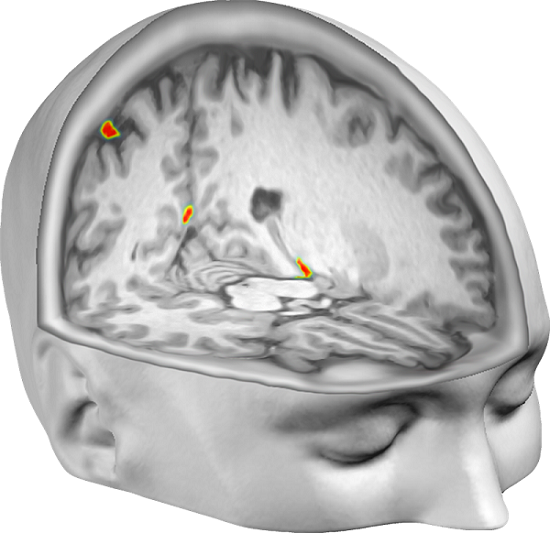
Brain regions in which the scientists could successfully decode the participants’ perceived self-location from patterns of neural activity. Credit: Malin Björnsdotter/Arvid Guterstam. Henrik Ehrsson , Arvid Guterstam , Malin Björnsdotter.

In a new study from Sweden’s Karolinska Institutet, neuroscientists created an out-of-body illusion in participants placed inside a brain scanner. They then used the illusion to perceptually ‘teleport’ the participants to different locations in a room and show that the perceived location of the bodily self can be decoded from activity patterns in specific brain regions.

The brains of people with type 1 diabetes show signs of accelerated ageing that correlate with slower information processing, according to new research.

Researchers studying postpartum depression have found that the hormone oxytocin increased activation in a reward-sensitive area of the brain when women viewed images of crying infants, but not when they viewed images of smiling ones. The researchers say oxytocin might spark the motivation to help an upset baby.

New findings reveal how long term cosmic ray exposure causes lasting cognitive impairment in astronauts.

People with depression or bipolar disorder often feel their thinking ability has gotten “fuzzy”, or less sharp than before their symptoms began. Now, researchers have shown in a very large study that effect is indeed real – and rooted in brain activity differences that show up on advanced brain scans.

Researchers have shown for the first time that a common neurotransmitter acts via a single type of neuron to enable the brain to process information more effectively. 

Finally this week, your genes may influence how sensitive you are to emotional information, according to research recently published in the Journal of Neuroscience. The study found that carriers of a certain genetic variation perceived positive and negative images more vividly, and had heightened activity in certain brain regions.


Weekly Neuroscience Update

researchers have developed a method to map the circuitry of the brain with a “Neuronal Positioning System” (NPS) similar to how a Global Positioning System (GPS) triangulates our location on the planet. Image credit: Dr. Shlomo Tsuriel and Dr. Alex Binshtok, Hebrew University of Jerusalem.

researchers have developed a method to map the circuitry of the brain with a “Neuronal Positioning System” (NPS) similar to how a Global Positioning System (GPS) triangulates our location on the planet. Image credit: Dr. Shlomo Tsuriel and Dr. Alex Binshtok, Hebrew University of Jerusalem.

In new research scientists have announced a “Neuronal Positioning System” (NPS) that maps the circuitry of the brain, similar to how a Global Positioning System (GPS) receiver triangulates one’s location on the planet.

EPFL scientists have developed a new method that can accurately simulate the chemical modification of the protein behind Parkinson’s disease. The technique, has opened a new way of understanding Parkinson’s, and can be expanded to other proteins and diseases as well.

Neuroscientists have found a way to activate opioid receptors with light.

New research shows that chemotherapy can lead to excessive mind wandering and an inability to concentrate. Dubbed ‘chemo-brain,’ the negative cognitive effects of the cancer treatment have long been suspected, but the study is the first to explain why patients have difficulty paying attention.

A study provides new evidence that book sharing in early childhood may promote brain development supporting reading readiness.

An international team of scientists has discovered what amounts to a molecular reset button for our internal body clock. Their findings reveal a potential target to treat a range of disorders, from sleep disturbances to other behavioral, cognitive, and metabolic abnormalities, commonly associated with jet lag, shift work and exposure to light at night, as well as with neuropsychiatric conditions such as depression and autism.

New findings provide potential explanations for the very high percentage of post-traumatic disorders in combat.

Scientists have discovered that neurons are risk takers: They use minor “DNA surgeries” to toggle their activity levels all day, every day. Since these activity levels are important in learning, memory and brain disorders, the researchers think their finding will shed light on a range of important questions.

Women may have a more difficult time than men in recovering from concussion, according to a new study published online in the journal Radiology.

Finally this week, researchers report a previously unappreciated phenomenon in which the location of injury to a neuron’s communication wire in the spinal cord — the axon — determines whether the neuron simply stabilizes or attempts to regenerate. The study, published by Neuron, demonstrates how advances in live-imaging techniques are revealing new insights into the body’s ability to respond to spinal cord injuries.


Weekly Neuroscience Update


Brain-scan-images-by-Hospital-Sant-Pau-702x336

A new study published in the American journal with the highest impact factor in worldwide,Molecular Psychiatry, reveals that consumers of cannabis are more prone to experiencing false memories.

Excessive movement common among children with attention-deficit/hyperactivity disorder is actually vital to how they remember information and work out complex cognitive tasks, a new study shows. The findings show the longtime prevailing methods for helping children with ADHD may be misguided.

Brain scans of students from contrasting backgrounds have made visible the legacy of a challenging childhood. Important brain regions are more developed among children raised in a comfortable home environment.

New research published in the journal Nature Communications represents a potentially fundamental shift in our understanding of how nerve cells in the brain generate the energy needed to function. The study shows neurons are more independent than previously believed and this research has implications for a range of neurological disorders.

Every time you make a memory, somewhere in your brain a tiny filament reaches out from one neuron and forms an electrochemical connection to a neighbouring neuron. A team of biologists at Vanderbilt University is studying how these connections are formed at the molecular and cellular level.

Finally this week, among the advice new parents receive is to read to their babies early and often. The hope is that sharing books together will help children’s language development and eventually, turn them into successful readers. Now there is evidence that reading to young children is in fact associated with differences in brain activity supporting early reading skills.

Weekly Neuroscience Update

The strength of brain areas mapped on to the cortical surface. Warm colors indicate high strength in the driver network and cool colors indicate low strength. Image credit: UCSB.

The strength of brain areas mapped on to the cortical surface. Warm colors indicate high strength in the driver network and cool colors indicate low strength. Image credit: UCSB.

A team of researchers provides new insight into what occurs in the brain during the learning process.

Neuroscientists have discovered how the powerful brain hormone oxytocin acts on individual brain cells to prompt specific social behaviors – findings that could lead to a better understanding of how oxytocin and other hormones could be used to treat behavioral problems resulting from disease or trauma to the brain.

Infants have innate knowledge about the world and when their expectations are defied, they learn best, researchers at Johns Hopkins University found.

Research on large-scale brain networks by the University of Michigan Medical School reveals that “hubs” in the brain – highly connected regions that like hubs of the airport system – tend to consistently attract information flow.

Over 70% of schizophrenia patients who are “treatment resistant” have apparently developed dopamine supersensitivity psychosis from long-term use of antipsychotic medications, according to a study in Psychiatry Research.

Meaningful activities experienced with others may reverse the normal brain shrinkage associated with the aging process.

Researchers from Royal Holloway, University of London have found that successful long-term learning happens after classroom teaching, after the learners have slept on the new material.

An international team of researchers have revealed in a collaborative study published in Neuron, that neurons in the eye change on the molecular level when they are exposed to prolonged light. The researchers could identify that a feedback signalling mechanism is responsible for these changes. The innate neuronal property might be utilized to protect neurons from degeneration or cell death in the future.

Finally this week, while recent reports question whether fish oil supplements support heart health, UC Irvine scientists have found that the fatty acids they contain are vitally important to the developing brain.


Weekly Neuroscience Update

age-brain-related-changes-autism

Researchers at the University of Miami find that large-scale connectivity in autism changes with age.

Although scientists know that depression affects the brain, they don’t know why some people respond to treatment while others do not. Now a team of researchers has shown for the first time in a large cohort of patients that electroconvulsive therapy (ECT), sometimes referred to as shock treatment, change certain areas of the brain that play a role in how people feel, learn and respond to positive and negative environmental factors.

Research by biologists at the University of York has identified new mechanisms potentially driving progression of an aggressive form of dementia.

A new study shows that the act of remembering leads to the subtle forgetting of other memories.

When we look at a known word, our brain sees it like a picture, not a group of letters needing to be processed. That’s the finding from a Georgetown University Medical Center (GUMC) study published in the Journal of Neuroscience, which shows the brain learns words quickly by tuning neurons to respond to a complete word, not parts of it.

Scientists at the University of Bonn have discovered a new cause of temporal lobe epilepsy.

Brown fat tissue, the body’s “good fat,” communicates with the brain through sensory nerves, possibly sharing information that is important for fighting human obesity, such as how much fat we have and how much fat we’ve lost, according to research published in the Journal of Neuroscience.

Finally this week, people who have suffered serious head injuries show changes in brain structure resembling those seen in older people, according to a new study.