The cerebellum (Latin for “little brain”) is a major feature of the hindbrain of all vertebrates.
Why do you need your cerebellum? Find out in this video which received Honorable Mention in the 2017 Brain Awareness Video Contest.
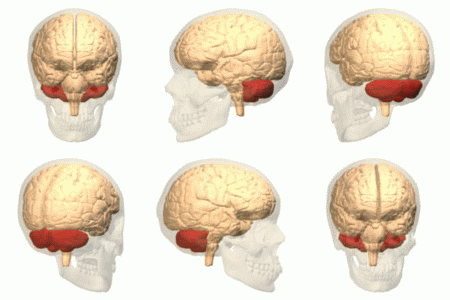
The cerebellum (Latin for “little brain”) is a major feature of the hindbrain of all vertebrates.
Why do you need your cerebellum? Find out in this video which received Honorable Mention in the 2017 Brain Awareness Video Contest.
West Australian instrumentalist and drummer Sam Maher performs on the handpan, exploring the ability for this instrument to transcend language and medicine.
Sean Mackey, MD, PhD, Redlich Professor and Chief of the Division of Pain Medicine at Stanford University, speaks on “Pain and the Brain” at Stanford Back Pain Education Day 2016.
*Yaaawwwwwn* Did just reading the word make you feel like yawning yourself? Known as contagious yawning, the reasons behind this phenomenon have been attributed to both the physiological and psychological. It’s been observed in children as young as four and even in dogs! Claudia Aguirre visits the many intriguing theories that might explain contagious yawning.
Learn more at http://news.mit.edu/2016/imaging-brain-multiple-size-scales-0725
In this short video excerpt from “Arrested Development: The Teenage Brain and Substance Abuse,” Nora D. Volkow, MD, Director, National Institute on Drug Abuse, U.S. National Institutes of Health, speaks about addiction and the teenage brain.
Study investigates crowd behaviour under stress in a virtual environment.
In emergency situations such as terrorist attacks, natural catastrophes, and fires, there is always a risk of mass panic leading to deadly crowd disasters. But what causes mass panic and where are the danger zones? An international researcher team examined these questions in a virtual environment and their results have been published in the Journal of the Royal Society Interface.
Because these questions are difficult to study in the real world, the international research team exposed 36 participants to an emergency in a three-dimensional virtual environment. Each participant simultaneously navigated an avatar through virtual space on a computer screen. The researchers studied the participants‘ behaviours in several experiments, setting them various tasks under high-stress conditions.
To find out how the participants reacted in an emergency situation, the researchers simulated an evacuation from a complex building with four exits, only one of which was usable. Although most of the group did not know which was the correct exit, some participants were directed to it by an arrow at the top of their computer screen. Participants knew that some group members were aware of the correct exit, but they did not know who those people were. In addition, the researchers increased the stress level by putting participants under time pressure and monetary pressure: Participants had to escape the building within 50 seconds to avoid a substantial loss of points. At the end of the session, the points won were converted into monetary bonuses. Further stress-inducing elements were poor lighting, red blinking lights, and fires at the blocked exits.
The experiments showed that collisions and pushing increased quickly under stress. The most dangerous zones were places where decisions had to be made, areas where bottlenecks occurred and caused congestion, and dead ends where participants were forced to turn around and walk back against the flow of the crowd.
The researchers also looked at group dynamics during the stressful evacuation situation. Their analyses revealed that individuals were exposed to much stronger social signals under high stress and high density levels than in less stressful situations. In other words, they were more aware of where the group was going, what it was doing, and how it was feeling, and were thus more strongly influenced by the group. The study’s findings indicate that individuals are more likely to follow a group under the influence of these strong social signals. This can quickly lead to mass herding and dangerous overcrowding.
Source: Mehdi Moussaïd – Max Planck Institute
Interfering with your vision makes it harder to describe what you know about the appearance of even common objects, according to new research.
Study participants were asked recall bits of visual information they know about specific objects. Half the time, they saw a blast of coloured static meant to disrupt the parts of the brain that process visual information. The static made a significant difference in their ability to recall the correct information, showing a connection between visual memory and the visual perception systems in the brain.
Visual interference selectively interrupted their ability to answer questions about the visual properties of objects. They had trouble trying to recall that kind of information. But it didn’t change how good they were at accessing what they knew about the nonvisual properties of the same objects.
For more on this study click here.
A new study provides insight into how synapses are formed in cortical neurons during early postnatal stages.
A new map of the human brain could be the most accurate yet, as it combines all sorts of different kinds of data. This might finally solve a century of disagreements over the shapes and positions of different brain areas.
Read more on this story in Nature.
 inside-the-brain.com