Weekly Neuroscience Update

band-691224_960_720.jpgIt may be possible to categorise the brain strategies used by professional musicians based on how they prioritise sight vs. sound when learning to play new music, according to a new study.

When we are in a deep sleep our brain’s activity ebbs and flows in big, obvious waves, like watching a tide of human bodies rise up and sit down around a sports stadium. It’s hard to miss. Now, Stanford researchers have found, those same cycles exist in wake as in sleep, but with only small sections sitting and standing in unison rather than the entire stadium. It’s as if tiny portions of the brain are independently falling asleep and waking back up all the time.

Researchers report the hippocampus isn’t just important for remembering past events, it also plays a vital role in future planning.

According to a new study, the brain blocks the ability for creating new memories shortly after waking in order to prevent the disruption of the stabilisation of memory consolidation that occurs during sleep.

Patients with depression can be categorised into four unique sub-types defined by distinct patterns of abnormal connectivity in the brain, according to new research.

The inability to hear subtle changes in pitch, a common and debilitating problem for people with schizophrenia, is due to dysfunctional N-methyl-D-aspartate (NMDA) brain receptors, according to a study by Columbia University Medical Center (CUMC) researchers. The study also shows that this hearing issue can be improved by combining auditory training exercises with a drug that targets NMDA receptors.

Researchers report abnormal activation in areas that respond to normal pain when a person with CRPS witnesses another person experience painful stimuli.

A new study has revealed the way that the brain handles the often noisy environments found on this planet, with the results explaining why animals, including humans, can easily cope with both the still and quiet of early-morning parks to the bustle and hubbub of cafés and streets. The researchers discovered that as auditory neurons become more familiar with a sound environment, they speed up their adaption to the noisiness of that environment.

The human brain is predisposed to learn negative stereotypes, according to research that offers clues as to how prejudice emerges and spreads through society.

Finally this week, researchers have conducted the first study of its kind, using proton magnetic resonance spectroscopy (MRS) to look at brain regions in both adults and children who stutter.


Brain Networking Among Musicians

When musicians play, what is happening inside their brains? Scientists at Berlin’s Max Planck Institute for Human Development have discovered that while performing together, their neurological activity goes into a kind of synchronization mode – almost as though they were connected by a wireless network.

Weekly Neuroscience Update

Brain-MRI-by-Hongwen-Song-et-al-702x336

A research team has used neuroimaging techniques to investigate how being in a romantic relationship produces alterations in the architecture of the brain. They found that being in love is associated with increased connectivity between regions of the brain associated with reward, motivation, emotion regulation, and social cognition.

Research from McGill University reveals that the brain’s motor network helps people remember and recognize music that they have performed in the past better than music they have only heard.

The human brain can select relevant objects from a flood of information and edit out what is irrelevant. It also knows which parts belong to a whole. If, for example, we direct our attention to the doors of a house, the brain will preferentially process its windows, but not the neighbouring houses. Psychologists have now discovered that this also happens when parts of the objects are merely maintained in our memory.

Researchers have found that teens who smoked marijuana daily for several years have an abnormally shaped hippocampus and do poorly on tasks involving long-term memory.

A new study has shown how intentional recall is beyond a simple reawakening of a memory; and actually leads us to forget other competing experiences that interfere with retrieval.

Researchers have identified key cells within the brain that are critical for determining circadian rhythms, the 24-hour processes that control sleep and wake cycles, as well as other important body functions such as hormone production, metabolism, and blood pressure

New York University researchers have devised a computer model to explain how a neural circuit learns to classify sensory stimuli into discrete categories, such as “car vs. motorcycle.” Their findings, which appear in the journal Nature Communications, shed new light on the brain processes underpinning judgments we make on a daily basis.

Queensland scientists have found that non-invasive ultrasound technology can be used to treat Alzheimer’s disease and restore memory.

Researchers at MIT have developed a method to stimulate brain tissue using external magnetic fields and injected magnetic nanoparticles — a technique allowing direct stimulation of neurons, which could be an effective treatment for a variety of neurological diseases, without the need for implants or external connections.

Researchers have come up with a new way to evaluate how well computers can divine information from images. The team describes its new system as a “visual Turing test,” after the legendary computer scientist Alan Turing’s test of the extent to which computers display human-like intelligence.

Thousands of genetic “dimmer” switches, regions of DNA known as regulatory elements, were turned up high during human evolution in the developing cerebral cortex, according to new research from the Yale School of Medicine.

Finally this week, a new study finds that giving a drug that changes the neurochemical balance in the brain causes a greater willingness to engage in prosocial behaviors, such as ensuring that resources are divided more equally.

How playing an instrument benefits your brain

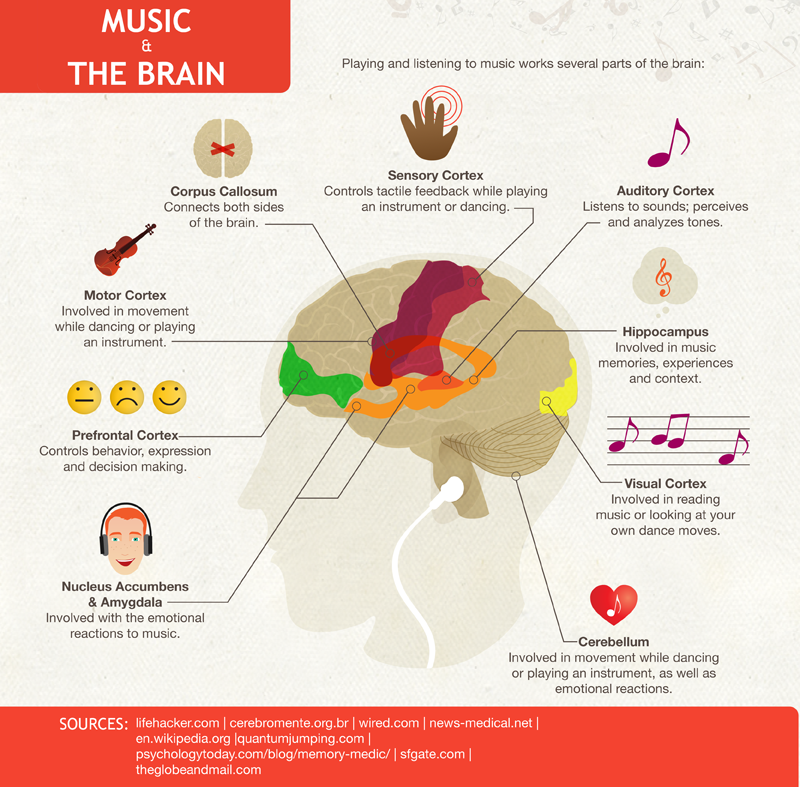
When you listen to music, multiple areas of your brain become engaged and active. But when you actually play an instrument, that activity becomes more like a full-body brain workout. What’s going on?

In this video, Anita Collins explains the fireworks that go off in musicians’ brains when they play, and examines some of the long-term positive effects of this mental workout.

How playing an instrument benefits your brain

When you listen to music, multiple areas of your brain become engaged and active. But when you actually play an instrument, that activity becomes more like a full-body brain workout. What’s going on? In this video, Anita Collins explains the fireworks that go off in musicians’ brains when they play, and examines some of the long-term positive effects of this mental workout.


Weekly Neuroscience Update

human-brain-120329

MRIs work by aligning the magnetic spin of the hydrogen molecules in the body. Credit: Image courtesy of MGH-UCLA Human Connectome Project.

Brain scans are now starting to peer down to the molecular level, revealing what brain cells are telling one another, researchers say.

A new study has provided insight into the behavioral damage caused by repeated blows to the head. The research provides a foundation for scientists to better understand and potentially develop new ways to detect and prevent the repetitive sports injuries that can lead to the condition known as chronic traumatic encephalopathy (CTE).

Sufferers of a common sleep-breathing disorder have diminished activity among neurons responsible for keeping heart rate low, reveals a new study published in The Journal of Physiology. The research discovered that in obstructive sleep apnoea (OSA), neurons in the brainstem that control heart rate experience a blunting of their activity. The reduction of neuronal activity likely contributes to the increased heart rate,blood pressure and risk of adverse cardiovascular events that occur in patients with OSA.

A variant of the gene KLOTHO is known for its anti-aging effects in people fortunate enough to carry a copy. Now researchers have found that it also has benefits when it comes to brain function.

Humans who lack the corpus callosum, a bundle of 200 million fibers that connect the left and right hemispheres of the brain, have long fascinated physicians, neuroscientists and other curious minds. Now, a group of researchers puts an end to the Sperry’s paradox, which describes major differences between individuals born with reduced or absent brain connections and those who acquire this condition later in life.

A study has shown that a long-overlooked form of neuron-to-neuron communication called miniature neurotransmission plays an essential role in the development of synapses, the regions where nerve impulses are transmitted and received.

The way that your heart rate increases in response to alertness in the brain has been recently discovered by researchers. Specifically, this study looked at the interactions between neurons that fire upon increased attention and anxiety and neurons that control heart rate to discover the “why,” “how,” and “where to next” behind this phenomenon. The results may have important implications for how certain conditions are treated in the future, such as post-traumatic stress disorder, chronic anxiety, or even stress.

A growing body of evidence suggests nonhuman animals can group living and inanimate things based on less than obvious shared traits, raising questions about how creatures accomplish this task.

Researchers at the University of Liverpool found musical training can increase blood flow in the left hemisphere of the brain, suggesting the area of the brain responsible for music and language share common pathways.

Weekly Neuroscience Update

This image from the study shows changes in degree of connectivity in the feedback group. Increases are shown in red/yellow and decreases in blue/purple. Decreases in connectivity are seen in limbic areas, and increases are seen in prefrontal regions. (Credit: D Scheinost et al./Yale University)

People provided with a real-time readout of activity in specific regions of their brains can learn to control that activity and lessen their anxiety, say Yale researchers.

A new study provides neurobiological evidence for dysfunction in the neural circuitry underlying emotion regulation in people with insomnia, which may have implications for the risk relationship between insomnia and depression.

Different brain areas are activated when we choose for ourselves to suppress an emotion, compared to situations where we are instructed to inhibit an emotion, according to a new study from the UCL Institute of Cognitive Neuroscience and Ghent University.

Migraines and depression can each cause a great deal of suffering, but new research indicates the combination of the two may be linked to something else entirely—a smaller brain.

The epigenetic modifications, which alter the way genes function without changing the underlying DNA sequence, can apparently be detected in the blood of pregnant women during any trimester, potentially providing a simple way to foretell depression in the weeks after giving birth, and an opportunity to intervene before symptoms become debilitating.

A three-year multinational study has tracked and detailed the progression of Huntington’s disease (HD), predicting clinical decline in people carrying the HD gene more than 10 years before the expected onset of symptoms.

Researchers have pinpointed a catalytic trigger for the onset of Alzheimer’s disease – when the fundamental structure of a protein molecule changes to cause a chain reaction that leads to the death of neurons in the brain.

Individuals who learn two languages at an early age seem to switch back and forth between separate “sound systems” for each language, according to new research conducted at the University of Arizona.

Chronic trauma can inflict lasting damage to brain regions associated with fear and anxiety. Previous imaging studies of people with post-traumatic stress disorder, or PTSD, have shown that these brain regions can over-or under-react in response to stressful tasks, such as recalling a traumatic event or reacting to a photo of a threatening face. Now, researchers at NYU School of Medicine have explored for the first time what happens in the brains of combat veterans with PTSD in the absence of external triggers.

And finally this week…

Listening to new music is rewarding for the brain, a study suggests. Using MRI scans, a Canadian team of scientists found that areas in the reward centre of the brain became active when people heard a song for the first time. The more the listener enjoyed what they were hearing, the stronger the connections were in the region of the brain called the nucleus accumbens. The study is published in the journal Science