Weekly Neuroscience Update

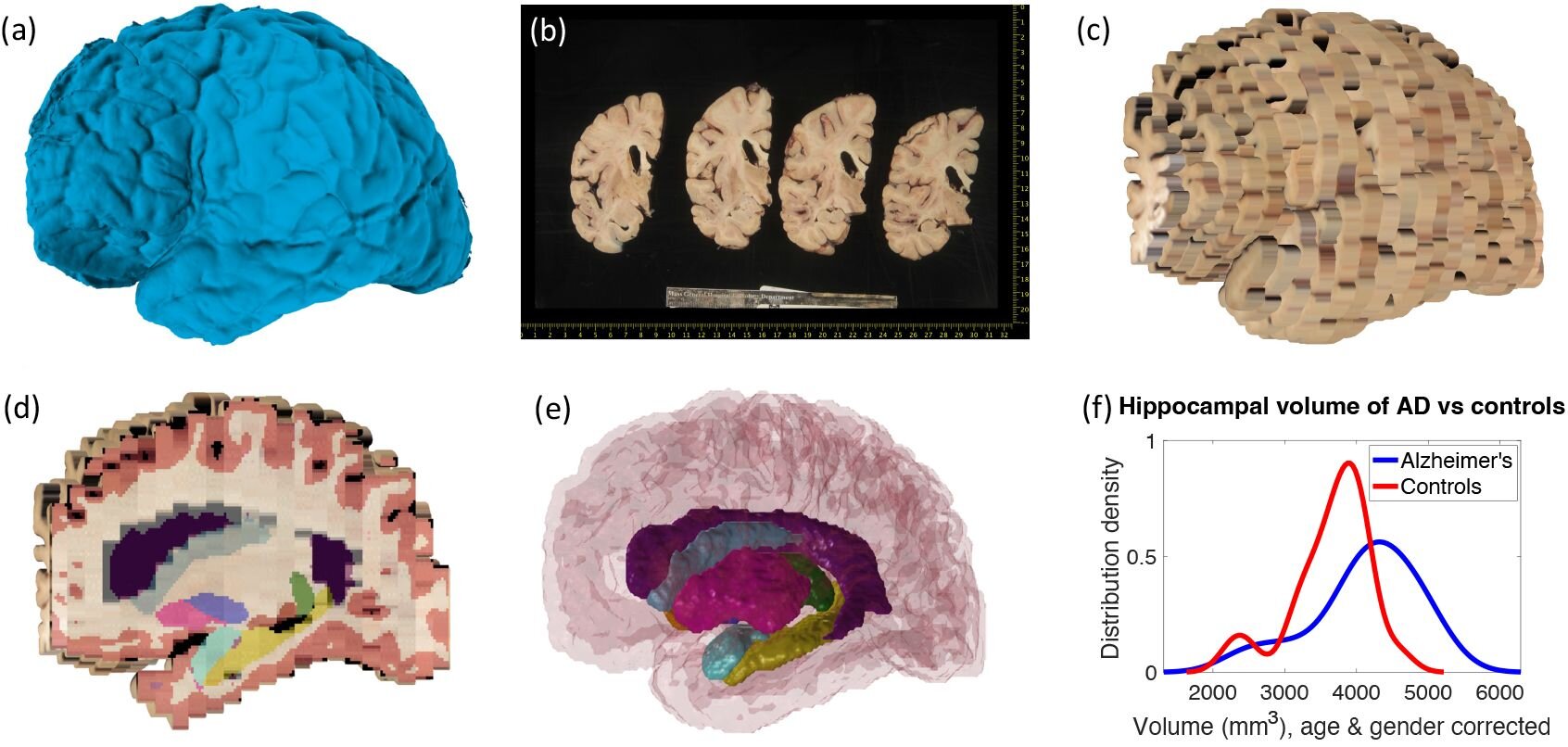
Examples of inputs and outputs from the MADRC dataset. 

Researchers have developed a suite of free tools for analyzing vast amounts of brain dissection photographs at brain banks worldwide to enhance understanding of neurodegenerative diseases.

A new study reveals a strong link between regular physical activity and enhanced brain health. Analyzing MRI scans from 10,125 individuals, researchers found that exercise, even moderate exercise like walking, is associated with increased brain volumes in crucial areas like gray matter, white matter, and the hippocampus. The study underscores exercise’s role in reducing dementia risk and maintaining brain size.

Scientists have discovered that a part of the brain associated with working memory and multisensory integration may also play an important role in how the brain processes social cues.

In a first-of-its-kind study published in Nature, researchers recorded activity from hundreds of individual neurons while participants listened to spoken sentences, giving us an unprecedented view into how the brain analyzes the sounds in words.

A new study has unveiled three distinct cognitive deficits contributing to reading difficulties in individuals with left-sided neglect dyslexia, a condition that often follows a right-hemisphere stroke.

Researchers have unveiled a significant similarity between AI memory processing and human hippocampal functions. This discovery, bridging AI and neuroscience, highlights a parallel in memory consolidation – a process crucial in transforming short-term to long-term memories – in both AI models and the human brain.

A new study highlights the significant role of imagination in evoking empathy and driving prosocial behaviour. 

A so-called pathological protein long associated with Parkinson’s disease has been found in a new study to trigger cells to increase protein synthesis, an event that eventually kills the subset of brain cells that die off in this neurodegenerative condition.

A new study presents a promising treatment for restoring the sense of smell in long-COVID patients.

Researchers have found that amyloid oligomers play a role in speeding up mitochondrial energetics during the early stages of Alzheimer’s, in contrast to what has been previously found in more advanced Alzheimer’s brain tissues. The results are published in Nature Communications.

Research led by the Karolinska Institutet, Sweden, has found an increased risk of cardiovascular disease associated with long-term ADHD medication use.

New research has uncovered a potential early marker for autism in infants: abnormally enlarged perivascular spaces (PVS) in the brain. The study found that infants with enlarged PVS had a 2.2 times greater chance of developing autism compared to those with the same genetic risk. The researchers followed infants with a higher likelihood of autism due to having an older sibling with the condition.

A pilot clinical trial has found electrical stimulation of the spinal cord is feasible, well-tolerated and shows therapeutic potential to treat depression.

Signs of injury to the brain’s white matter called white matter hyperintensities, as seen on brain scans, may be tied more strongly to vascular risk factors, brain shrinkage, and other markers of dementia in former tackle football players than in those who did not play football, according to a study published in Neurology.

Artificial intelligence, coupled with data from an iPad coloring game, could assist in early diagnosis of autism, a new study shows.

A review in the Journal of Internal Medicine explores the potential of non-invasive interventions such as light, sound, and magnets to stimulate gamma brain waves for the treatment of Alzheimer’s disease. Such strategies may be beneficial because Alzheimer’s disease is characterized by reduced fast brain oscillations in the gamma range (30–100 Hz).

Finally this week, researchers have made a significant breakthrough in understanding the genetic basis of anxiety disorders (ADs), which affect over 280 million people globally.

Weekly Neuroscience Update

Credit: Communications Biology (2023).

Researchers have demonstrated the use of AI-selected natural images and AI-generated synthetic images as neuroscientific tools for probing the visual processing areas of the brain. The goal is to apply a data-driven approach to understand how vision is organized while potentially removing biases that may arise when looking at responses to a more limited set of researcher-selected images.

A first-line therapy for obsessive-compulsive disorder (OCD) reshapes connectivity of the brain, according to a new study

A new analysis of the brain activity of people with post-traumatic stress disorder (PTSD) is the first to reveal that traumatic memories are represented in the brain in an entirely different way than sad autobiographical memories.

Researchers have identified objective evidence of how the neck muscles are involved in primary headaches.

Optimal windows exist for action and perception during the 0.8 seconds of a heartbeat, according to research published in the open-access journal PLOS Biology. The sequence of contraction and relaxation is linked to changes in the motor system and its ability to respond to stimulation, and this could have implications for treatments for depression and stroke that excite nerve cells.

In a new study, researchers say they found high levels of a repair protein present long after a traumatic brain injury such as a concussion takes place.

A new study shows that individuals who report tinnitus, which presents as a ringing in the ears in more than 1 out of 10 adults worldwide, are experiencing auditory nerve loss that is not picked up by conventional hearing tests.

An international study group has identified how three novel genes cause neurodevelopmental disorders.

A new study has demonstrated that a novel treatment is effective in most patients with major depressive symptoms even after multiple failed courses of antidepressant medication. The treatment, repetitive transcranial magnetic stimulation (rTMS), may work even more rapidly than past findings have suggested, starting to alleviate symptoms as quickly as one week.

Finally this week, newborn babies can perceive the beat in music, new research has confirmed. 

Weekly Neuroscience Update

Credit: eLife (2023)

Researchers have investigated the shared and unique neural processes that underlie different types of long-term memory: general semantic, personal semantic, and episodic memory, suggesting that these memory types all use the same network of the brain, rather than relying on different areas of the brain altogether. This questions a previous theory that characterizes general semantic and episodic memory as two distinct systems. Instead, the authors suggest that different long-term memory types could be viewed as a spectrum, where they rely on activating the same areas of the brain at differing magnitudes.

Scientists can now pinpoint where someone’s eyes are looking just by listening to their ears.

Using a specialized device that translates images into sound, neuroscientists have shown that people who are blind recognize basic faces using the part of the brain known as the fusiform face area, a region that is crucial for the processing of faces in sighted people.

People with long COVID exhibit patterns of changes in the brain that are different from fully recovered COVID-19 patients, according to new research.

What is the mechanism that allows our brains to incorporate new information about the world, and form memories? New work led by Dr. Tomás Ryan from Trinity College Dublin shows that learning occurs through the continuous formation of new connectivity patterns between specific engram cells in different regions of the brain.

New research indicates that acoustic stimulation of the brain may ease persistent symptoms in individuals who have experienced mild traumatic brain injury in the past.

Scientists have discovered that Alzheimer’s-related changes in brain networks extend beyond memory and attention, impacting sensory and motor circuits. These findings challenge previous assumptions about Alzheimer’s effects.

A pivotal discovery in addiction science has found a correlation between microstructural deficits in the prefrontal cortex-habenula tract and the development and maintenance of addiction.

Researchers have unveiled a pioneering technique for charting the intricate conversations occurring within our brains. Such insights are key to decoding behavioral alterations in neurological disease patients. The innovative tool, CaMPARI, allows scientists to witness brain activity in real-time, marking active neurons red and inactive ones green. This breakthrough could offer pathways to better treatments and understanding of diseases like Alzheimer’s.

A team of neuroscientists has found evidence suggesting that the neural development of babies still in the womb is impacted by the language they hear spoken by their mothers as they carry them.

A new study has discovered a link between a new gene pathway and structural brain anomalies in some people who stutter into adulthood, opening up promising research avenues to enhance the understanding of persistent developmental stuttering.

Finally this week, researchers have developed a tool that simplifies the identification of errors in neural networks used for image recognition.

Mental Health Requires Courage #WorldMentalHealthDay

He who increases knowledge, increases sorrow but who wants to live a life of ignorance?

The key to a happy life

The key to a happy life is the ability to transcend personal suffering, find a balance, and recognise that the world has problems. This requires mental effort and those of us who strive to better understand ourselves in the world come out the other side as a new person, with some peace of mind and a way to live.

Fundamental or accidental?

A limit to understanding ourselves in the world is the fact that we do not know that some of the things we perceive to be truly fundamental today may actually be just accidental. For instance, the brain uses systematic patterns of thought to produce philosophy including science, mathematics, literature, ideas and beliefs including a belief in a deity to guide us towards new insights. What we need to understand is that none of these may be fundamental in themselves. They are just tools that our ancestors used to probe the unknown and to see what is possible – knowing that what is common for us is just a tiny sliver of what actually exists.

Accidental fundamentalism is often mistaken for truth

In the West we have made the truth our highest value. This motivation while important is weak compared to the actual power of belief. We are born into a culture which often insists on a particular religious or ideological philosophy as fact and the only way to understand ourselves in the world, but adhering to this belief may cause personal suffering by impeding insights necessary to achieve peace of mind. Resisting enculturation is the highest expression of human psychological development and is a hallmark of what is called in psychology as the fully self-actualised person.

Recasting reality

Self-actualisers reject accepted cultural ‘truths’ and see beyond the confines of an era to achieve a clearer perception of reality. A further subtle difference sets these people apart. Most of us see life as striving to get this or that – whether it be material things or having a family or doing well career wise. Self-actualizers in contrast do not strive as much as develop. They are only ambitious to the extent in being able to express themselves more fully and perfectly, delighting in what they are able to do. Another general point is their profound freedom of mind. In contrast to the conforming pressures around them self-actualizers are a walking example of free will.

Mental health requires courage

In this way happiness can be described as personal autonomy. The independence of mind to explore and choose the best skills and tools needed to achieve personal insight. Where you are no longer beholden to culture, creed or religion and without any attendant guilt or fear in abandoning old ways in order to try new ones as you evolve to become the master of your own fate.

What to believe?

Mental health is two things:(i) being in touch with reality and (ii) being open to new experiences. But here’s the thing – there is no reality only perception.

Understand that the world is not necessarily as you perceive it. Everyone has filters and only by acknowledging them can you begin to get a clearer picture. Even in a close relationship the same simple act can be viewed differently. A man will see paying all the bills as his duty while his wife will see it as an act of love. Appreciate that your views might be prejudices.

Most importantly make sure that the perceptions you do retain or adopt are grounded in verifiable fact and can be tested. Otherwise any actions you take based on your beliefs will be on shaky ground.