Weekly Neuroscience Update

hypothalamus-genetics-obesity

Credit: BruceBlaus

Scientists have discovered a new genetic syndrome of obesity, over-eating, mental and behavioural problems in six families, from across the world. The study represents an important step in our understanding of how the hypothalamus and oxytocin control appetite and behaviour. 

A new study published in Biological Psychiatry suggests that a brain reward centre, the striatum, may be directly affected by inflammation and that striatal change is related to the emergence of illness behaviors.

By studying stroke patients who have lost the ability to spell, researchers have pinpointed the parts of the brain that control how we write words.

A study has shown for the first time that the structure of the brain circuitry known as the corticolimbic system is more likely to be passed down from mothers to daughters than from mothers to sons or from fathers to children of either gender. The corticolimbic system governs emotional regulation and processing and plays a role in mood disorders, including depression.

New research proves that suffering repeated traumatic experiences throughout infancy and adolescence multiplies by 7 the risk of suffering psychosis during adulthood.

Researchers are using a mathematical tool to help determine which concussion patients will go on to suffer migraine headaches, according to a new study published online in the journal Radiology.

Some of the earliest nerve cells to develop in the womb shape brain circuits that process sights and sounds, but then give way to mature networks that convert this sensory information into thoughts. This is the finding of a study led by researchers at NYU Langone Medical Center and published in the February 3 edition of Neuron.

Scientists have demonstrated for the first time that it is possible to specifically modify gene expression in diseased upper motor neurons, brain cells that break down in ALS.

New research indicates that the location of receptors that transmit pain signals IS important in how big or small a pain signal will be and how effectively drugs can block those signals.

A new way of using MRI scanners to look for evidence of multiple sclerosis in the brain has been successfully tested by researchers.

A team of European researchers has found evidence that suggests that human consciousness is a state where the neural network that makes up the brain operates at an optimal degree of connectedness. In their paper published in Journal of the Royal Society Interface, the team describes their study of the human brain using volunteers undergoing fMRI scans while succumbing to the effects of an anesthetic that caused them to lose consciousness, and what was revealed in reviewing the scan data.

Researchers have determined that testing a portion of a person’s submandibular gland may be a way to diagnose early Parkinson’s disease.

Finally this week, researchers of a new study published in the current issue of Biological Psychiatry report successful reduction of depressive symptoms in patients using a novel non-invasive method of vagus nerve stimulation, or VNS.
Weekly Neuroscience Update

autism-men-neuroimaging

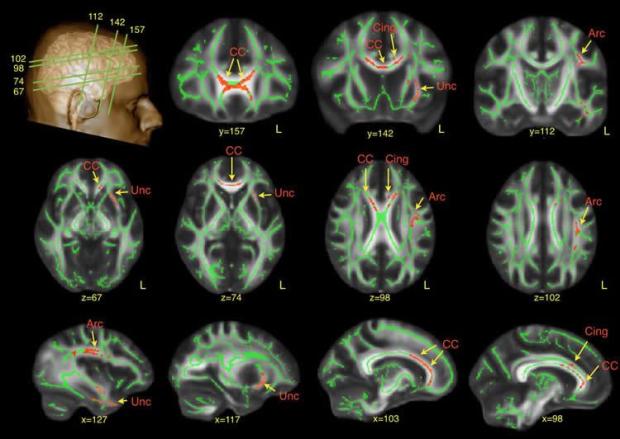
Red regions indicate reduced fractional anisotropy values in autism spectrum disorder (ASD). Credit: The researchers/King’s College London.

Research at King’s College London has revealed subtle brain differences in adult males with autism spectrum disorder (ASD), which may go some way towards explaining why symptoms persist into adulthood in some people with the disorder.

Women who take estrogen supplements from before or at the start of menopause and continue with them for a few years have better preserved brain structure, which may reduce the risk of dementia.

Scientists have taken a significant step toward understanding the cause of schizophrenia, in a landmark study that provides the first rigorously tested insight into the biology behind any common psychiatric disorder.

Stopping disruptions in cellular “trash removal” brought on by errors in molecular marks on DNA may guard against neurodegenerative diseases like Parkinson’s.

Roughly twenty years before the first symptoms of Alzheimer’s disease appear, inflammatory changes in the brain can be seen, according to a new study from Karolinska Institutet published in the medical scientific journal Brain.

In a new study, researchers reveal how brain scans could be used to identify children at high risk for later-life depression – information that could pave the way for early intervention and prevention.

Researchers have shown that graphene can be used to make electrodes that can be implanted in the brain, which could potentially be used to restore sensory functions for amputee or paralysed patients, or for individuals with motor disorders such as Parkinson’s disease.

A new study has linked stress and anxiety to the same neurocircuitry in the brain as depression and dementia.

Different regions of our brain need to work simultaneously in order for us to process emotion. But according to new research, such regions are disconnected among individuals who experience multiple episodes of major depression.

A team of international researchers have announced the discovery of a system in the brain that may underlie the development of involuntary vocalizations (commonly called vocal tics) that often occur in people with Tourette syndrome.

A new study sheds light on multiple sclerosis (MS), specifically damage in the brain caused by the disease that may explain the slow and continuous cognitive decline that many patients experience. The findings, which appear in the Journal of Neuroscience, show that the brain’s immune system is responsible for disrupting communication between nerve cells, even in parts of the brain that are not normally considered to be primary targets of the disease.

Cognitive function and health appear to be genetically linked, according to research published in Molecular Psychiatry. The study was carried out by an international team from the US, the UK and Germany.

Researchers have discovered the mechanics of how dopamine transports into and out of brain cells, a finding that could someday lead to more effective treatment of drug addictions and neurological disorders such as Parkinson’s disease.

The brains of children who are obese function differently from those of children of healthy weight, and exhibit an “imbalance” between food-seeking and food-avoiding behaviors, researchers at Vanderbilt University Medical Center have found.

Finally this week, neuroscientists have now shown that rhythmic brain waves, called theta oscillations, engage and synchronize the brain regions that support the integration of memories. The results were published in the journal Current Biology.

Weekly Neuroscience Update

v

The brain’s immune cells are hyperactive in people who are at risk of developing schizophrenia, as well as during the earliest stages of the disease, according to a new study. The findings suggest that inflammatory processes play an important role in the development of the disease, and raise the possibility that it could be treated with drugs that block or reduce this cellular response.

A new study suggests that receiving rewards as you learn can help cement new facts and skills in your memory, particularly when combined with a daytime nap.

Protein deposits associated with dementia influence brain activity during sleep.

Hearing loss accelerates cognitive decline in elderly adults, but the use of hearing aids counters this acceleration. A new scientific longitudinal study shows that those who use hearing aids have about the same cognitive level as those with no hearing loss.

The brain cells of patients with bipolar disorder, characterized by severe swings between depression and elation, are more sensitive to stimuli than other people’s brain cells, researchers have discovered.

Neuroscientists have determined some of the specific characteristics of electrical stimuli that should be applied to the brain to produce different sensations in an artificial upper limb intended to restore natural motor control and sensation in amputees.

A research study has debunked the widely-held belief that the hippocampus, a crucial part of the brain that consolidates new memories and helps connect emotions to the senses, is larger in females than in males.

In order to retain a piece of information for a short time, working memory is required. The underlying processes are considerably more complex than hitherto assumed, as researchers report in the journal “Cell Reports”. Two brain states must alternate rhythmically in order for a piece of information to be successfully maintained.

A study led by Johns Hopkins Medicine researchers suggests that awakening several times throughout the night is more detrimental to people’s positive moods than getting the same shortened amount of sleep without interruption.

Early life stress is a major risk factor for later episodes of depression. Scientific research into this link has revealed that the increased risk following such childhood adversity is associated with sensitization of the brain circuits involved with processing threat and driving the stress response. More recently, research has begun to demonstrate that in parallel to this stress sensitization, there may also be diminished processing of reward in the brain and associated reductions in a person’s ability to experience positive emotions.


Weekly Neuroscience Update

A new study has found that while stereotypic shapes exist for this structure, individuals with a broader hippocampus tend to perform better on various tests that assess memory. The image is for illustrative purposes only. Image credit: Camillo Golgi.

A new study has found that while stereotypic shapes exist for this structure, individuals with a broader hippocampus tend to perform better on various tests that assess memory. The image is for illustrative purposes only. Image credit: Camillo Golgi.

New research challenges the long-held belief that a larger hippocampus is directly linked to improved memory function.

Premature birth can alter the connectivity between key areas of the brain, according to a new study led by King’s College London. The findings should help researchers to better understand why premature birth is linked to a greater risk of neurodevelopmental problems, including autistic spectrum disorders and attention deficit disorders.

Scientists have uncovered mathematical equations behind the way the brain forms – and even loses – memories.

New scanning methods which map the wiring of the brain could provide a valuable new tool to predict people at risk of schizophrenia, according to a new study.

People with depression may be more likely to develop Parkinson’s disease, according to a large study published in Neurology.

Medical researchers have known for several years that there is some sort of link between long-term depression and an increased risk of stroke. But now scientists are finding that even after such depression eases, the risk of stroke can remain high.

A new study from the University of Cambridge has identified one of the oldest fossil brains ever discovered – more than 500 million years old – and used it to help determine how heads first evolved in early animals.

Researchers have succeeded in reconstructing the neuronal networks that interconnect the elementary units of sensory cortex — cortical columns. The scientists say that this study marks a major step forward to advance the understanding of the organizational principles of the neocortex and sets the stage for future studies that will provide extraordinary insight into how sensory information is represented, processed and encoded within the cortical circuitry.

Smokers who are able to quit might actually be hard-wired for success, according to a study from Duke Medicine.

Scientists are attempting to mimic the memory and learning functions of neurons found in the human brain. To do so, they investigated the electronic equivalent of the synapse, the bridge, making it possible for neurons to communicate with each other.

Finally this week, in a study using functional magnetic resonance imaging, scientists found that our inherent risk-taking preferences affect how we view and act on information from other people.

Weekly Neuroscience Update

With the aid of this detailed brain map, researchers were able to identify previously unknown cell types, including six different types of oligodendrocytes and a nerve cell. This image of an oligodendrocyte is for illustrative purposes only. Image credit: Jurjen Broeke.

With the aid of this detailed brain map, researchers were able to identify previously unknown cell types, including six different types of oligodendrocytes and a nerve cell. This image of an oligodendrocyte is for illustrative purposes only. Image credit: Jurjen Broeke.

Using a process known as single cell sequencing, scientists at Karolinska Institutet have produced a detailed map of cortical cell types and the genes active within them. The study, which is published in the journal ‘Science’, marks the first time this method of analysis has been used on such a large scale on such complex tissue.

Researchers have identified five genetic variants that influence the size of structures within the brain, a discovery that could help determine the genetic processes that underlie neuropsychiatric diseases.

A new study sheds light on the brain cells that function in establishing one’s location and direction. The findings contribute to our understanding of the neural mechanisms underlying our abilities to successfully navigate our environment, which may be crucial to dealing with brain damage due to trauma or a stroke and the onset of diseases such as Alzheimer’s.

Meditation over many years is tied to smaller age-related decreases in brain volume, according to a new study.

In the social world, people constantly gather information through visual cues that are used to evaluate others and interact. A new study has determined that babies can make sense of complex social situations, and that they expect people to behave appropriately.

According to a new study published in the journal JAMA Psychiatry, clinical depression is associated with a 30 percent increase of inflammation in the brain. The study set out to investigate whether inflammation is a driver of clinical depression independent of other physical illness.

Finally this week, the brain’s speech area, named after 19th century French physician Pierre Paul Broca, shuts down when we talk out loud, according to a new study that challenges the long-held assumption that ‘Broca’s area’ governs all aspects of speech production.

Weekly Neuroscience Update

Reviewing MRI data, researchers found the brain anatomy of people with autism above the age of six was mostly indistinguishable from that of typically developing individuals. This image is for illustrative purposes only. Credit McZusatz.

Reviewing MRI data, researchers found the brain anatomy of people with autism above the age of six was mostly indistinguishable from that of typically developing individuals. This image is for illustrative purposes only. Credit McZusatz.

Brain anatomy in MRI scans of people with autism above age six is mostly indistinguishable from that of typically developing individuals and, therefore, of little clinical or scientific value.

Some types of dementia are actually a result of many tiny, unnoticed strokes damaging the brain over time, researchers at the Krembil Neuroscience Centre in Toronto, Canada, have found. This suggests that this type of dementia could be treatable — probably through lifestyle changes.

Therapists could pick up signs of depression just be listening to how their patients talk, after a study found that unhappy people speak in a different tone.

Why do we remember some things and not others? In a unique imaging study researchers have discovered how neurons in the brain might allow some experiences to be remembered while others are forgotten. It turns out, if you want to remember something about your environment, you better involve your dendrites.

Looking at the brain as a highly interactive network of nodes, rather than a collection of individual areas of activity, could offer a new way to diagnose the memory disorders that tend to affect older people.

An international study has identified genetic markers that may help in identifying individuals who could benefit from the alcoholism treatment drug acamprosate. The findings, published in the journal Translational Psychiatry, show that patients carrying these genetic variants have longer periods of abstinence during the first three months of acamprosate treatment.

New research on how the brain leads us to believe we have sharp vision.

Disturbances in the early stages of brain growth, such as preterm birth – when many of the brain’s structures have not yet fully developed – appears to affect the brain’s neuro-circuitry, which may explain premature babies’ higher risk of neurodevelopmental disorders including ADHD and autism spectrum disorder.

Data from 50 laboratories around the world has found that rare mutations in dozens of genes may be responsible for 30% or more cases of autism.

Researchers have been tracking the traces of implicit and explicit memories of fear in human. The study was published in the journal Neurobiology of Learning and Memory; it describes how, in a context of fear, our brain differently encodes contextual memory of a negative event and the emotional response associated.

A major breakthrough in the development of stem cell-derived brain cells has put researchers on a firm path towards the first ever stem cell transplantations in people with Parkinson’s disease. A new study presents the next generation of transplantable dopamine neurons produced from stem cells. These cells carry the same properties as the dopamine neurons found in the human brain.

The brain’s plasticity and its adaptability to new situations do not function the way researchers previously thought, according to a new study published in the journal Cell.

Finally this week, researchers have shown how a single neuron can perform multiple functions in a model organism, illuminating for the first time this fundamental biological mechanism and shedding light on the human brain.


Weekly Neuroscience Update

The study revealed that EGFR signaling is suppressed in a subset of glioblastomas. This image is for illustrative purposes only and shows an MRI brain scan of a person with glioblastoma brain cancer. Credit The Armed Forces Institute of Pathology.

The study revealed that EGFR signaling is suppressed in a subset of glioblastomas. This image is for illustrative purposes only and shows an MRI brain scan of a person with glioblastoma brain cancer. Credit The Armed Forces Institute of Pathology.

Researchers have found one of the keys to why certain glioblastomas – the primary form of a deadly brain cancer – are resistant to drug therapy. The answer lies not in the DNA sequence of the tumor, but in its epigenetic signature. These findings have been published online as a priority report in the journal Oncotarget.

It has been proposed that green tea extract may have a beneficial impact on cognitive functioning, suggesting promising clinical implications. However, the neural mechanisms underlying this putative cognitive enhancing effect of green tea extract still remain unknown.

According to researchers at the University of Montreal, the regions of the brain below the cortex play an important role as we train our bodies’ movements and, critically, they interact more effectively after a night of sleep.

Researchers find that the risk of future stroke is 39% higher among patients with cognitive impairment than those with normal cognitive function, according to a new study published in the Canadian Medical Association Journal (CMAJ).

A study is shining new light on a sleep disorder called “sleep drunkenness.” The disorder may be as prevalent as affecting one in every seven people. The research is published in Neurology.

A mindfulness-based therapy for depression has the added benefit of reducing health-care visits among patients who often see their family doctors, according to a new study.

In what may be the largest study of sleep problems among individuals with multiple sclerosis (MS), researchers at UC Davis have found that widely undiagnosed sleep disorders may be at the root of the most common and disabling symptom of the disease: fatigue.

Scientists have provided the first evidence that the lack of a naturally occurring protein is linked to early signs of dementia.

Weekly Neuroscience Update


brain-white-matter-child-fitness (1)

The team used diffusion tensor imaging (DTI, also called diffusion MRI) to look at five white-matter tracts in the brains of the 24 participants. This method analyzes water diffusion into tissues. For white matter, less water diffusion means the tissue is more fibrous and compact, both desirable traits. This image shows an MRI of white matter in the human brain. The image is for illustrative purposes only, and is not connected to the research. Credit Kubicki et al.

A new study of 9 and 10-year-olds finds that those who are more aerobically fit have more fibrous and compact white-matter tracts in the brain than their peers who are less fit. “White matter” describes the bundles of axons that carry nerve signals from one brain region to another. More compact white matter is associated with faster and more efficient nerve activity. The team reports its findings in the open-access journal Frontiers in Human Neuroscience.

In a new study published in The Journal of Neuroscience, researchers report that the amygdala — a part of the brain associated with decision making, memory and emotion — plays a part in telling us who to trust almost instantly.

The latest research on sports concussions in teens has been the focus of recent study.

Depression is known to be a common symptom of Parkinson’s disease, but remains untreated for many patients, according to a new study.

Following another person’s gaze can reveal a wealth of information critical to social interactions and also to safety. Gaze following typically emerges in infancy, and new research looking at preterm infants suggests that its visual experience, not maturational age, that underlies this critical ability.

fMRI scans reveal brain differences in risk-taking teens

Children and adolescents with autism have a surplus of synapses in the brain, and this excess is due to a slowdown in a normal brain “pruning” process during development, according to a study by neuroscientists at Columbia University Medical Center (CUMC).

While much attention has focused on the link between violent video game playing and aggression among youths, a new study finds significantly increased signs of depression among preteens with high daily exposure to violent video games.

An imaging study of chronic users of codeine-containing cough syrups (CCS) has found deficits in specific regions of brain white matter and associates these changes with increased impulsivity in CCS users.

New treatments for multiple sclerosis (MS) using common anti-psychotic agents have been discovered by Victoria University of Wellington researchers.

People with schizophrenia struggle to turn goals into actions because brain structures governing desire and emotion are less active and fail to pass goal-directed messages to cortical regions affecting human decision-making, new research reveals.