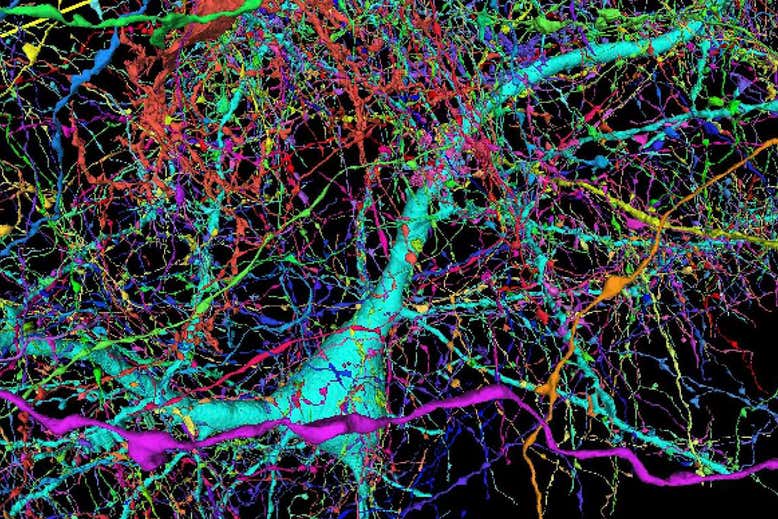
Around 4000 nerve fibres connect to this single neuron Google/Lichtman Laboratory
Google has helped create the most detailed map yet of the connections within the human brain. It reveals a staggering amount of detail, including patterns of connections between neurons, as well as what may be a new kind of neuron.
Researchers have identified three biomarkers in blood samples that confirm the link between exercise and improved cognitive function in older adults.
A new study reveals what goes on in the brain when a person embarks on a musical collaboration project.
Chronic inflammation in the gut may propel processes in the body that give rise to Parkinson’s disease, according to new research.
The largest study of its kind has unveiled new insights into how genes are regulated in dementia, including discovering 84 new genes linked to the disease.
A new study shows that a deep neural network model can accurately predict the brain age of healthy patients based on electroencephalogram data recorded during an overnight sleep study, and EEG-predicted brain age indices display unique characteristics within populations with different diseases.
Finally this week,scientists have identified an area of the brain that drives cravings for protein-rich food.
A new study reveals that being overweight or obese significantly reduces blood flow in the brain. The study also shows that increased physical activity can positively modify, or even negate, this reduction in brain blood flow.
Soccer players who feel anxious at the thought of kicking a penalty kick and who miss the goal show more activity in the prefrontal cortex. Overthinking the shot, researchers say, could play a role in missing a goal.
Non-invasive neuromodulation delivered via low-intensity focused ultrasound can have cell-type-specific selectivity in manipulating neurons.
People born into families with members who live longer lives show better cognitive performance and a slower decline in cognitive processing speed as they age.
A new neuroimaging technique captures the brain in motion in real-time, generating a 3D view and with improved detail. The new technology could help clinicians to spot hard-to-detect neurological conditions.
Researchers found in a recent study that modulation of map-like representations in our brain’s hippocampal formation can predict contextual memory retrieval in an ambiguous environment.
A new study reports on an association between specific gut bacteria species and the manifestation of neurodegenerative disorders.
New research reveals why sleep can put people with epilepsy at increased risk of sudden death.
A new study uncovers the genetic architecture of progression and prognosis, identifying five genetic locations (loci) associated with progression. The team also developed the first risk score for predicting progression of PD over time to dementia (PDD), a major determinant of quality of life.
A newly developed artificial intelligence algorithm can accurately and reliably assess unconsciousness in patients under anesthesia based on brain activity.
Damage to highly connected regions of white matter in the brain following injury is more predictive of cognitive impairment than damage to highly connected gray matter hubs.
The cerebellum underwent evolutionary changes that may have contributed to the development of language, culture, and tool use in humans, a new study reveals.
A new study sheds light on how highly sensitive people process information. After experiencing something emotionally evocative, brain activity displayed a depth of processing while at rest. Depth of processing is a key feature of high emotional sensitivity.
Researchers have uncovered molecular clues that help explain what makes some neurons more susceptible than others in Alzheimer’s disease.
Finally this week tking a daily prebiotic supplement improves general wellbeing, reduces symptoms of anxiety, and promotes better gut health, a new study reports.
A new algorithm that combines naturalistic driving data with machine learning is 88% accurate at predicting mild cognitive impairment and dementia in older adults.
People with schizophrenia and other neuropsychiatric disorders may have a more permissive blood-brain barrier which allows the immune system to become more actively involved in the central nervous system. The resulting inflammation may contribute to the clinical manifestation of psychosis-like symptoms.
Mindfulness programs can improve the mental health of school-age children and help them to feel more optimistic, according to new research.
A new study finds evidence of inflammation in the blood of patients during the early stages of Parkinson’s disease. The findings support the theory that inflammation is a driver of the neurodegenerative disorder. The effect was most noticeable in women with Parkinson’s.
Taking a daily prebiotic supplement improves general wellbeing, reduces symptoms of anxiety, and promotes better gut health, a new study reports.
Researchers propose a new theoryof what happens in the brain when we experience familiar seeming visual stimuli. The theory, dubbed sensory referenced suppression, suggests the brain understands different levels of activation expected for sensory input and corrects for it, leaving behind the signal for familiarity.
A new study shows that heart brain interactions, measured using electroencephalography (EEG), provide a novel diagnostic avenue for patients with disorders of consciousness.
A multidecade study of young adults living in the United Kingdom has found higher rates of mental illness symptoms among those exposed to higher levels of traffic-related air pollutants, particularly nitrogen oxides, during childhood and adolescence.
The brain encodes information about our relationships and the relationships between our friends using areas involved in spatial processing, according to new research published in Journal of Neuroscience.
Researchers have taken another step forward in developing an artificial intelligence tool to predict schizophrenia by analyzing brain scans.
COVID-19 may not directly infect the brain, but the virus is still capable of causing significant neurological damage, a new study reports. Researchers say the neurological changes seen as a result of coronavirus infection are likely related to inflammation triggered by viral infection in different parts of the body or the brain’s blood vessels.
Stroke risk for patients with traumatic brain injuries is at its highest in the four months following injury and remains significant for up to five years post-injury, finds a new systematic review.
A new blood test can distinguish the severity of a person’s depression and their risk for developing severe depression at a later point. The test can also determine if a person is at risk for developing bipolar disorder. Researchers say the blood test can also assist in tailoring individual options for therapeutic interventions.
Light therapy which consists of exposure to both controlled natural light and artificial lighting may be a new tool in the treatment of neurodegenerative diseases such as Alzheimer’s and Parkinson’s disease.
Researchers link the inflammation associated with chronic sinus infections to alterations in brain activity in networks that govern cognition, external stimuli, and introspection. The findings shed light on why people suffering from sinus infections often report poor concentration and other short-term cognitive problems.
A new study recently published in eNeurolays the groundwork for more detailed research on how humans hear in dynamic environments.
When people make eye contact with another person, their attention is immediately solicited and this causes a distortion in temporal perception. However, the shift in time perception does not change when people glance at non-social items or objects according to new research.
Sharing our personal experiences on social media may negatively impact how we feel about our memories, especially if the post doesn’t get many likes, a new study reports.
New research has shed light on how autism-spectrum disorder (ASD) manifests in the brains of girls, prompting the scientists to warn that conclusions drawn from studies conducted primarily in boys should not be assumed to hold true for girls.
Finally this week, a shared set of systems in the brain may play an important role in controlling the retrieval of facts and personal memories utilised in everyday life, new research shows.
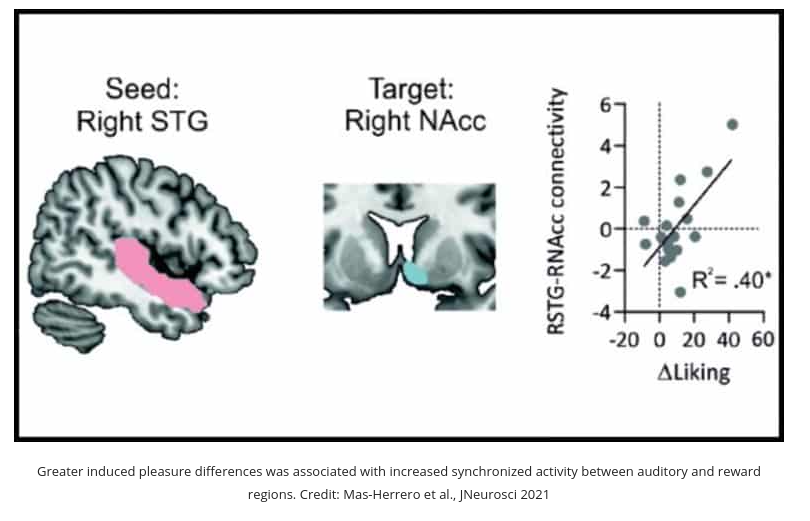
Communication between the brain’s auditory and reward circuits is the reason why humans find music rewarding, according to new research published in Journal of Neuroscience.
Multilingual people have trained their brains to learn languages, making it easier to acquire more new languages after mastering a second or third. In addition to demystifying the seemingly herculean genius of multilinguals, researchers say these results provide some of the first neuroscientific evidence that language skills are additive, a theory known as the cumulative-enhancement model of language acquisition.
A new whole-genome sequencing study has revealed thirteen novel genes associated with Alzheimer’s disease. Researchers also found a new link between Alzheimer’s and synaptic function.
For people with Parkinson’s disease, problems with thinking and memory skills are among the most common nonmotor symptoms of the disease. A new studyshows that exercise may help slow cognitive decline for some people with the disease.
Computer scientists have created a ground-breaking model that could improve our understanding of developmental disorders such as autism.
Researchers have succeeded for the first time in measuring brain wavesdirectly via a cochlear implant. These brainwaves indicate in an objective way how good or bad a person’s hearing is. The research results are important for the further development of smart hearing aids.
New research suggests that chronic viral infections have a profound and lasting impact on the human immune system in ways that are similar to those seen during aging.
A studyof Japanese university students and recent graduates has revealed that writing on physical paper can lead to more brain activity when remembering the information an hour later. Researchers say that the unique, complex, spatial and tactile information associated with writing by hand on physical paper is likely what leads to improved memory.
Finally this week, a new study confirms that the processing of visual information is altered in depressed people, a phenomenon most likely linked with the processing of information in the cerebral cortex.
A new study reveals a high fructose diet could contribute to bipolar disorder, ADHD, and behavioral aggression.
In Alzheimer’s disease, impaired blood flow to brain regions coincides with tau protein buildup. This relationship strengthens as cognition declines, according to new research published in Journal of Neuroscience.
A new lab test can accurately pinpoint and analyze the deadliest cells in the most common and aggressive brain cancer in adults.
A greater density of cells in a key reward center of the brain is associated with obesity in children and predicts future weight gain, a new study finds.
A team of researchers has found that an amino acid produced by the brain could play a crucial role in preventing a type of epileptic seizure.
The characteristics of language structure and writing system may explain why some bilingual people are dyslexic in English, but not in their other proficient language.
Finally this week, a study of four drugs to combat chronic neuropathic pain finds Nortriptyline has the highest efficacious percentage and lowest quit rate.
Researchers used diffusion tensor imaging, which indicates the directionality of water diffusion in the brain, to examine how white matter connections lose integrity. These frontostriatal tracts are shown moving anterior to posterior (green), left to right (red) and superior to inferior (blue). Image is credited to the researchers.
As the human brain ages, the neural circuits that allow its different parts to communicate with each other gradually wear down, even in healthy adults.
Genetic risk score for bipolar disorderis associated with an increased risk of developing bipolar symptoms. The genetic risk factor for schizophrenia is linked to an increased risk of those with depression developing psychosis.
A new study into the causes of sensorimotor impairments prevalent among autistic people could pave the way for better treatment and management in the future, say psychologists.
New research details how the complex set of molecular and fluid dynamics that comprise the glymphatic system – the brain’s unique process of waste removal – are synchronized with the master internal clock that regulates the sleep-wake cycle.
Future technology may be able to monitor and modify the brain to produce enhanced team performance, while increasing the efficiency and accuracy of decisions.
Parkinson’s disease can be divided into two variants that start in different places in the body. For some, the neurodegenerative disease starts in the intestines and spreads to the brain. In others, the disease begins in the brain and spreads to the intestines and other organs.
New research released from the University of Colorado Anschutz Medical Campus proposes that Alzheimer’s disease may be driven by the overactivation of fructose made in the brain.
Anticholinergic medications, commonly used for conditions including allergies, high blood pressure, Parkinson’s disease, and motion sickness, have been linked to an increased risk of cognitive decline and memory problems, especially in those with genetic risk factors for Alzheimer’s disease.
Finally this week, a new study links brain structure to color perceptual function. Microscopy revealed ‘hue maps,’ or color palettes, in the brain that are spectrally organized arrangements of hue responses.
A new study identifies the neural markers of beat synchronization in the brain and sheds light on how auditory perception and motor processes work together.
Current sleep patterns could help determine your risk of developing Alzheimer’s diseaseas you age. People who experience more fragmented sleep and less non-REM slow-wave sleep are more likely to have increased levels of amyloid-beta.
An international research team reports that problems in spatial navigation can also be detected in people with a genetic risk for Alzheimer’s.
A new studydemonstrates that a technology developed at the University of Central Florida could serve as a more reliable clinically-based model of amyotrophic lateral sclerosis (ALS) and a better screening tool for novel therapies than currently use preclinical models.
Scientists have developed a new theory as to how hearing loss may cause dementia and believe that tackling this sensory impairment early may help to prevent the disease.
A new study compares adolescent siblings to determine the impact of early and frequent use of marijuana on cognitive function
Finally this week a new two-stage model seeks to answer a longstanding philosophical debate over whether consciousness is continuous or discrete. Findings suggest discrete consciousness is preceded by a long-lasting unconscious processing period.
Chang Lab’s research reveals what area of the human brain controls the pitch of our speech.
Researchers have revealed the area of the brain that controls our voice box, allowing us to alter the pitch of our speech. The insight could pave the way for advancing neuroprosthetics to allow people who can’t speak, to express themselves in a naturalistic way.
A new study reports the brain mechanisms responsible for triggering memory are identical, whether a person is awake or asleep.
While the effects of sleep deprivation are well known, researchers discover sleeping too much could have a detrimental effect on your brain. A new study reports sleeping more than eight hours per night can reduce cognitive ability and reasoning skills.
Researchers have discovered the thalamus plays a crucial role in the development of normal sleep and waking states.
A new studyreports T cells are activated in the intestines and migrate to the brain, causing an inflammatory cascade that may lead to multiple sclerosis. Researchers say the gut microbiome may play a more significant role in the development and progression of MS than previously believed.
A new study reports an afternoon nap can help us to process unconscious information and enhance cognition.
Utilizing lesion network mapping, a recently developed technique for analyzing how the brain works, researchers have studied free will perceptionrelated to movement decisions.
A new study reports a protein made by astrocytes plays a critical role in brain plasticity by assisting with neural maturation and flexibility.
Only a small proportion of cases of dementia are thought to be inherited – the cause of the vast majority is unknown. Now, in a study published today in the journal Nature Communications, a team of scientists led by researchers at the University of Cambridge believe they may have found an explanation: spontaneous errors in our DNA that arise as cells divide and reproduces.
Finally, this week, a new study reports people may be able to avoid depression, even if they have a genetic predisposition to SAD, by maintaining or boosting serotonin levels throughout the year.
Whole brain analyses revealed that higher dispositional mindfulness during painful heat was associated with greater deactivation of a brain region called the posterior cingulate cortex, a central neural node of the default mode network. Further, in those that reported higher pain, there was greater activation of this critically important brain region. image is credited to Zeidan et al.
Ever wonder why some people seem to feel less pain than others? A new study may have found one of the answers – mindfulness.
A new study reveals elevated glial activation in the brains of those with fibromyalgia.
Brains of baby boys born prematurely are affected differently and more severely than premature infant girls’ brains. This is according to a study published in the Springer Nature-branded journal Pediatric Research.
According to researchers, the speed at which a person speaks influences the way we hear and understand upcoming words.
A new studyreports under conditions of stress, KCNB1 builds up in the brain, before becoming toxic and promoting the production of amyloid beta. In Alzheimer’s patients, the KCNB1 levels are higher than in those without the condition.
Researchers report pyramidal neurons in the basolateral amygdala help us to recognize and categorize foods.
A new study sheds additional light on how the brain consolidates memory during sleep. Researchers report rapid fluctuations in gamma band activity in the hippocampus during nREM sleep helps facilitate memory reactivation.
Finally this week,researchers report on how the brain learns to recognize an individual face, regardless of where it appears in different visual locations.