Weekly Neuroscience Update

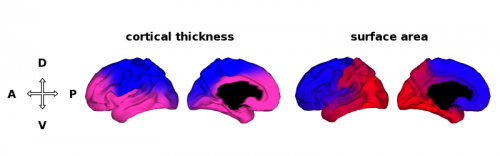
Maps of the brain based on genetic correlation clusters, when only two clusters are specified. This approach solution identified a dorsal-ventral (D-V, i.e., top to bottom) division as the most distinct partition in the genetic patterning of cortical thickness. By contrast, for surface area the two genetic clusters form an anterior-posterior (A-P, i.e., front to back) division. Abbreviations: D, dorsal; V, ventral; A, anterior; P, posterior. Credit: Chi-Hua Chen, Ph.D., UCSD

Maps of the brain based on genetic correlation clusters, when only two clusters are specified. This approach solution identified a dorsal-ventral (D-V, i.e., top to bottom) division as the most distinct partition in the genetic patterning of cortical thickness. By contrast, for surface area the two genetic clusters form an anterior-posterior (A-P, i.e., front to back) division. Abbreviations: D, dorsal; V, ventral; A, anterior; P, posterior. Credit: Chi-Hua Chen, Ph.D., UCSD

An international research team studying the structure and organization of the brain has found that different genetic factors may affect the thickness of different parts of the cortex of the brain.

Johns Hopkins researchers say they have pinpointed a site in a highly developed area of the human brain that plays an important role in the subconscious recognition of which way is straight up and which way is down. The finding, described online in the journal Cerebral Cortex, may help account for some causes of spatial disorientation and dizziness, and offer targets for treating the feelings of unsteadiness and “floating” people experience when the brain fails to properly integrate input from the body’s senses.

The discovery of the first chemical to prevent the death of brain tissue in a neurodegenerative disease has been hailed as the “turning point” in the fight against Alzheimer’s disease.

A bedside scan could reveal an active mind hidden inside an unresponsive body. The method provides another tool for recognising consciousness in people who have been wrongly diagnosed as being in a vegetative state. Tests are also under way to use it to monitor people under general anaesthetic, to make sure they do not regain consciousness during an operation.

The more you want to use your brain – and the more you enjoy doing it – the more likely you are to stay sharp as you age. This is according to findings recently published in the Journals of Gerontology: Psychological Sciences.

A team of scientists have identified neural circuits that modulate REM sleep. 

People who are depressed may have triple the risk of developing Parkinson’s disease, according to a study published in the October 2, 2013, online issue of Neurology

Scientists have discovered a process by which the “power plants” of the brain – tiny mitochondria found inside cells – signal that they are damaged and need to be eliminated. This is according to a study published in the journal Nature Cell Biology.

The hormone vasopressin may play a key role in jet lag, new research suggests.

Researchers have gained new insight into how localized hearing works in the brain. Their research is published in the Oct. 2, 2013 issue of the Journal of Neuroscience.

Weekly Neuroscience Update

japanesesupe

Researchers in Japan have used the powerful K computer, the world’s fastest supercomputer, to simulate the complex neural structure of our brain.

Heavy drinking as a teenager is the single biggest risk factor for developing dementia unusually early, according to new research. A study of almost 500,000 Swedish men identified “alcohol intoxication” as a late adolescent as the most serious of nine separate risk factors for young onset dementia (YOD) – that is, dementia before reaching 65.

For the first time, researchers have documented irregular brain activity within the first 24 hours of a concussive injury, as well as an increased level of brain activity weeks later—suggesting that the brain may compensate for the injury during the recovery time. The findings are published in the September issue of the Journal of the International Neuropsychological Society.

New findings may help neuroscientists pinpoint better targets for anti-anxiety treatments.

The synapses in the brain act as key communication points between approximately one hundred billion neurons. They form a complex network connecting various centres in the brain through electrical impulses. New research from Lund University suggests that it is precisely here, in the synapses, that Huntington’s disease might begin.

In patients with early Alzheimer’s disease, disruptions in brain networks emerge about the same time as chemical markers of the disease appear in the spinal fluid, researchers at Washington University School of Medicine in St. Louis have shown.

New research indicates that teens with anorexia nervosa have bigger brains than teens that do not have the eating disorder.

Assessing consciousness in patients with severe brain trauma is a difficult challenge for doctors, as the injury effectively takes away any ability to blink, squeeze a hand or otherwise respond. But scientists have found a way to measure the brain’s response to a magnetic pulse, helping them determine a person’s level of awareness.


Weekly Neuroscience Update

A novel screening method makes it easier to diagnose and treat children with autism

A child with autism discovers how to evoke the onscreen video he likes best. Credit: Rutgers Sensory-Motor Integration Lab

Researchers have developed a new screening method to diagnose autism, which unlike current methods does not rely on subjective criteria. These results are published in a series of studies in the open-access journal Frontiers in Neuroscience.

Going to bed at different times every night throughout early childhood seems to curb children’s brain power, according to a large, long term study.

A computational vision scientist at the University of South Australia has just published new research describing a key advance in our understanding of how the brain perceives the physical world.

Oxytocin has long been known as the warm, fuzzy hormone that promotes feelings of love, social bonding and well-being. It’s even being tested as an anti-anxiety drug. But new research shows oxytocin also can cause emotional pain, an entirely new, darker identity for the hormone.

Ultrasound waves sent to specific brain regions can alter a person’s mood, according to a new study published in the journal Brain Stimulation.

A gene related to neural tube defects in dogs has for the first time been identified by researchers.

UCLA chemists and molecular biologists have for the first time used a “structure-based” approach to drug design to identify compounds with the potential to delay or treat Alzheimer’s disease, and possibly Parkinson’s, Lou Gehrig’s disease and other degenerative disorders.

Weekly Neuroscience Update

This image from the study shows changes in degree of connectivity in the feedback group. Increases are shown in red/yellow and decreases in blue/purple. Decreases in connectivity are seen in limbic areas, and increases are seen in prefrontal regions. (Credit: D Scheinost et al./Yale University)

People provided with a real-time readout of activity in specific regions of their brains can learn to control that activity and lessen their anxiety, say Yale researchers.

A new study provides neurobiological evidence for dysfunction in the neural circuitry underlying emotion regulation in people with insomnia, which may have implications for the risk relationship between insomnia and depression.

Different brain areas are activated when we choose for ourselves to suppress an emotion, compared to situations where we are instructed to inhibit an emotion, according to a new study from the UCL Institute of Cognitive Neuroscience and Ghent University.

Migraines and depression can each cause a great deal of suffering, but new research indicates the combination of the two may be linked to something else entirely—a smaller brain.

The epigenetic modifications, which alter the way genes function without changing the underlying DNA sequence, can apparently be detected in the blood of pregnant women during any trimester, potentially providing a simple way to foretell depression in the weeks after giving birth, and an opportunity to intervene before symptoms become debilitating.

A three-year multinational study has tracked and detailed the progression of Huntington’s disease (HD), predicting clinical decline in people carrying the HD gene more than 10 years before the expected onset of symptoms.

Researchers have pinpointed a catalytic trigger for the onset of Alzheimer’s disease – when the fundamental structure of a protein molecule changes to cause a chain reaction that leads to the death of neurons in the brain.

Individuals who learn two languages at an early age seem to switch back and forth between separate “sound systems” for each language, according to new research conducted at the University of Arizona.

Chronic trauma can inflict lasting damage to brain regions associated with fear and anxiety. Previous imaging studies of people with post-traumatic stress disorder, or PTSD, have shown that these brain regions can over-or under-react in response to stressful tasks, such as recalling a traumatic event or reacting to a photo of a threatening face. Now, researchers at NYU School of Medicine have explored for the first time what happens in the brains of combat veterans with PTSD in the absence of external triggers.

And finally this week…

Listening to new music is rewarding for the brain, a study suggests. Using MRI scans, a Canadian team of scientists found that areas in the reward centre of the brain became active when people heard a song for the first time. The more the listener enjoyed what they were hearing, the stronger the connections were in the region of the brain called the nucleus accumbens. The study is published in the journal Science

Weekly Neuroscience Update

Brain scan

The researchers monitored brain activity while playing volunteers new music

Listening to new music is rewarding for the brain, a study suggests. Using MRI scans, a Canadian team of scientists found that areas in the reward centre of the brain became active when people heard a song for the first time. The more the listener enjoyed what they were hearing, the stronger the connections were in the region of the brain called the nucleus accumbens. The study is published in the journal Science.

Meanwhile, an imaging study by Stanford University School of Medicine scientists reveals that the brains of different people listening to the same piece of music actually respond in the same way –  which may in part explain why music plays such a big role in our social existence.

Researchers have identified an important therapeutic target for alleviating the symptoms of Lou Gehrig’s disease, also known as amyotrophic lateral sclerosis (ALS), and other related neurodegenerative disorders such as Alzheimer’s disease, Parkinson’s disease and Huntington’s disease.

In a study published in the online version of Neurobiology of Disease, the team both confirmed the importance of this new target as well as a series of compounds that can be used to attenuate the dysregulation of one of the important cellular processes that lead to and ultimately to .

Neuroscientists have developed a method of analyzing brain activity to detect autism in children. Their findings appear in the online journal PLOS ONE.

Slow oscillations in brain activity, which occur during so-called slow-wave sleep, are critical for retaining memories. Researchers reporting online in the Cell Press journal Neuron have found that playing sounds synchronized to the rhythm of the slow brain oscillations of people who are sleeping enhances these oscillations and boosts their memory. This demonstrates an easy and noninvasive way to influence human brain activity to improve sleep and enhance memory.

Alzheimer’s Disease – and Ways to Avoid it

Why do some people age gracefully, showing only minor and at worst, frustrating cognitive changes, while others show a more severe and disabling memory decline such as that seen in Alzheimer’s disease?

Today, as part of the Limerick Lifelong Festival, I gave a talk on the factors that trigger Alzheimer’s and described  how diet and exercise can help to prevent the disease and promote quality of life.  I will be writing more on this topic in the coming days.

Weekly Neuroscience Update

A run of poor sleep can have a potentially profound effect on the internal workings of the human body, say UK researchers.

As a bird sings, some neurons in its brain prepare to make the next sounds while others are synchronized with the current notes—a coordination of physical actions and brain activity that is needed to produce complex movements, new research at the University of Chicago shows. In an article in the current issue of Nature, neuroscientist Daniel Margoliash and colleagues show, for the first time, how the brain is organized to govern skilled performance—a finding that may lead to new ways of understanding human speech production.

Deep brain stimulation has helped people with severe obsessive-compulsive disorder, and new research begins to explain why. A Dutch study appearing in the Feb. 24 online issue of the journal Nature Neuroscience found the procedure essentially restored normal function in a part of the brain called the nucleus accumbens.

Researchers have identified a possible treatment window of several years for plaques in the brain that are thought to cause memory loss in diseases such as Alzheimer’s. The Mayo Clinic study is published in the Feb. 27 online issue of Neurology.

Though it’s most often associated with disorders like diabetes, Harvard researchers have shown how the signaling pathway of insulin and insulin-like peptides plays another critical role in the body – helping to regulate learning and memory.

Researchers in Scotland and Germany have discovered a molecular mechanism that shows promise for developing a cure for Huntington’s Disease (HD).

Some people do not learn from their mistakes because of the way their brain works, according to research led by an academic at Goldsmiths, University of London. The research examined what it is about the brain that defines someone as a ‘good learner’ from those who do not learn from their mistakes.

Scientists from the University of Oxford say they have discovered how the brain protects itself from damage that occurs in stroke.

A team of French researchers has discovered that the human brain is capable of distinguishing between different types of syllables as early as three months prior to full term birth. 

Weekly Neuroscience Update

Scientists have located a specific set of neurons that indicate how time passes, confirming that the brain plays an essential role in how we experience the passage of time.

Neuroscientists have found that by training on attention tests, people young and old can improve brain performance and multitasking skills.

A gene that is associated with regeneration of injured nerve cells has been identified by scientists at Penn State University and Duke University.

When given early treatment, children with autism spectrum disorders (ASD) made significant improvements in behavior, communication, and most strikingly, brain function, Yale School of Medicine researchers report in a new study.

Researchers have found some of the earliest signs of Alzheimer’s disease, more than two decades before the first symptoms usually appear.

Weekly Neuroscience News

An early childhood surrounded by books and educational toys will leave positive fingerprints on a person’s brain well into their late teens, a two-decade-long research study has shown.

Dopamine is a neurotransmitter that is associated with emotions, movement, and the brain’s pleasure and reward system. In the current issue of Advances in Neuroimmune Biology, investigators provide a broad overview of the direct and indirect role of dopamine in modulating the immune system and discuss how recent research has opened up new possibilities for treating diseases such as Parkinson’s and Alzheimer’s disease, schizophrenia, multiple sclerosis or even the autoimmune disorders.

Studies released this week explore the neurological component of dietary disorders, uncovering evidence that the brain’s biological mechanisms may contribute to significant public health challenges — obesity, diabetes, binge eating, and the allure of the high-calorie meal.

By peering into students’ brains, a recent study, published in the journal NeuroImage, found that learning languages can help bulk up the brain.

Research is helping reveal how human and primate brains process and interpret facial expressions, and the role of facial mimicry in everything from deciphering an unclear smile to establishing relationships of power and status.

Neuroscientists from New York University and the University of California, Irvine have isolated the “when” and “where” of molecular activity that occurs in the formation of short-, intermediate-, and long-term memories. Their findings, which appear in the journal the Proceedings of the National Academy of Sciences, offer new insights into the molecular architecture of memory formation and, with it, a better roadmap for developing therapeutic interventions for related afflictions.

An inexpensive, five-minute eye scan can accurately assess the amount of brain damage in people with the debilitating autoimmune disorder multiple sclerosis (MS), and offer clues about how quickly the disease is progressing, according to results of two Johns Hopkins studies.