
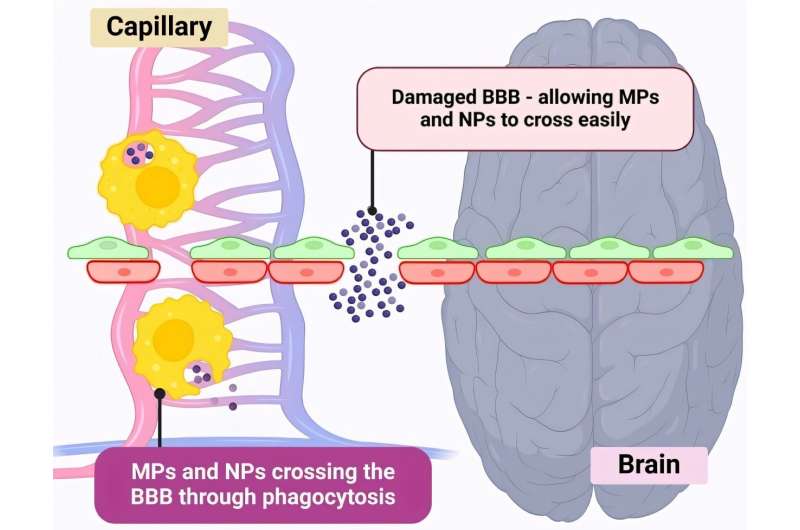
A new review highlights five major ways microplastics can harm the brain, raising concerns that they may worsen neurodegenerative diseases like Alzheimer’s and Parkinson’s. These tiny particles can trigger inflammation, disrupt the blood–brain barrier, generate oxidative stress, impair mitochondria, and damage neurons.
Researchers have mapped how brain networks differ in individuals at Clinical High Risk (CHR) for psychosis, providing a new perspective on the mechanisms underlying the disease onset.
A new study found that variations in the brain’s insulin receptor network affect how women respond to early-life adversity. This effect has a lesser impact in men, suggesting there is a sex-specific process at play.
Dopamine neurons—the cells that drive reward and motivation while we’re awake—become surprisingly active during nonrapid eye movement sleep right after we learn something new.
The human brain processes spoken language in a step-by-step sequence that closely matches how large language models transform text. Using electrocorticography recordings from people listening to a podcast, researchers found that early brain responses aligned with early AI layers, while deeper layers corresponded to later neural activity in regions such as Broca’s area.
In a new leap for neurobiology and bioelectronics, scientists have developed a wireless device that uses light to send information directly to the brain—bypassing the body’s natural sensory pathways.
Young children exposed to unusually high temperatures are less likely to reach basic developmental milestones in literacy and numeracy. Analyzing data from over 19,000 children across multiple countries, the study found that average maximum temperatures above 86 °F were associated with measurable declines in early learning outcomes.
A new study shows that dance can be beneficial in halting the cognitive decline associated with Parkinson’s disease and, for some participants, they even showed signs of improvement.
A research team has developed a new AI foundation model that creatively solved the problem of the “label data shortage,” regarded as the biggest challenge in deep learning-based brain signal analysis. This technology is designed to self-learn brain signals and is gaining attention for its ability to deliver high accuracy with very small amounts of labels.
Semaglutide medications like Ozempic and Wegovy can help lower the risk of heart and metabolic diseases in people with schizophrenia spectrum disorders, according to a new study.
A newly discovered biological signal in the blood could help health care teams and researchers better understand how children respond to brain injuries at the cellular level, according to research in the Journal of Neurotrauma.
Neuroscientists have developed a first-of-its-kind method to rapidly produce synchronized, human brain wave-like activity in lab-grown neural networks that can communicate over long distances.
A new analysis shows that anti-inflammatory medications may help reduce symptoms for a subset of people with depression who also have chronic, low-grade inflammation. By reviewing randomized controlled trials that specifically enrolled individuals with elevated inflammatory markers, researchers found that anti-inflammatory treatments significantly reduced both overall depressive symptoms and anhedonia.
An international study has found that wearable technology could help detect Parkinson’s disease (PD) up to nine years before clinical diagnosis simply by monitoring how people turn when they walk.
Researchers have identified a distinct immuno-inflammatory biomarker across major psychiatric disorders that can be detected using noninvasive brain imaging. Patients exhibiting this brain signature showed systemic inflammation and poorer response to standard treatments.
A preliminary study of people with diabetes suggests that use of glucose-lowering GLP-1 drugs may be linked to a lower risk of developing epilepsy.
A new study proposes that autism arises when genetic vulnerability, an early environmental trigger, and prolonged activation of the cellular stress response align during critical developmental windows. This “three-hit” metabolic model reframes autism as a disorder of disrupted cellular communication and energy metabolism rather than an inevitable genetic outcome.
Finally this week, researchers have discovered how a neural circuit drives relapse after opioid use, a finding that could lead to more effective treatments for opioid use disorders.


 inside-the-brain.com