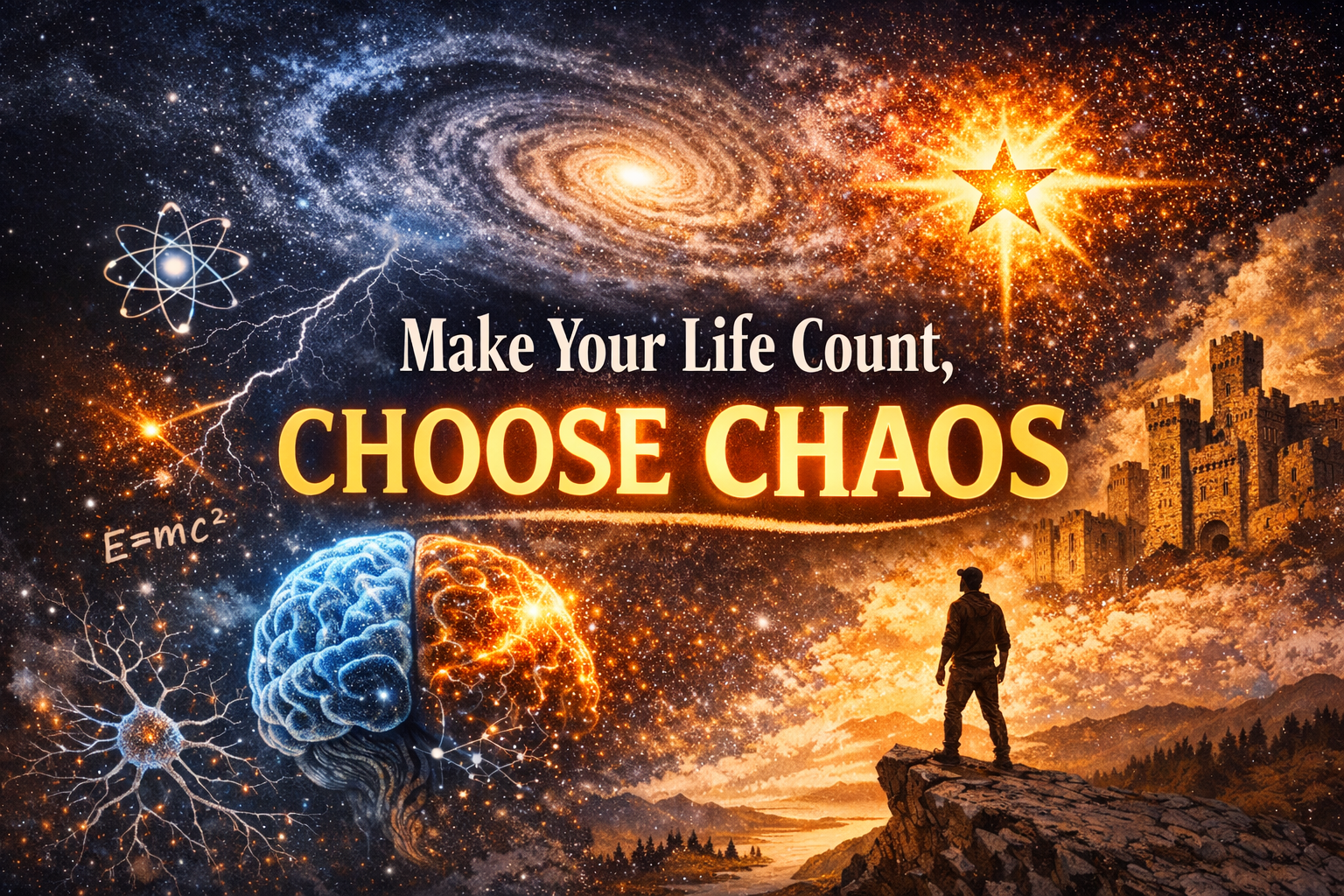
Science offers us a lens for understanding chaos, starting with energy itself. Two fundamental laws govern everyday reality, and they both describe the nature of energy as it relates to our Universe. The First Law of Thermodynamics, sometimes called the Law of Energy Conservation, tells us that energy cannot be created or destroyed – only transformed. For instance, the burning of coal transforms its chemical energy into light and heat energy.
The Second Law adds direction: it dictates that entropy, or disorder, must always increase. When coal burns, tightly ordered molecules break apart into gases that disperse into swirls of smoke. These two laws, governing the flow and transformation of energy, set the stage for everything we experience in the physical world – what we call everyday reality.
The nature of chaos
But chaos is different from disorder. Disorder is random fragmentation with no deeper pattern – like leaves scattered beneath a tree. Chaos, by contrast, is structured unpredictability. Here, the path of a falling leaf is determined by wind, gravity, and angle – where tiny shifts in its starting point make a final landing impossible to predict. The same principle explains why weather forecasts falter, why traffic jams appear out of nowhere, why populations fluctuate, and why heart rhythms can suddenly misfire. Chaos is complexity sensitive to beginnings: dynamic, unpredictable, yet patterned. That’s why we can predict different weather patterns for the different seasons.
The edge of chaos
This same tension between order and unpredictability is mirrored in biology, and nowhere more profoundly than in the human brain. Critical to understanding how we humans learn and evolve, neuroscience reveals that the brain operates on the edge of chaos, in a state of dynamic equilibrium between rigid order and complete randomness. This delicate balance allows the brain to exhibit both stable, predictable patterns, and flexible, adaptive responses to novel situations. In contrast, fixed, ordered states within the brain are linked to conditions such as epilepsy and mental illness. By teetering on the edge of chaos, the healthy brain can rapidly reconfigure its neural networks to process information efficiently, learn new tasks, and solve complex problems. Think of ‘weather’ inside your head.
 inside-the-brain.com