Researchers at the University of Birmingham have uncovered a surprising role of the hippocampus—linking this part of the brain to the control of skilled actions such as handwriting, typing, and playing music.
The psychedelic drug psilocybin may rewire brain connectivity to treat body dysmorphic disorder, new research suggests.
A significant breakthrough in the understanding of sleep mechanism opens new promise for treating sleep disorders and associated neuropsychiatric conditions: Scientists have pinpointed the melatonin receptor MT1 as a crucial regulator of REM (Rapid Eye Movement) sleep.
Researchers have developed a new method that allows scientists to cultivate brain organoids with distinct cortical areas and front-to-back patterning.
A recent study published in Sciencehas identified a previously unknown mechanism in the brain that occurs during sleep, helping to reset memory pathways. Researchers found that a burst of neural silence in a specific part of the brain, the hippocampus, allows neurons involved in memory to reset and prepare for new learning the following day. This phenomenon, termed a “barrage of action potentials” or “BARR,” allows neurons to reset, ensuring that our brains can continue storing new information without overwhelming the neural networks responsible for memory.
Monash University-led research, believed to be the first of its kind, has used blood tests and MRI scans to show that the effects of traumatic brain injuries (TBI) can last decades.
Researchers have found that SSRI (selective serotonin reuptake inhibitor) antidepressants have the potential to improve certain cognitive functions, such as verbal memory. They measured brain function in patients before and after taking the SSRI, escitalopram, and correlated this to a drop in the level of one of the serotonin receptors in the brain and to cognitive improvements during treatment.
In the U.K.’s largest study to date, researchers have come to a better understanding of the immediate and long-term impacts of COVID-19 on the brain.
New research has found that cannabis use during pregnancy can cause molecular changes in the genes of exposed children, impacting brain development. The study identified significant DNA alterations in genes related to neurodevelopment, suggesting a direct link between prenatal cannabis exposure and developmental issues.
Finally this week, a new study has uncovered new insights into how the brain processes and integrates pain information.
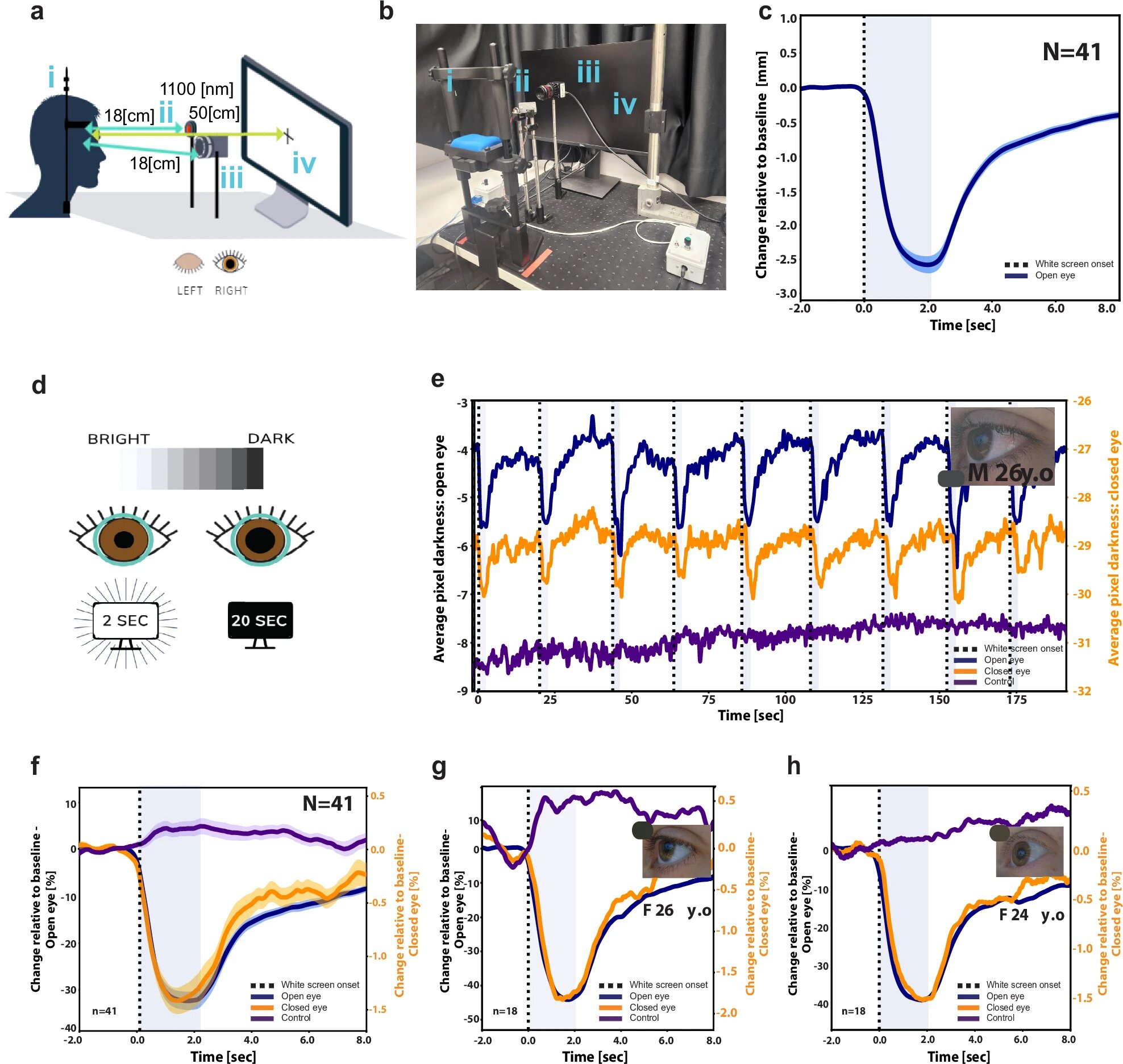
Pupillary light reflex (PLR) assessment in open-eye and closed-eye conditions. Credit: Communications Medicine (2024).
A new technological advancement now enables researchers to observe changes in pupil size and gaze direction behind closed eyelids for the first time, using non-contact infrared imaging. This capability is expected to aid in identifying wakefulness states during sleep, anesthesia, and intensive care by monitoring pupil size variations. It could also be instrumental in gauging sedation levels, detecting seizures and nightmares, and acknowledging pain or responsiveness following trauma or within intensive care settings.
A recent study using artificial intelligence has yielded a new understanding of how the brain anticipates future occurrences and processes data. It was found that the brain’s inherent activity, even in the absence of external stimuli, is crucial to our cognitive and emotional processes.
New research shows that varied cognitive training, rather than repetitive tasks, helps older adults improve working memory.
Scientists have mapped how propofol, a widely used anesthetic, alters brain connectivity to induce unconsciousness. Using fMRI, they found that propofol disrupts connections in the thalamus, reducing complex information processing and limiting sensory integration.
Research on older individuals indicates that vision impairment may be responsible for one in five dementia cases.
A new technology that uses harmless light waves to measure activity in babies’ brains has provided the most complete picture to date of brain functions like hearing, vision and cognitive processing outside a conventional, restrictive brain scanner.
Scientists have developed an innovative approach to studying brain connections using functional magnetic resonance imaging (fMRI). Recently published in Cell Systems, this workintroduces a new way of understanding brain architecture through dynamic functional networks, challenging the traditional static approach.
A new study publishedin Nature Communications examines how the brain initiates spontaneous actions. In addition to demonstrating how spontaneous action emerges without environmental input, this research has implications for the origins of slow ramping of neural activity before movement onset—a commonly-observed but poorly understood phenomenon.
Researchers have published a novel study exploring the effects of delayed feedback on learning in individuals with moderate-to-severe traumatic brain injury (TBI).
A breakthrough in medical imaging is making it possible for researchers to observe brain activity during movement and pick up the early signs of disorders that affect brain-to-body coordination, such as Parkinson’s disease.
A new study investigated the origin of ataxia in the brain of patients with stroke and found a significant number of the stroke lesions in the patients were located outside the cerebellum.
Researchers have developed a noninvasive technique that could dramatically improve the way doctors monitor intracranial hypertension, a condition where increased pressure in the brain can lead to severe outcomes like strokes and hemorrhages.
Robotic ‘coaches’ aiding upper limb rehabilitation for stroke and brain injury survivors have been successfully trialed in Vienna, Austria.
Scientists have created a dynamic technique to monitor swift changes in brain activity, particularly those associated with cravings. This method differs from conventional neuroimaging by offering a continuous perspective on the variations in craving intensity. The research revealed that individuals with intense cravings tend to remain longer in brain states that intensify these cravings and do not activate the brain networks that could diminish them.
A recent study highlights the interaction between brain structure and social context, suggesting that some children are more vulnerable to social stressors than others.
With maps of the connections between neurons and artificial intelligence methods, researchers can now do what they never thought possible: predict the activity of individual neurons without making a single measurement in a living brain.
A review highlighting recent advances in genetically encoded fluorescent tools for labeling and selectively manipulating synapses has been published in Nature Reviews Neuroscience.
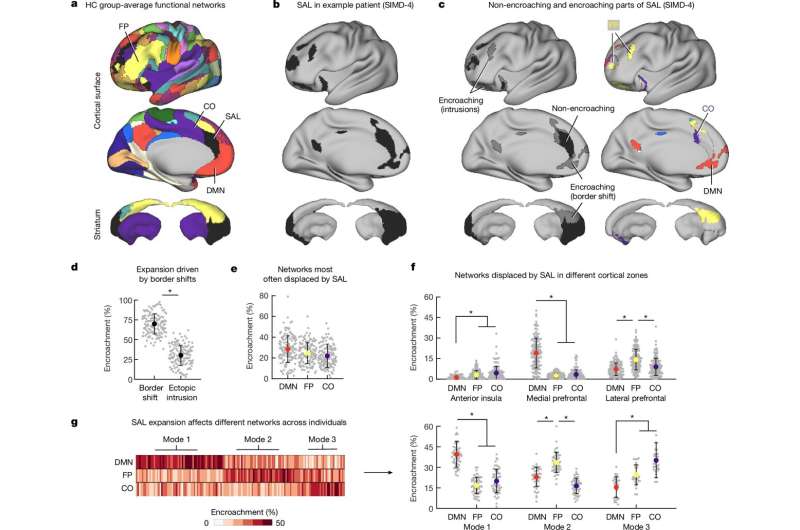
Three modes of salience network expansion in depression. Credit: Nature (2024)
By repeatedly scanning the brains of a small group of patients for a year and a half, researchers have identified a distinct pattern of neuronal interactions that appears to predispose some people to developing depression.
A new study reveals that higher levels of inequality—whether economic, environmental, or health-related—are associated with faster brain aging, particularly in countries with greater disparities.
Researchers have published a new clinical protocol examining the combination of aerobic exercise and cognitive rehabilitation to improve learning and memory in individuals with multiple sclerosis (MS) who have mobility disability.
A new study reveals that the protein Tau – a key player implicated in several neurodegenerative conditions including Alzheimer’s disease – also plays a positive role in the brain.
Scientists have revealed new insights into the mechanisms behind cerebral small vessel disease, a condition that affects the smaller blood vessels in the brain and causes approximately half of all dementia cases.
Sports-related concussions may not be associated with long-term cognitive risks for non-professional athletes, a new study suggests.
Researchers have discovered that the Tau protein, often linked to neurodegenerative diseases like Alzheimer’s, also has a protective role in the brain. Tau helps combat oxidative stress by aiding in the formation of lipid droplets in glial cells, which sequester toxic lipids and protect neurons.
Scientists have developed an integrated optical sensor capable of detecting dopamine directly from an unprocessed blood sample.
A recent study has mapped genes linked to schizophrenia and uncovered a mechanism that disrupts synaptic plasticity in affected individuals. The researchers showed the role of three proteins in mediating the impairments of plasticity in schizophrenia. The findings may hold promise for the development of new treatments.
Finally this week, researchers have identified a protein called OSER1 that plays a key role in regulating longevity, offering new insights into why some people live longer than others.


 inside-the-brain.com