This video examines the vital role of dopamine and serotonin in influencing our social behavior, featuring a groundbreaking study with Parkinson’s disease patients undergoing awake brain surgery.
Directed by computational neuroscientist Read Montague and a global team, the study reveals the complex interplay of neurotransmitters that shape our decision-making in social situations. By studying the role of dopamine and serotonin, we can gain a deeper understanding of the biochemical processes that influence our social behavior.
The insights gained from this study could lead to advancements in the treatment of neurological conditions like Parkinson’s disease. For instance, understanding how these neurotransmitters affect decision-making could help in developing more targeted therapies.
The research could also have significant implications for psychiatric conditions. Many psychiatric disorders, such as depression and anxiety, are linked to imbalances in neurotransmitters like dopamine and serotonin. A better understanding of these processes could lead to improved treatments.
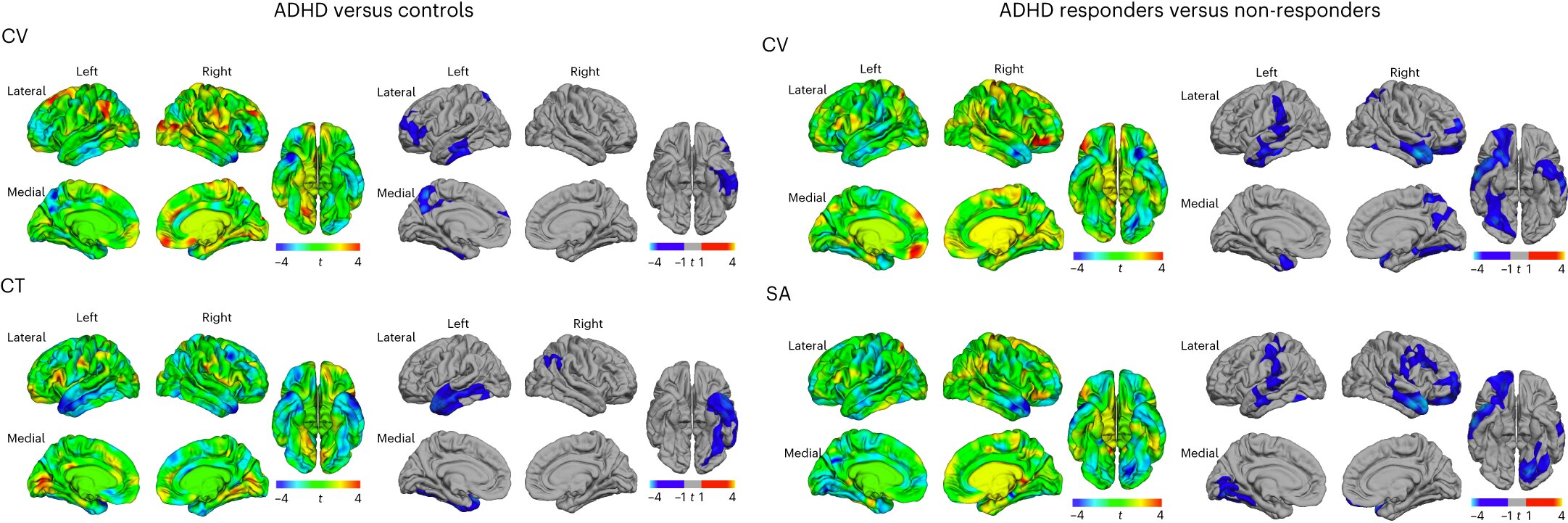
Vertex-wise comparisons between ADHD (N = 60) and controls (N = 23), and between ADHD responders (N = 42) and non-responders (N = 18). Credit: Nature Mental Health (2024).
New research has found that the effectiveness of ADHD medication may be associated with an individual’s neuroanatomy.
Although there are still some aspects pending confirmation for its use in the clinical setting, and its resolution needs to be improved slightly, a new study has shown that a method routinely used to carry out ophthalmological tests can also be used to monitor the neurodegeneration that occurs in Parkinson’s patients.
Scientists have uncovered a mechanism in the brain that allows cocaine and morphine to take over natural reward processing systems.
New research has identified a specific pattern of autoantibodies in the blood that precedes the clinical onset of multiple sclerosis (MS), potentially paving the way for early diagnosis and treatment. Their study found that 10% of MS patients displayed a unique set of autoantibodies against both human proteins and common pathogens like the Epstein-Barr Virus years before showing symptoms.
Researchers have identified a promising new approach to treating persistent neurological symptoms associated with Lyme disease.
A new study investigates why everyday actions like locking a door are often forgotten. The study revealed that while emotionally charged or unique events are initially memorable, even these can fade within 24 hours, particularly positive experiences. This research provides insight into the selective nature of memory and suggests that our brains prioritize and even forget information to manage cognitive load.
Managing a stroke patient’s blood sugar levels after they receive powerful clot-busting drugs might help them survive their health crisis, a new trial finds.
Researchers have created a thin film that combines an electrode grid and LEDs that can both track and produce a visual representation of the brain’s activity in real time during surgery. The device is designed to provide neurosurgeons with visual information about a patient’s brain to monitor brain states during surgical interventions to remove brain lesions including tumors and epileptic tissue.
New research has found a significant association between participating in low to moderate intensity exercise and reduced rates of depression. However, this was not strongly observed for high-intensity exercise. Physical activity was also significantly associated with reduced risk of severe mental health conditions, including a reduction in psychosis/schizophrenia by 27%.
An international collaborative research team has discovered a novel mechanism underlying memory involving rapid changes in a specific DNA structure.
People who take acid-reducing drugs may have a higher risk of migraine and other severe headache than people who do not take these medications, according to a study published in the online issue of Neurology Clinical Practice.
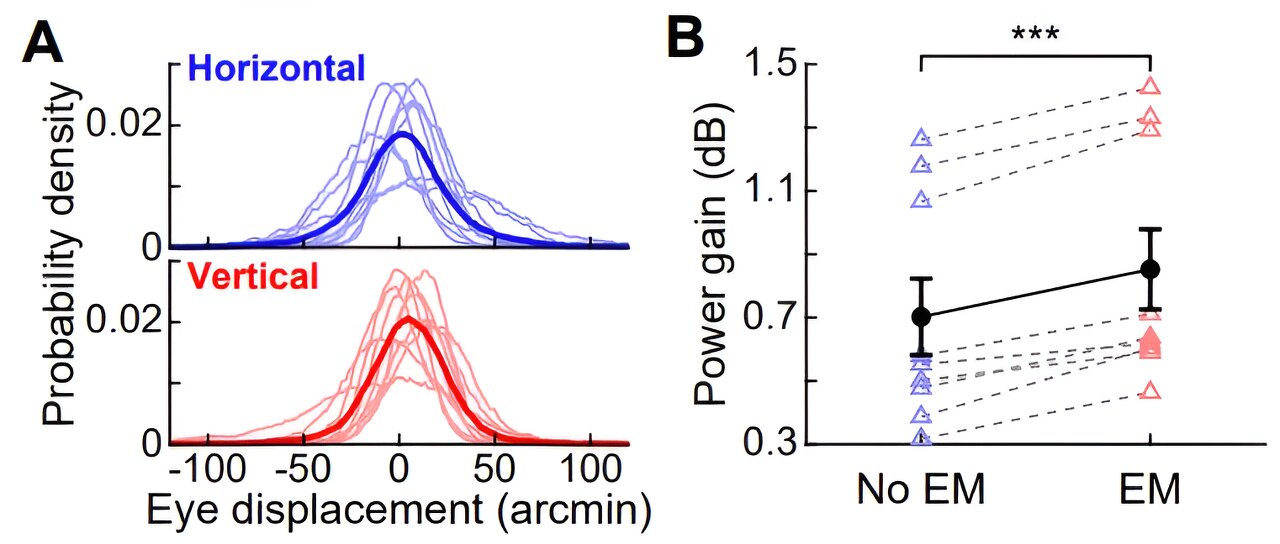
Eye movements associated with blinks and their consequences on luminance transients. (A) Distributions of blink-induced gaze displacements. Data represent the offsets in horizontal (top) and vertical eye position (bottom) between the times at which the eyelid starts moving and its return to normal opening. (B) Contributions of eye movements to the strength of the luminance modulations caused by blinks. Credit: Proceedings of the National Academy of Sciences
Scientists at the University of Rochester, in the U.S., have found that eye blinking does more than simply wet the eyes—it also helps to keep vision sharp by maintaining the strength of visual signals.
A new study investigates the brain’s mechanisms behind deep focus. The research employs fMRI to explore low-frequency fluctuations in brain networks during focused and less-focused states. The team discovered that certain brain networks synchronize and desynchronize, affecting an individual’s ability to maintain attention. This insight into the dynamic nature of brain activity could lead to better strategies for enhancing focus and attention in various cognitive tasks.
Researchers released new findings on how sex and gender influence cognitive abilities. The research found that while spatial cognition correlates more with biological factors such as sex at birth and hormones, verbal cognition is more influenced by sociocultural factors like gender identity.
Scientists have published a study in Neuron that identified two types of interneurons, the inhibitory neurons of the brain, as instructors of a key developmental process in the brain.
A new study involving jazz guitarists has explored the brain processes that enable creative flow. The research reveals that achieving flow requires a solid foundation of expertise, after which one must learn to relax conscious control to allow creativity to flourish.
Researchers have developed a groundbreaking approach using Diffusion MRI to explore the brain structures of individuals with autism spectrum disorder (ASD).
A new study emphasizes the importance of brain rhythms in understanding cognition. The research explores how rhythmic electrical fields, generated by neurons, influence and align neighboring neurons, enhancing cognitive function.
The harder your brain works at your job, the less likely you may be to have memory and thinking problems later in life, according to a new study published in Neurology.
Researchers have shed light on how individuals with treatment-resistant depression (TRD) process emotions differently due to abnormalities in the amygdala and prefrontal cortex. By using stereotactic electroencephalography (sEEG), they were able to observe how these brain regions react to positive and negative stimuli, revealing a significant imbalance in emotional processing.
Researchers have linked a region in the brain to how humans redirect thoughts and attention when distracted. The connection is important because it offers insights into the cognitive and behavioral side effects of a technique being used to treat patients with Parkinson’s disease.
Finally this week, some people with tough-to-treat epilepsy might benefit if doctors target a brain region newly linked to the disorder, a new study suggests.
This video explores the essence of creative flow, challenging existing theories and offering new insights into how we can harness our brain’s potential for effortless and enjoyable productivity.
Scientists have been working on neural speech prostheses, special devices that can help people who have trouble speaking by translating brain activity into speech.
New research findings provide a novel understanding of how the human brain regulates emotions, distinguishing between emotion generation and regulation. By analyzing fMRI studies, researchers identified specific brain regions, including areas of the anterior prefrontal cortex, that are key to emotion regulation.
The sense of smell is highly influenced by the cues from other senses, while the sense of sight and hearing are affected to a much lesser extent, shows a new study in Journal of Neuroscience.
Researchers have uncovered a previously unknown source of two key brain waves crucial for deep sleep: slow waves and sleep spindles. Traditionally believed to originate from one brain circuit linking the thalamus and cortex, the team’s findings,published in Scientific Reports, suggest that the axons in memory centers of the hippocampus play a role.
Earlier menopause combined with a higher risk of cardiovascular disease is linked to an increased risk of thinking and memory problems later, according to new research.
A noninvasive brain stimulation treatment improved depression and anxiety symptoms among older adults in a new study. The findings, published in the journal Brain Stimulation, suggest the treatment, known as transcranial direct current stimulation, or tDCS, holds promise as a noninvasive, drug-free option to treat depression and anxiety symptoms, which affect 1 in 4 older adults.
A new study explores the influence of personalized music on cognitive arousal and performance.
To the left of the figure, the red-yellow color denotes the regions that degenerate earlier than the rest of the brain, and are vulnerable to Alzheimer’s disease. These brain areas are higher-order regions that process and combine information coming from our different senses. To the right of the figure, each dot represents the brain data from one UK Biobank participant. The overall curve shows that, in these particularly fragile regions of the brain, there is accelerated degeneration with age. Credit: G. Douaud and J. Manuello.
In a new study published in Nature Communications, researchers investigated the genetic and modifiable influences on fragile brain regions by looking at the brain scans of 40,000 UK Biobank participants aged over 45.
Scientists have shown for the first time that a type of thinking that has been described for over a century as a developmental milestone of adolescence may grow teenagers’ brains over time.
A team of neurologists, stem cell specialists and molecular biologists affiliated with several institutions in the U.S. and led by a group at Stanford University School of Medicine has found evidence that the root cause of Alzheimer’s disease may be fat buildup in brain cells. The study is published in the journal Nature.
New research highlights the critical role of unique gut bacteria in newborns, producing serotonin to educate immune cells and prevent allergic reactions early in life.
People continuously exposed to bright, artificial light at night may be at increased risk of developing conditions that affect blood flow to the brain and having a stroke, according to research published in Stroke.
Researchers reveal new findings on the complexity of age-related memory decline and neural dedifferentiation, challenging existing theories on cognitive aging.
A new study has found that amyotrophic lateral sclerosis (ALS) and frontotemporal lobar degeneration (FTLD) exhibit strikingly similar cellular and molecular characteristics, despite affecting different brain regions and showing distinct clinical symptoms.
New research reveals how the human brain processes vital signals from the heart and lungs, offering new insights into the complex brain-body integration essential for health and cognition.
In a new study, AI processed text from health histories and neurologic examinations to locate lesions in the brain. The study, which looked specifically at the large language model called generative pre-trained transformer 4 (GPT-4), is published in the online issue of Neurology Clinical Practice.
Bilingualism may serve as a powerful tool against age-related cognitive decline, particularly in social cognition areas such as the theory of mind. A new study demonstrates that early bilingualism leads to beneficial structural changes in the brain, including increased gray matter volume and cortical thickness, which contribute to a stronger cognitive reserve.
In a study published in Nature Mental Health, scientists have found that individuals suffering from chronic musculoskeletal pain (CMP) may face a higher risk of brain aging.
A new analysis involving over 13,000 people has found changes to blood vessels in the brain that can increase the risk of stroke and dementia are common in people with a range of heart conditions, regardless of whether they have experienced a stroke.
A Canadian-led study has identified genes that may be partially responsible for the development of cerebral palsy.
Researchers have introduced a new, refined method for analyzing brain signals, enhancing our understanding of brain functionality. This research has the potential to improve treatments for neurological conditions such as Parkinson’s disease, pain, epilepsy and depression.
A study reveals that Lewy body disease, a major neurodegenerative disorder, may start developing in individuals as early as middle age, well before symptoms manifest.
Researchers have shown that the brain chemical GABA regulates activity in the retina of the eye in autistic and non-autistic individuals differently. Autistic people have larger responses to single light flashes in the retina of the eye and this new study shows that increasing GABA activity can reduce this response.
Finally this week, a study by the University of Sheffield has cast doubt on the efficacy of non-invasive brain stimulation techniques in improving visual working memory.



 inside-the-brain.com