Weekly Neuroscience Update

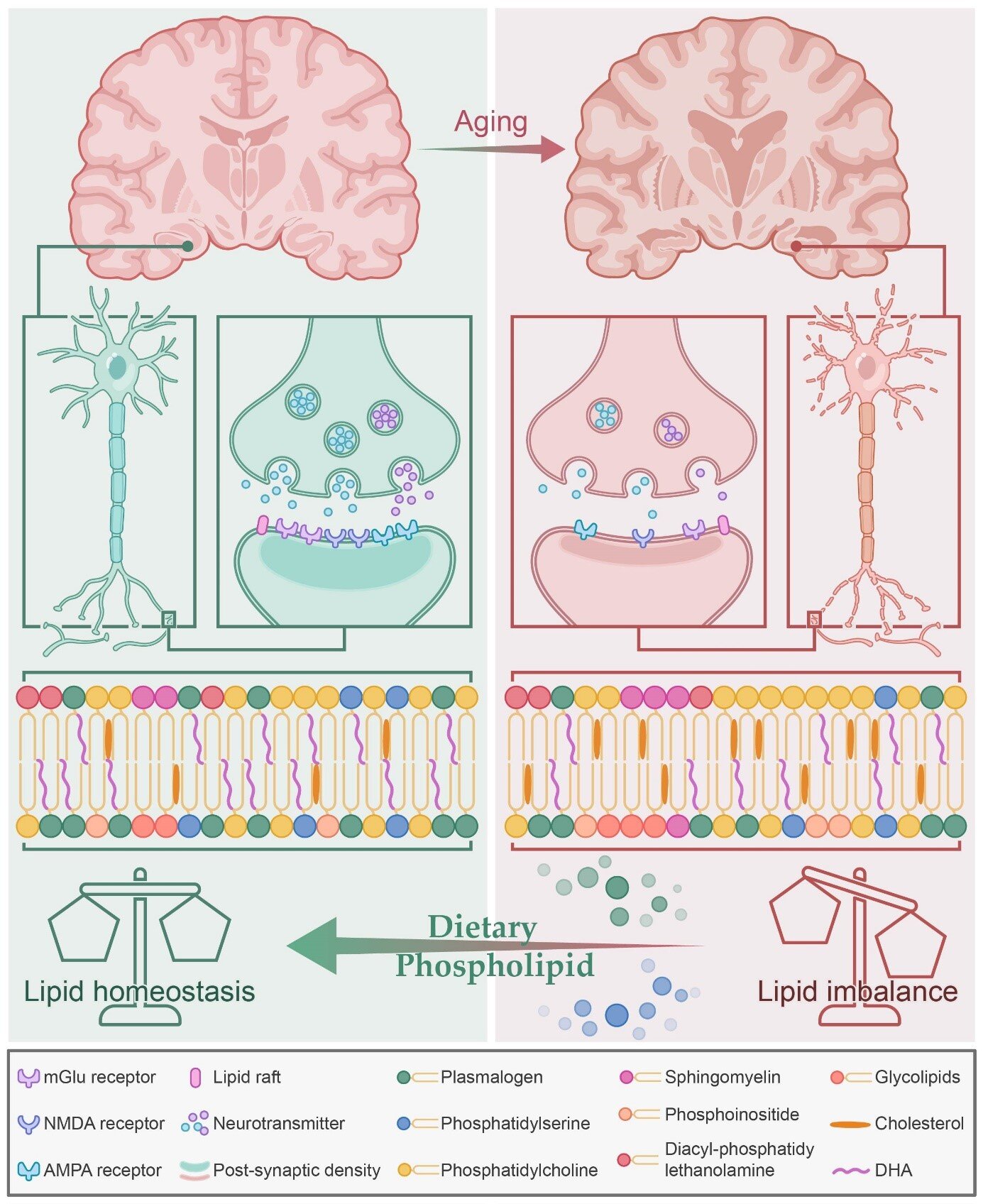
Dietary phospholipid intervention could prevent brain aging by maintaining lipid homeostasis and enhancing synaptic plasticity. Credit: Wei Xiong et al.

A new review highlights the significant role of dietary lipids in preventing brain aging and cognitive decline. As the global burden of aging-related brain diseases, particularly dementia, continues to rise, this research offers promising insights into potential nutritional interventions that could improve brain function during aging.

Cerebrospinal fluid (CSF) leaks may be one of the mechanisms that link traumatic brain injury (TBI) with dementia, according to a new hypothesis.

Short-term exposure to air pollution may be linked to an increased risk of stroke, according to a meta-analysis published in Neurology. Short-term exposure was defined as occurring within five days of the stroke.

People with a higher cumulative estrogen exposure throughout their life may have a lower risk of cerebral small vessel disease, according to a new study.

New research is painting a clearer picture of the early signs of multiple sclerosis (MS), showing that people are nearly twice as likely to experience mental illness in the years leading up to the onset of the disease.

Increased TV/DVD screen time at 1 and 2 years of age negatively affects developmental performance at 2 and 3 years of age, according to a study published in JAMA Pediatrics.

Whether you are an early bird or a night owl, your internal clock plays a critical role in maximizing your mental performance, according to a recent study. This effect is so strong that it can significantly impact academic performance for adolescent students and the results of brain health assessments for older adults.

Researchers are using ultra-high field 7 Tesla MRI to provide a better understanding of how sleep is regulated.

A new study suggests a common brain network exists among people with substance use disorder. By evaluating data from across more than 144 studies of addiction, the team found abnormalities across substance use disorders mapped to a common brain network across substances and lesion locations, suggesting a potential brain circuit to target with neurostimulation therapies.

Finally this week, people differ significantly in their memory performance and researchers have now discovered that certain brain signals are related to these differences.

Weekly Neuroscience Update

A new study sheds light on the neural underpinning of subjective odor perceptions.

New research has found that cognitive behavioral therapy (CBT) can significantly reduce the burden of fibromyalgia in part by reducing pain-catastrophizing, a negative cognitive and emotional response that can intensify pain through feelings of helplessness, rumination and intrusive thoughts. This finding is backed by neuroimaging data, evidencing reduced connectivity between regions of the brain associated with self-awareness, pain and emotional processing.

Researchers have discovered how an active form of a gene present in 75% of the human population works to protect the brain against neurodegeneration.

A recent study provides new insight into the relationship between the release of the neurotransmitter dopamine and decision-making processes. The scientists found that when dopamine is released, decisions are made faster, but tend to be more inaccurate.

A new study recently published in JAMA Neurology provides insights into the complex and intricate relationship of contact sports and the risk of dementia.

A team of leading clinicians, engineers, and neuroscientists has made a groundbreaking discovery in the field of treatment-resistant depression. By analyzing the brain activity of patients undergoing deep brain stimulation (DBS), a promising therapy involving implanted electrodes that stimulate the brain, the researchers identified a unique pattern in brain activity that reflects the recovery process in patients with treatment-resistant depression.

Scientists have revealed how the effects of psychosis spread throughout the brain.

Researchers have identified new regions of the brain crucial to the formation of long-term memory, challenging the conventional notion that the hippocampus is central to memory consolidation, by demonstrating that a different set of brain networks play a role.

Finally this week, scientists have revealed the molecular structure of a type of receptor that’s crucial to brain development and function.

Weekly Neuroscience Update

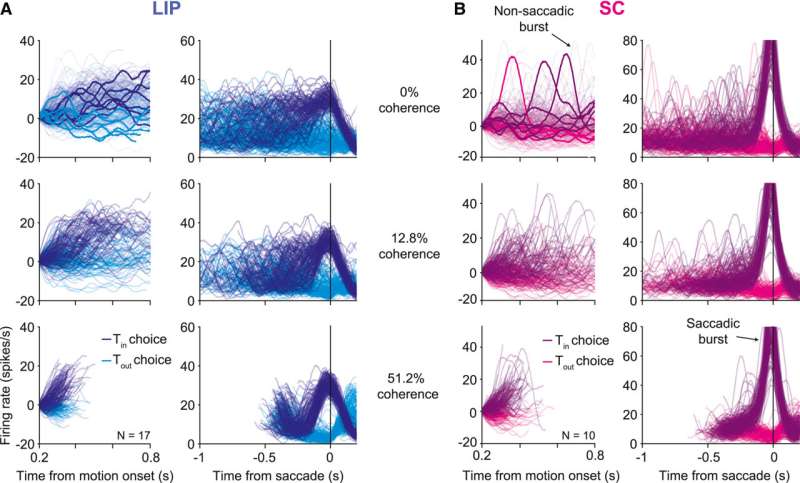
Single-trial dynamics in LIP and SC are different. (Neuron, 2023)

A new paper, published in Neuron, highlights the role of the superior colliculus (SC), a structure in the midbrain, in terminating decisions.

Degeneration of dopaminergic neurons is widely accepted as the first event that leads to Parkinson’s, but a new study suggests that a dysfunction in the neuron’s synapses—the tiny gap across which a neuron can send an impulse to another neuron—leads to deficits in dopamine and precedes the neurodegeneration.

Depression, a challenging condition to diagnose early, may now be detected more promptly using a simple 1-minute Electroencephalogram (EEG) test at home.

Scientists have confirmed that human brains are naturally wired to perform advanced calculations, much like a high-powered computer, to make sense of the world through a process known as Bayesian inference.

New research shows how repeated traumatic brain injury contributes to Alzheimer’s disease.

Racial disparities can be seen in dementia severity, functional impairment, and neuropsychiatric symptoms among patients with frontotemporal dementia (FTD), according to a study recently published in JAMA Neurology.

A new study identifies a potential new approach to PTSD treatment.

Any head injury—even a mild one—raises a person’s risk of later having an ischemic stroke. Having multiple injuries increases that risk, even more so than the severity of a single traumatic brain injury, researchers have found.

New research finds that cerebrospinal fluid net flow is markedly decreased in Huntington’s disease, with the decrease being greater in the later stages of the disease.

The targeted use of ultrasound technology can bring about significant changes in brain function that could pave the way towards treatment of conditions such as depression, addiction, or anxiety, a new study suggests.

Finally this week, new research finds that antidepressants may actually reduce negative memories in individuals suffering from depression while improving overall memory function.

Weekly Neuroscience Update

 Credit: Institute for Basic Science

In a groundbreaking review paper published in Nature Reviews Neuroscience, scientists have shed new light on the role of GABA, a key signaling molecule in the brain.

Maternal structured lifestyle interventions during pregnancy based on a Mediterranean diet or mindfulness-based stress reduction (MBSR) improve child neurodevelopmental outcomes at age 2 years, according to a study.

A new study supports widespread use of brain research probes in epilepsy patients.

Researchers who previously developed the first 3D human cell culture models of Alzheimer’s disease (AD) that displays two major hallmarks of the condition—the generation of amyloid beta deposits followed by tau tangles—have now used their model to investigate whether the exercise-induced muscle hormone irisin affects amyloid beta pathology.

Among people with benign recurrent vertigo (BRV), Meniere disease (MD), or vestibular migraine (VM) who have persistent vertigo attacks, there is no change in attack frequency over time, according to a new study.

Researchers have developed a molecular test to identify the presence of brain tumors by measuring abnormal genetic material shed by tumors and circulating in cerebrospinal fluid (CSF). 

A study of twins shows that having a concussion early in life is tied to having lower scores on tests of thinking and memory skills decades later as well as having a more rapid decline in those scores than twins who did not have a concussion, or traumatic brain injury (TBI). 

Scientists have detailed how the activity of tactile neurons in the fingertip in response to an applied force is influenced by the fingertip’s mechanical memory of previous forces.

A paper published in Nature Communications shows that when neurons are given information about the changing world around them (task-related sensory input) it changes how they behave, putting them on edge so that tiny inputs can then set off “avalanches” of brain activity, supporting a theory known as the critical brain hypothesis.

Finally, this week, a new finding published in the journal JAMA Pediatrics, shows that the amount of screen time spent by one-year-olds is associated with developmental delays.

Weekly Neuroscience Update

Credit: Nature (2023)

A new study has identified the link between memory and appetite.

Scientists have made a ‘paradigm shifting’ discovery on the mechanisms required for learning and memory that could lead to new therapies for Alzheimer’s disease and potentially Down syndrome.

Researchers have analyzed which physiological indicators recorded when watching a movie can predict the audience’s assessment. It turned out that the activity of zygomaticus major (the “smiling muscle”), heart rate variability and EEG indicators can tell us most about the viewer’s impression of the movie.

The largest genetic study of its kind has discovered specific changes in our DNA that increase the risk of developing epilepsy.

Researchers found that the skin, not pre-existing genetic programming, instructs nerve cells on how to mature for specific sensory tasks. The findings showcase that skin cues determine whether nerve endings develop to detect sensations in hairy or hairless skin. If corroborated by further research, this discovery could pave the way for therapies to mend damaged nerves or better comprehend congenital neuropathies.

A new study has explored the link between infant birthweight, gestational age and future cognitive problems.

Researchers have successfully developed temporary, organic electrodes that can be seamlessly integrated into biological systems. The method opens up a future where bioelectronics can be implanted in and removed from the body without surgery.

New research shows wildfire smoke impacts on the brain.

A new study has found that, among a sample of 152 young athletes exposed to repetitive head impacts (RHI) who were under age 30 at the time of death, 41.4% (63) had neuropathological evidence of CTE, a degenerative brain disease caused by RHI.

New research supports the idea that the brains of older adults who maintain physical fitness by engaging in regular strenuous exercise more closely resemble those of younger adults.

Researchers have succeeded in transforming brain signals into audible speech. By decoding signals from the brain through a combination of implants and AI, they were able to predict the words people wanted to say with an accuracy of 92 to 100%. Their findings are published in the Journal of Neural Engineering.

Finally this week, a virtual reality study has revealed a link between a sense of presence and cognitive abilities.