Weekly Neuroscience Update

 Clock proteins generating cyanobacterial circadian rhythms. Credit: NINS/IMS

Scientists want to increase their understanding of circadian rhythms, those internal 24-hour biological clock cycles of sleeping and waking that occur in organisms, ranging from humans to plants to fungi to bacteria. Now a research team has examined the complex workings of cyanobacteria and can better comprehend what drives its circadian clock.

A new study published is the first to look at multiple levels of biology within women with postpartum depression (PPD) to see how women with the condition differ from those without it.

There are five different diseases that attack the language areas in the left hemisphere of the brain and slowly cause progressive impairments of language known as primary progressive aphasia, reports a new study.

A team of scientists has discovered how working memory is “formatted”—a finding that enhances our understanding of how visual memories are stored. 

People whose brains release more of the neurochemical oxytocin are kinder to others and are more satisfied with their lives. This is the finding of new research, published in Frontiers in Behavioral Neuroscience, that also discovered that oxytocin release increases with age, showing why, on average, people are more caring as they get older.

A genetic study involving thousands of people with bipolar disorder has revealed new insight into the condition’s molecular underpinnings.  

One of the most important molecules in the brain doesn’t work quite the way scientists thought it did, according to new work by researchers. The results, published April 20 in Nature, may aid the development of a new generation of more effective neurological and psychiatric therapies with fewer side effects.

Alzheimer’s Disease could be caused by damage to a protective barrier in the body that allows fatty substances to build up in the brain, newly published research argues.

Researchers have established for the first time a link between depressive disorders and mechanical changes in blood cells.

Nearly half of all older adults now die with a diagnosis of dementia listed on their medical record, up 36% from two decades ago, a new study shows.

Finally this week, epigenetic markers of cognitive aging can predict performance on cognitive tests later in life, according to a study published in the journal Aging.

Weekly Neuroscience Update

The number of axons estimated to interconnect the 360 cortical parcels of the HCP-MMP1.0 atlas. Credit: The researchers

A new study reveals axon density is lower than previously believed between distant regions of the brain.

In a study published in the journal Cell Reports, an international team of investigators used biomarkers, statistical modeling, and other techniques to develop tools for measuring the biological ages of various organ systems. Based on their findings, the researchers report that there are multiple “clocks” within the body that vary widely based on factors including genetics and lifestyle in each individual.

Researchers have identified a new pathway in the brain that plays an important role in our response to fear.

Researchers have now demonstrated that the brain waves during periods of deep sleep in a specific area of the brain can be used to determine the extent of an individual’s propensity for risk during their everyday life.

A study at Boston Children’s Hospital explains for the first time why COVID-19 causes severe inflammation in some people, leading to acute respiratory distress and multi-organ damage. 

A team of researchers has found a link between the use of antibiotics by middle-aged women and cognitive decline later in life. The group has published a paper describing their work on the open-access site PLOS ONE.

Women who experienced childhood trauma had an increased risk of developing multiple sclerosis later in life. The evidence suggests childhood abuse and trauma can alter the immune system and increase the risk of developing autoimmune diseases.

A study has found no increased risk of developing brain tumors regardless of whether a person was a frequent cell phone user or if they had never used a cell phone before.

The consolidation of learning that occurs during sleep is a result of the learning process and not merely because certain brain regions get used a lot during learning. This finding is published in The Journal of Neuroscience and resolves a long-standing debate among sleep researchers.

People who grew up in rural or suburban areas have better spatial navigation skills than those raised in cities, particularly cities with grid-pattern streets, finds a new study.

The return of consciousness after traumatic brain injury (TBI) remains something of a mystery for scientists and is not easy to predict. A series of recently published studies have found that by using technologies to monitor brain functions after TBI, scientists may be able to better predict who will “wake up” after TBI and what brain circuits to target to potentially treat disorders of consciousness.

Finally this week, researchers have established for the first time a link between depressive disorders and mechanical changes in blood cells.

Weekly Neuroscience Update

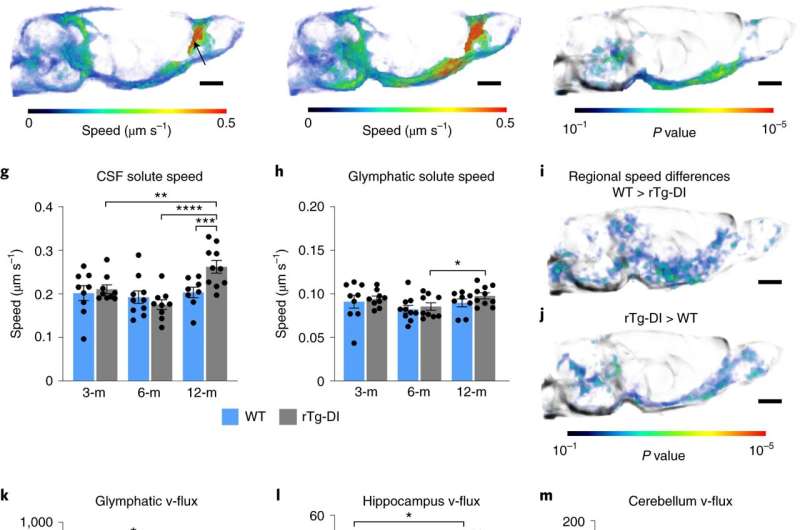
CSF flow speed becomes hyperdynamic with severe CAA. Credit: Nature Aging (2022). DOI: 10.1038/s43587-022-00181-4

A new study suggests that a contributing factor in dementia may come down to a double dose of bad waste management in the brain.

The first major study to compare brain scans of people before and after they catch Covid has revealed shrinkage and tissue damage in regions linked to smell and mental capacities months after subjects tested positive.

Light-to-moderate regular alcohol consumption is linked to reductions in overall brain volume, a new study reports.

Researchers have discovered two types of brain cells that play a key role in dividing continuous human experience into distinct segments that can be recalled later. The discovery provides new promise as a path toward development of novel treatments for memory disorders such as dementia and Alzheimer’s disease. 

Stanford Medicine researchers have linked a specific gene known to be associated with ALS with a characteristic of the disease, opening avenues for a targeted therapy.

A research group from the University of Bologna discovered the first causal evidence of the double dissociation between what we see and what we believe we see: these two different mechanisms derive from the frequency and amplitude of alpha oscillations.

A new, first-of-its-kind clinical trial will examine how the brain adapts to advanced, bionic arms in children born without a limb, with the ultimate goal of improving children’s control of their prosthetic.

People who suffer from a neurological or mental health condition are at increased risk of developing another disorder later in life. Parkinson’s disease patients are four times more likely to develop dementia, and those with mental health disorders were also at greater risk of developing dementia later in life.

Finally this week, new research shows if the circadian clock is disrupted, we might be at greater risk of retinal degeneration as we age.