Without the thousands of people who volunteer to have their brains scanned each year, many areas of modern neuroscience research would not be possible. But what is it like to have your brain scanned? This Wellcome Trust video shows us.
Month: December 2014
Weekly Neuroscience Update
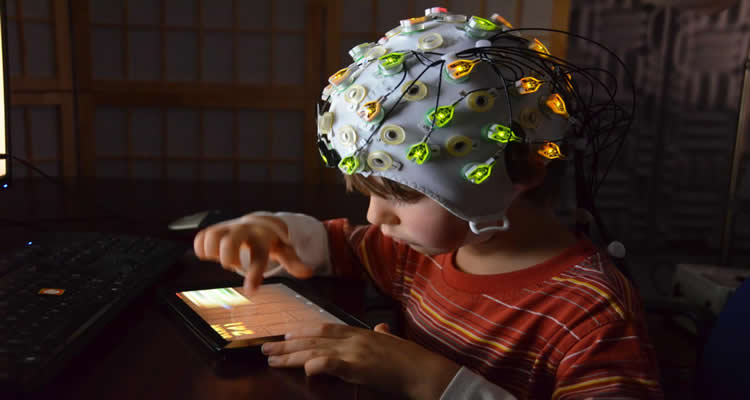
Children were monitored with EEGs while watching animated characters perform prosocial and antisocial behaviors, and later participated in a task measuring generosity. Credit Jean Decety/University of Chicago.
University of Chicago developmental neuroscientists have found specific brain markers that predict generosity in children. Those neural markers appear to be linked to both social and moral evaluation processes.
Researchers at The University of Western Australia have found that brain stimulation may help retrain unhelpful cognitive habits associated with anxiety and depression. The paper was published this week in the international journal Biological Psychiatry.
Methamphetamine users are three times more at risk for getting Parkinson’s disease than non-illicit drug users, new research shows.
Researchers have developed new technology that can assess the location and impact of a brain injury merely by tracking the eye movements of patients as they watch music videos for less than four minutes, according to a study published in the Journal of Neurosurgery.
Spending less time in slow-wave or deep sleep is linked to the loss of brain cells that can lead to dementia, a new study finds.
Scientists have discovered a new signal pathway in the brain that plays an important role in learning and the processing of sensory input.
New UCLA research indicates that lost memories can be restored. The findings offer some hope for patients in the early stages of Alzheimer’s disease.
Weekly Neuroscience Update

The human brain using colors and shapes to show neurological differences between two people. Credit Arthur Toga, University of California, Los Angeles via NIGMS.
While many different combinations of genetic traits can cause autism, brains affected by autism share a pattern of ramped-up immune responses, an analysis of data from autopsied human brains reveals. The study, published online in the journal Nature Communications, included data from 72 autism and control brains.
Teenagers who have suffered a traumatic brain injury are twice as likely to drink alcohol or use drugs when compared with whose who have never experienced a similar blow or trauma to the head.
Activating the brain’s amygdala, an almond-shaped mass that processes emotions, can create an addictive, intense desire for sugary foods, a new study found. Rewards such as sweet, tasty food or even addictive drugs like alcohol or cocaine can be extremely attractive when this brain structure is triggered. And another study, led by researchers at University of California, San Diego School of Medicine, revealed that the brains of obese children literally light up differently when tasting sugar.
Scientists have discovered a link between sleep loss and cell injury. Results of a new study find sleep deprivation causes the damage to cells, especially in the liver, lung, and small intestine. Recovery sleep following deprivation heals the damage.
Neural circuits that activate when we daydream run in the opposite direction to how we process reality, a new study finds.
Yale researchers using a new brain imaging analysis method have confirmed that smoking cigarettes activates a dopamine-driven pleasure and satisfaction response differently in men compared to women.
Whether we’re paying attention to something we see can be discerned by monitoring the firings of specific groups of brain cells. Now, new work from Johns Hopkins shows that the same holds true for the sense of touch.
Serious, long-term stress can have dire consequences for your brain. That’s because the immune system and the brain are intimately related, say researchers at the Ruhr University Bochum, Germany.
In the current issue of Psychotherapy and Psychosomatics a new study identifies biological characteristics who may predict who is going to respond to psychotherapy.
Some high school football players exhibit measurable brain changes after a single season of play even in the absence of concussion, according to a study presented at the annual meeting of the Radiological Society of North America. Meanwhile, as debate increases about whether female lacrosse players should wear headgear, a new study reports measurements of the accelerations that stick blows deliver to the head. The study also measured the dampening effect of various kinds of headgear.
Quitting smoking sets off a series of changes in the brain that researchers say may better identify smokers who will start smoking again.
Everyday events are easy to forget, but unpleasant ones can remain engraved in the brain. A new study published in the Proceedings of the National Academy of Sciences identifies a neural mechanism through which unpleasant experiences are translated into signals that trigger fear memories by changing neural connections in a part of the brain called the amygdala. The findings show that a long-standing theory on how the brain forms memories, called Hebbian plasticity, is partially correct, but not as simple as was originally proposed.
The neurons that shaped civilization
Neuroscientist Vilayanur Ramachandran outlines the fascinating functions of mirror neurons. Only recently discovered, these neurons allow us to learn complex social behaviors, some of which formed the foundations of human civilization as we know it.
The Scientist Entrepreneur
This is a slide-deck from my recent presentation at last month’s Careers in Neuroscience Symposium (CNS) 2014 in Galway on the topic of the scientist as entrepreneur. This was a one-day event, held in association with Neuroscience Ireland, aimed at early-career researchers engaged in all aspects of neuroscience research.
Inside The Plastic Brain
Neuroscientist Michael Merzenich looks at one of the secrets of the brain’s incredible power: its ability to actively re-wire itself. He’s researching ways to harness the brain’s plasticity to enhance our skills and recover lost function.
Inside The See-Through Brain
Scientists have come up with a way to make whole brains transparent, so they can be labelled with molecular markers and imaged using a light microscope. The technique, called CLARITY, enabled its creators to produce the detailed 3D visualisations you see in this video which takes a look into the brain of a 7-year-old boy who had autism.
 inside-the-brain.com